
Understanding weather Worksheets for Ages 6-9
4 filtered results
Difficulty Level
Grade
Age
-
From - To
Subject
Activity
Standards
Enhance your child's understanding of weather with our engaging worksheets designed for ages 6-9. Our carefully crafted activities introduce young learners to fundamental weather concepts, including the water cycle, types of precipitation, and seasonal changes. Each worksheet is interactive, making learning fun and comprehensive through coloring, matching, and simple experiments. Perfect for home or classroom use, these worksheets align with educational standards to support kids in expanding their weather knowledge while developing critical thinking and observation skills. Foster a love for science and the natural world with our exciting "Understanding Weather" worksheets.
Favorites
With answer key
Interactive
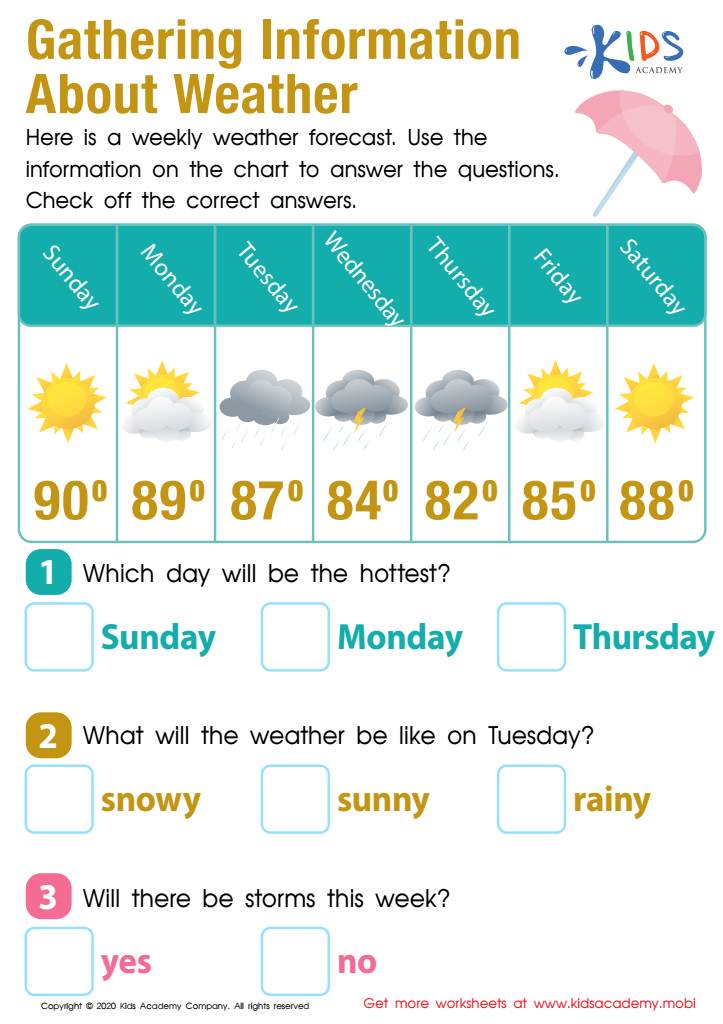
Gathering Information About the Weather Worksheet
Teach your child to interpret a weather forecast with this helpful science worksheet from Kids Academy! Guide them to analyze the data, figure out what the weather will be like on each day and answer the questions at the bottom by checking off the correct answers. This will help them understand and plan for their week!
 Assign to My Students
Gathering Information About the Weather Worksheet
Worksheet
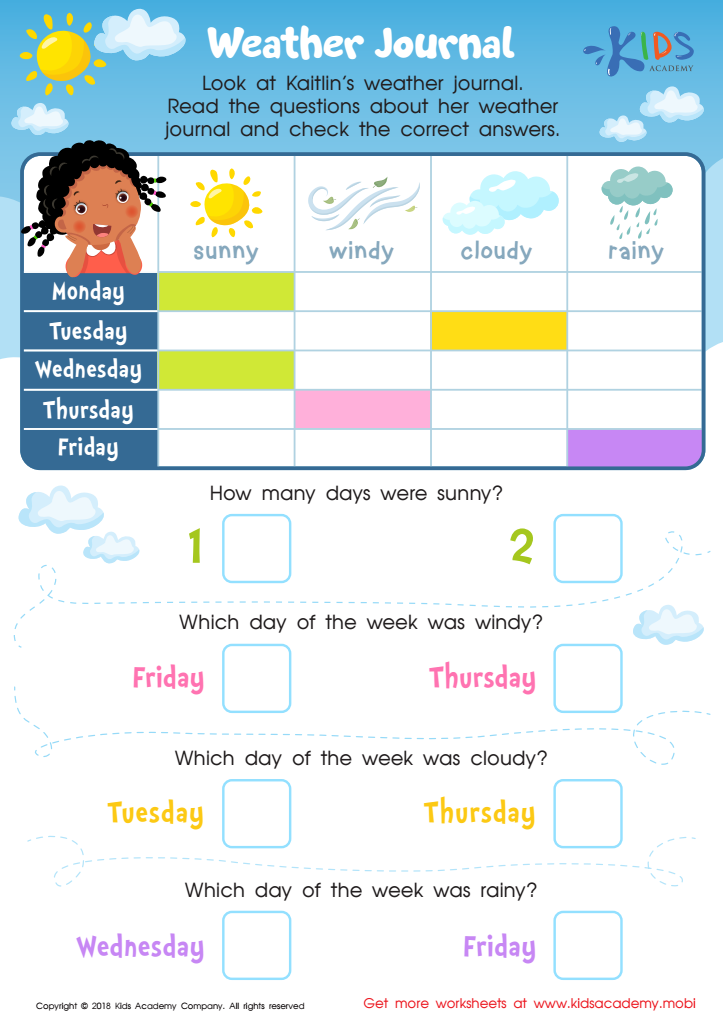
Weather Journal Worksheet
Kaitlin keeps a weather journal. Encourage your child to do the same! Look at Kaitlin's journal with them, and have them note the weather for each day. Read aloud the questions and check the correct answers.
Weather Journal Worksheet
Worksheet
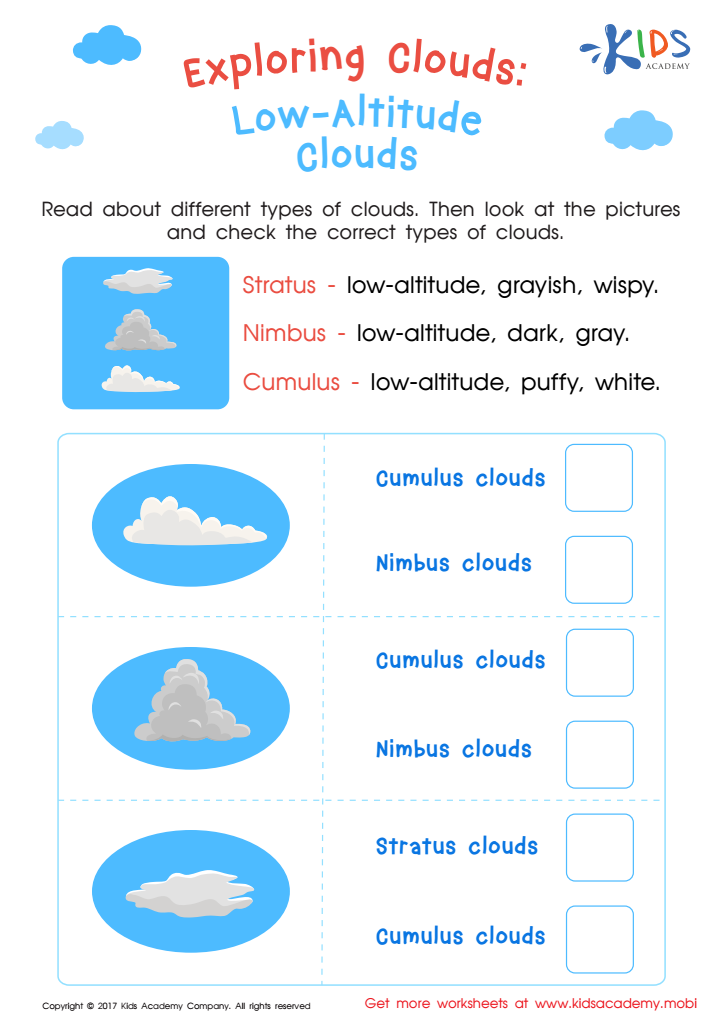
Exploring Clouds: Low Altitude Clouds Printable
Use this fun worksheet to teach them about the different types of low altitude clouds like cirrocumulus, stratocumulus, and cumulonimbus. 80 words.
When a storm clouds up the sky, have your child identify the different types of clouds! This worksheet can help them learn about the nimbus, cirrocumulus, stratocumulus, and cumulonimbus clouds. It's a great way to teach them about the various low altitude clouds and have fun at the same time!
Exploring Clouds: Low Altitude Clouds Printable
Worksheet
Join Kids Academy for Free
Who is primarily going to use this learning content?







Understanding weather is vital for children aged 6-9 as it fosters safety, education, and curiosity. At this young age, kids begin participating in more outdoor activities, and recognizing weather patterns equips them to make informed decisions about appropriate clothing and safety measures, such as using umbrellas in rain or seeking shade on sunny days. Beyond safety, grasping weather concepts builds the foundation for science education. Weather phenomena—like rain, snow, and thunderstorms—can spark curiosity and lead to explorations in subjects like physics, geography, and mathematics. Seasonal changes can be tied into lessons on the Earth’s rotation and atmospheric conditions, making these abstract ideas more tangible.
Additionally, understanding weather nurtures environmental awareness. Children learn how weather impacts plants, animals, and human activities, fostering respect and care for the planet. Discussions about weather phenomena and their implications, such as climate change, can plant the seeds for responsible eco-friendly behavior from an early age.
Furthermore, talking about weather provides daily practical life skills. Predicting how weather conditions like fog or snow may affect travel plans or outdoor events teaches kids to adapt and plan—essential skills for problem-solving and preparedness. Parents and teachers modeling this awareness encourage lifelong habits of critical thought and responsible decision-making.








