Logical Reasoning 2D Shapes Worksheets for Ages 6-9
3 filtered results
Difficulty Level
Grade
Age
-
From - To
Subject
Activity
Standards
Discover our engaging Logical Reasoning 2D Shapes Worksheets, specially designed for children ages 6-9. These interactive resources help young learners enhance their critical thinking and problem-solving skills while exploring the world of two-dimensional shapes. Through fun puzzles and challenging exercises, kids will identify shapes, understand their properties, and make connections between different figures. Our worksheets promote logical reasoning in a playful manner, making math learning enjoyable and effective. Perfect for classroom activities or at-home practice, these worksheets are an essential tool for building a solid foundation in math. Encourage your child’s analytical skills today with our creative 2D shapes worksheets!
Favorites
With answer key
Interactive
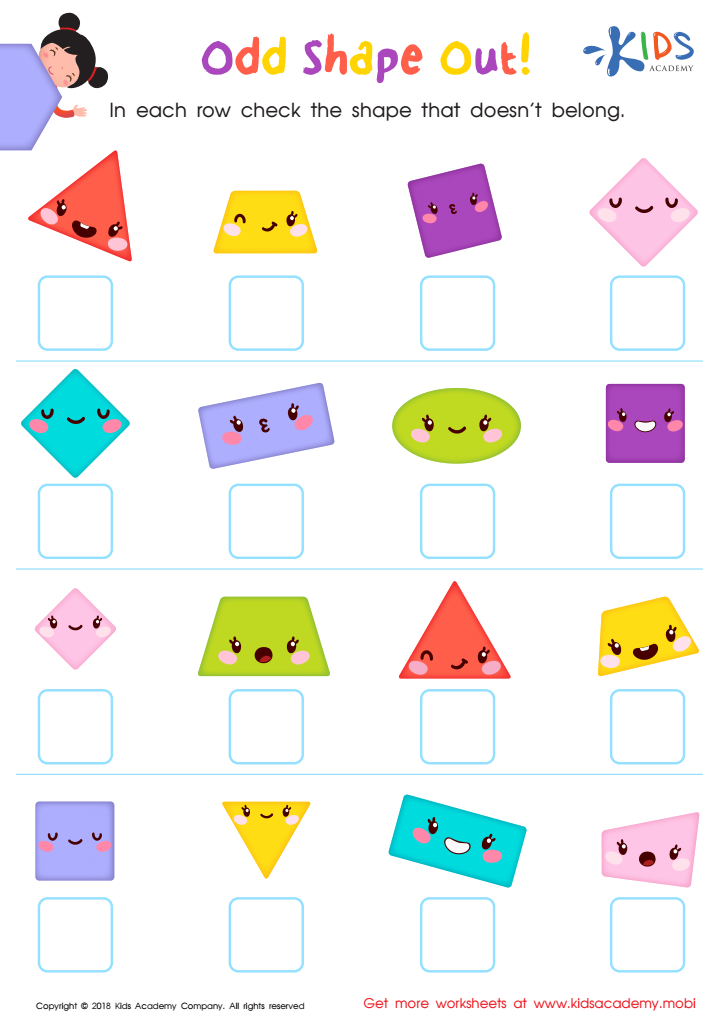
Odd Shape Out Worksheet for Grade 3
Time to test your child's shape knowledge! With this worksheet, help them find the odd shape out in each row and check the box under it. Print out the pdf and look through it with them – each row has four brightly colored shapes. See if they can spot any differences among them and then check the box below the shape that does not belong.
 Assign to My Students
Odd Shape Out Worksheet for Grade 3
Worksheet


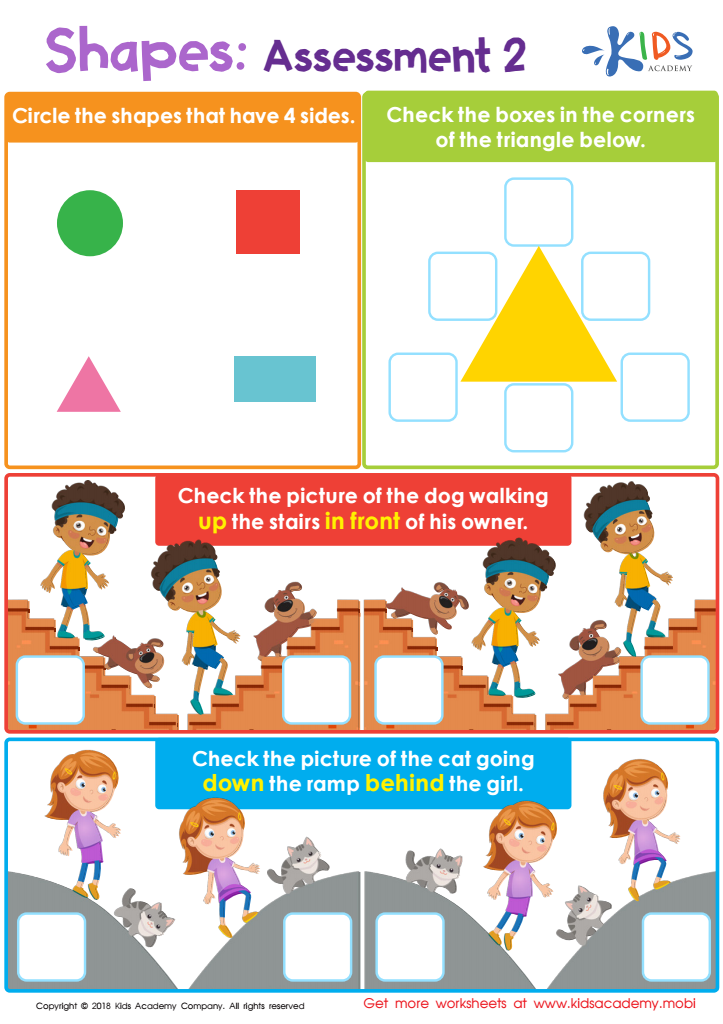
Shapes: Assessment 2 Worksheet
This geometry worksheet assesses a student's knowledge of shapes and positional words. They must identify shapes with 4 sides and corners on a triangle. The worksheet also tests understanding of words like "up", "front", "down" and "behind". Easily determine what your student knows about these concepts with this downloadable worksheet!
Shapes: Assessment 2 Worksheet
Worksheet
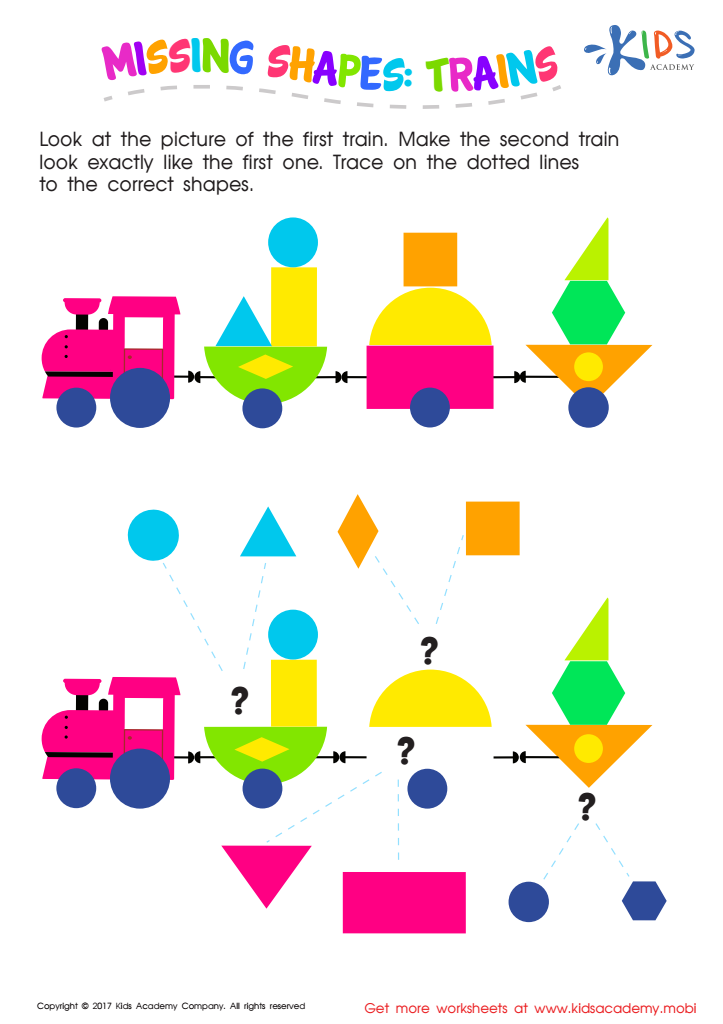
Missing Shapes: Trains Worksheet
Before beginning, ask your child what the object in the picture is, the sound it makes and where it can be found. If they know, confidently move on. Help them make the second train look like the first by tracing dotted lines. Hold their hand for guidance.
Missing Shapes: Trains Worksheet
Worksheet
Join Kids Academy for Free
Who is primarily going to use this learning content?








Parents and teachers should prioritize logical reasoning and understanding of 2D shapes for children ages 6-9 because these skills lay the foundation for critical thinking and problem-solving. At this age, children are developing cognitive abilities that will influence their future learning experiences. Grasping concepts of 2D shapes—such as triangles, squares, and circles—enhances spatial awareness and aids in developing mathematical skills, which are crucial for later applications in geometry and beyond.
Logical reasoning involves recognizing patterns, categorizing objects, and making connections between different concepts. Encouraging these skills in young learners fosters creativity while improving their ability to articulate ideas and solve problems. Fluency with 2D shapes also enhances finer motor skills through activities like drawing and modeling, which can increase children's engagement and interest in learning.
Moreover, these foundational skills are essential for success in STEM (Science, Technology, Engineering, and Mathematics) fields, which are increasingly integral to our technology-driven society. By nurturing logical reasoning and spatial skills in early education, we empower children to become confident, competent thinkers-preparing them not just for math, but for all aspects of their academic and future lives.