Recognizing Patterns Adding up to 1000 with Regrouping Worksheets for Ages 6-9
4 filtered results
-
From - To
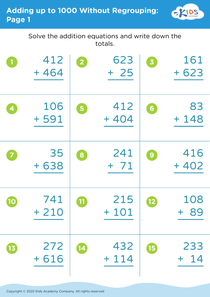
Enhance your child’s mathematical skills with our "Recognizing Patterns Adding up to 1000 with Regrouping Worksheets," specially designed for ages 6-9. These engaging worksheets introduce young learners to the concept of regrouping through fun patterns, helping them solve addition problems that reach up to 1000. By recognizing boundaries and repeated sequences, children will gain confidence in their calculations, making math a playful learning experience. Perfect for use at home or in the classroom, our resources stimulate critical thinking and provide ample practice opportunities. Foster a love for math in your child today—explore our worksheets to support their learning journey!
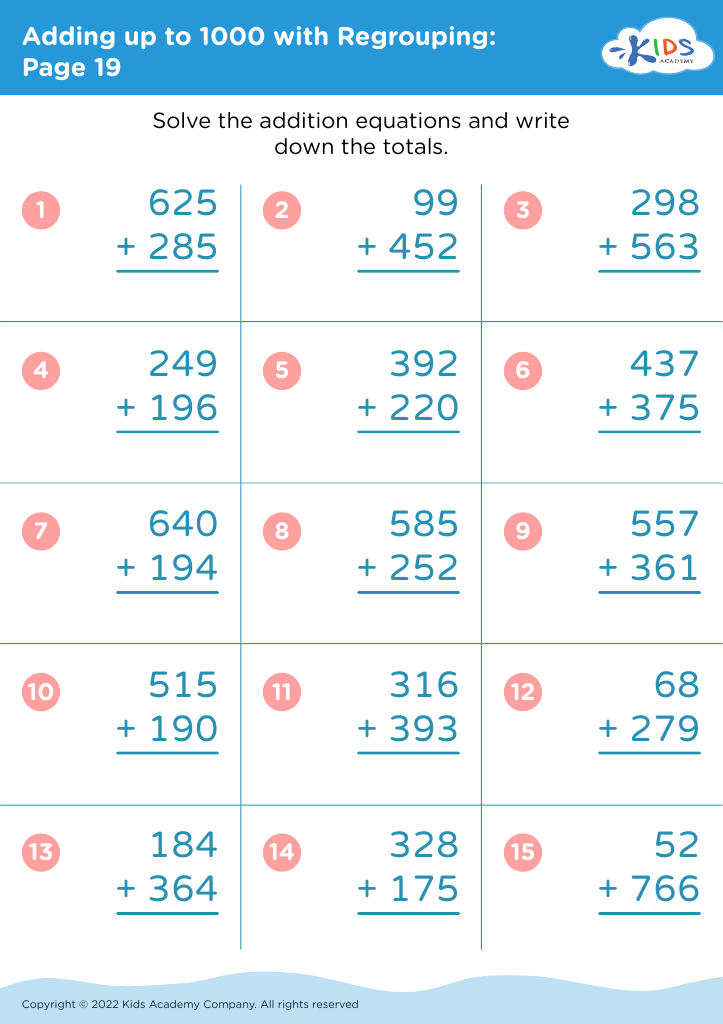
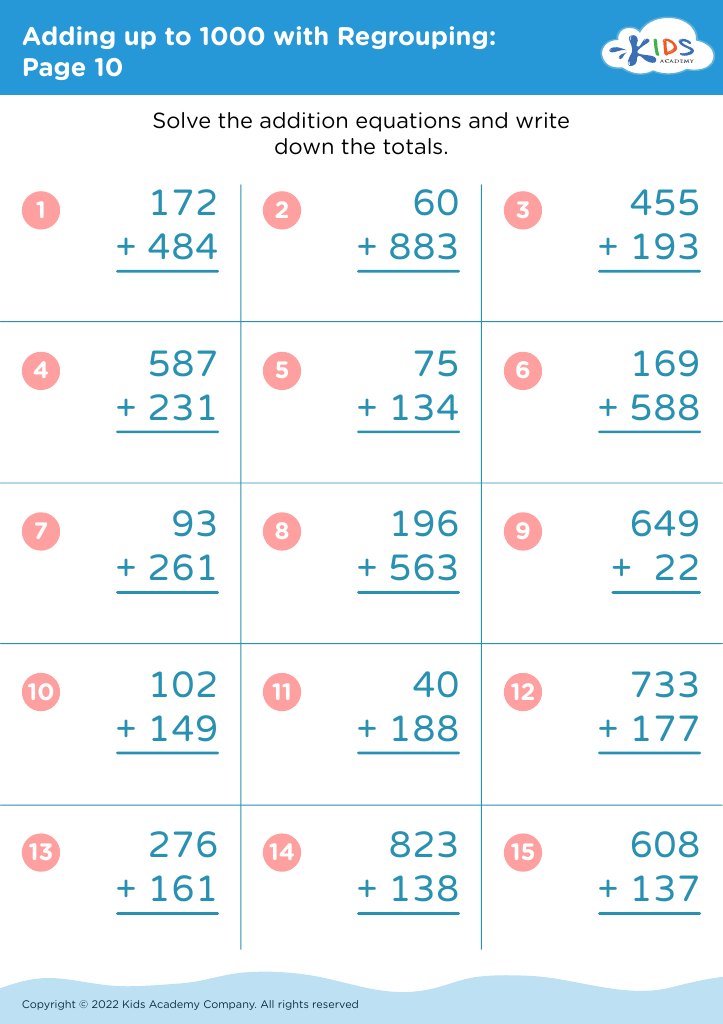
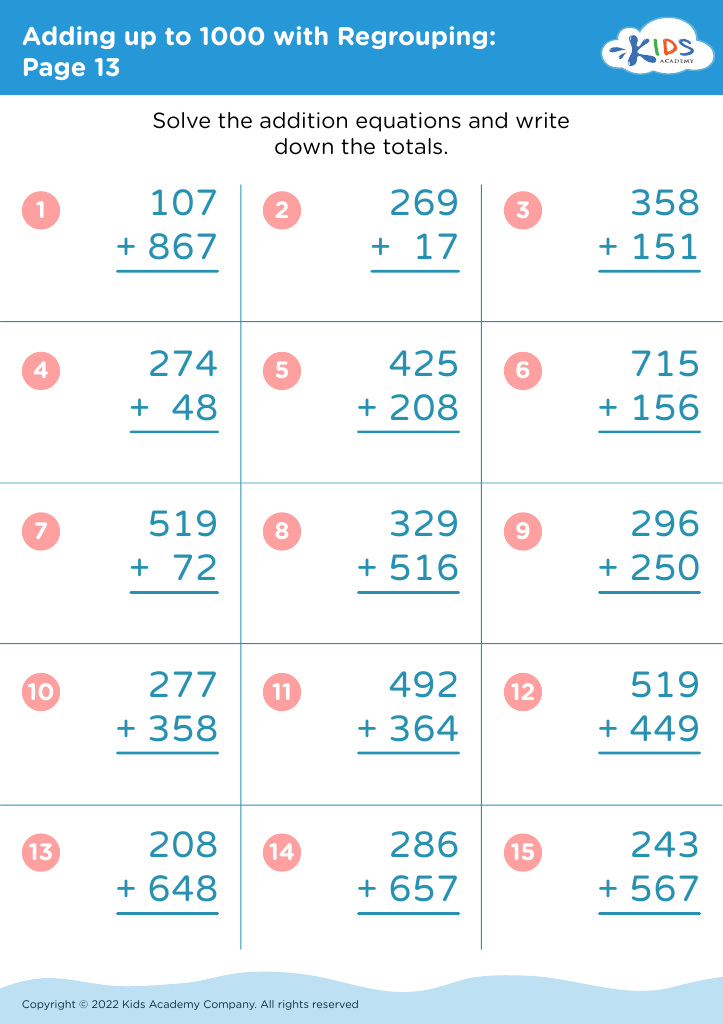
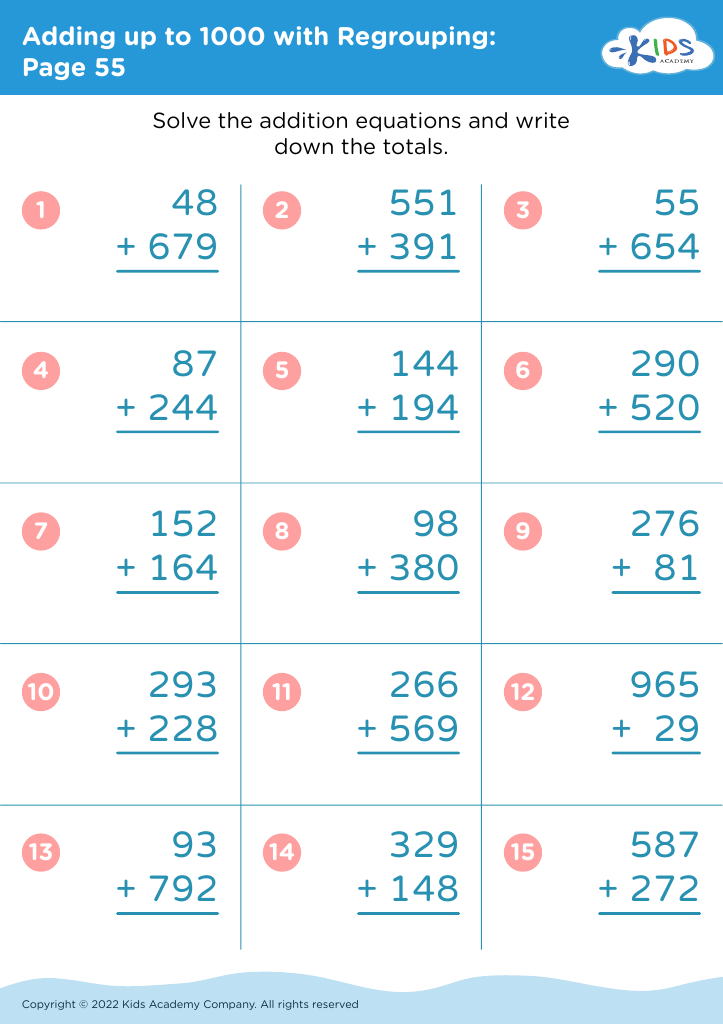


Recognizing patterns is a vital mathematical skill that lays the foundation for complex problem-solving. For children aged 6-9, learning to add up to 1000 with regrouping fosters not only number sense but also enhances critical thinking and analytical skills. As kids explore numerical patterns, they begin to understand the relationships between numbers, which is essential for tackling larger sums in the future.
Regrouping, or carrying over values in addition, introduces children to concepts like place value and the importance of working with numbers in groups. Parents and teachers should prioritize this skill because it equips learners with strategies to simplify seemingly daunting tasks, making math accessible and less intimidating.
Moreover, recognizing patterns aids memory retention; children can more easily recall how to handle complex sums when they see the structure behind numbers. This foundational knowledge supports later math topics such as multiplication, division, and even algebra.
Encouraging proficiency in recognizing patterns and regrouping not only boosts mathematical understanding but also enhances overall confidence in problem-solving, fostering a lifelong positive attitude towards math and learning. Engaging children in fun, interactive ways to recognize these patterns can spark their interest in math and bolster their academic growth.