Recognizing shapes Adding up to 1000 with Regrouping Worksheets for Ages 6-9
4 filtered results
-
From - To
Explore our "Recognizing Shapes Adding Up to 1000 with Regrouping Worksheets," designed specifically for children aged 6-9. These engaging worksheets promote shape recognition while reinforcing addition skills, allowing young learners to seamlessly integrate geometry with math. As students tackle challenges that combine regrouping and shape identification, they develop critical thinking and problem-solving abilities. Our resources help build confidence in mathematics through visually appealing exercises, encouraging fun, interactive learning. Perfect for in-class learning or at-home practice, these worksheets support your child's journey to mastering addition and shapes, paving the way for future math success. Discover the joy of learning with Kids Academy!
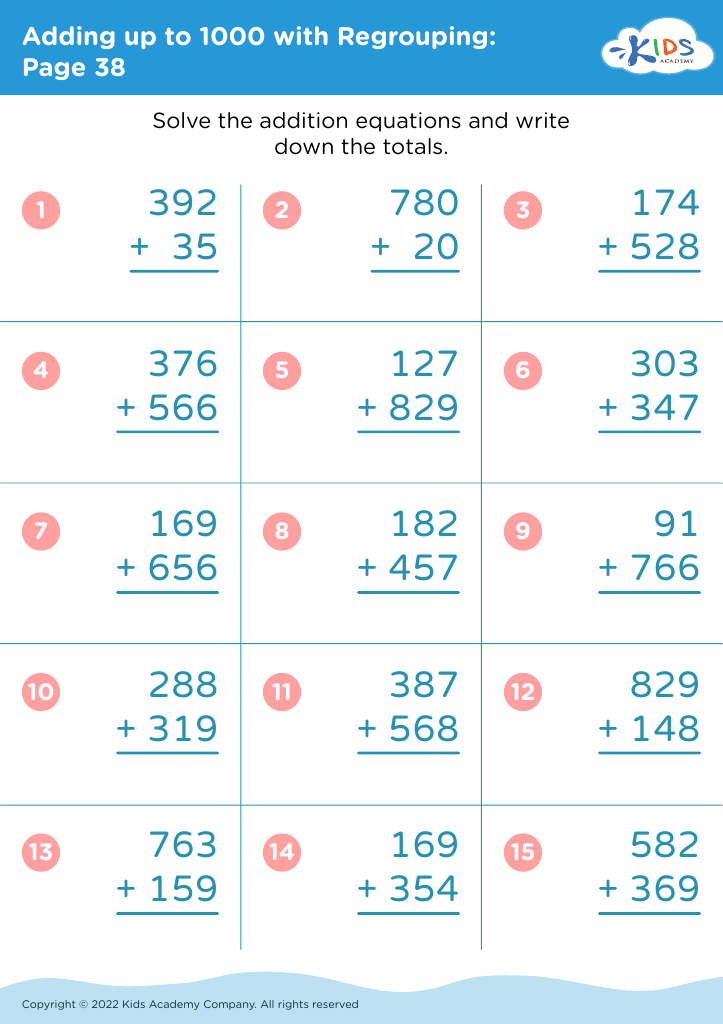


Recognizing shapes and learning to add up to 1000 with regrouping are crucial skills for children aged 6-9, and parents and teachers should prioritize them for several reasons. Firstly, understanding shapes lays the foundation for spatial awareness, which is essential in various real-life applications, from geometry in higher math to everyday activities like navigating spaces and understanding maps.
Additionally, mastering addition with regrouping promotes a deeper comprehension of number relationships and enhances cognitive abilities. It helps children grasp the concepts of place value and the fundamentals of carrying over numbers, which are foundational building blocks for more advanced mathematics. By engaging children in activities that reinforce these skills, we also encourage critical thinking and problem-solving capabilities.
Moreover, these skills foster confidence in young learners, empowering them to tackle more complex math concepts in the future. When children feel adept at recognizing shapes and performing addition with regrouping, they are more likely to develop a positive attitude toward math and enjoy learning. Ultimately, supporting children in these areas is a crucial step towards instilling a lifelong love for mathematics and enhancing their overall academic success.