Simplifying Fractions Adding up to 1000 Without Regrouping Worksheets for Ages 6-9
3 filtered results
-
From - To
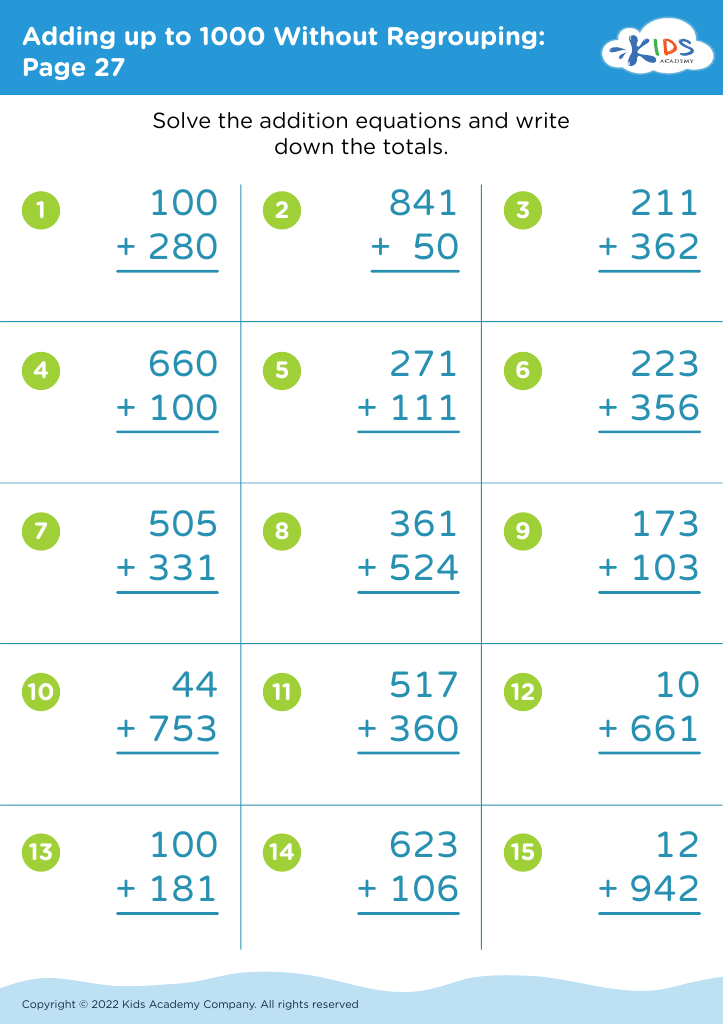
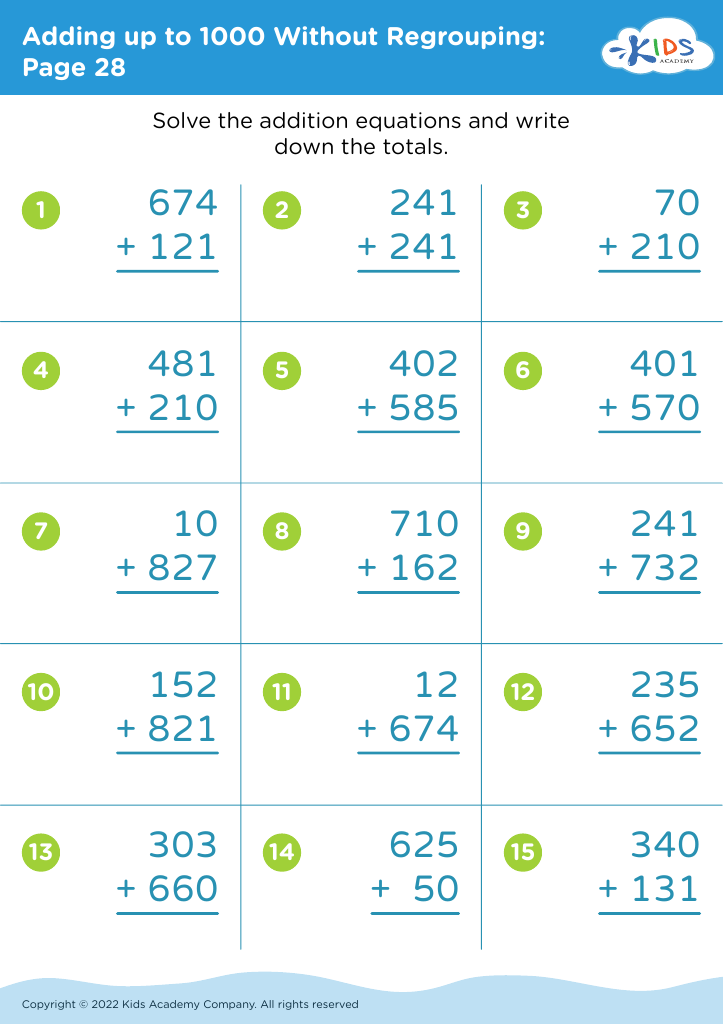
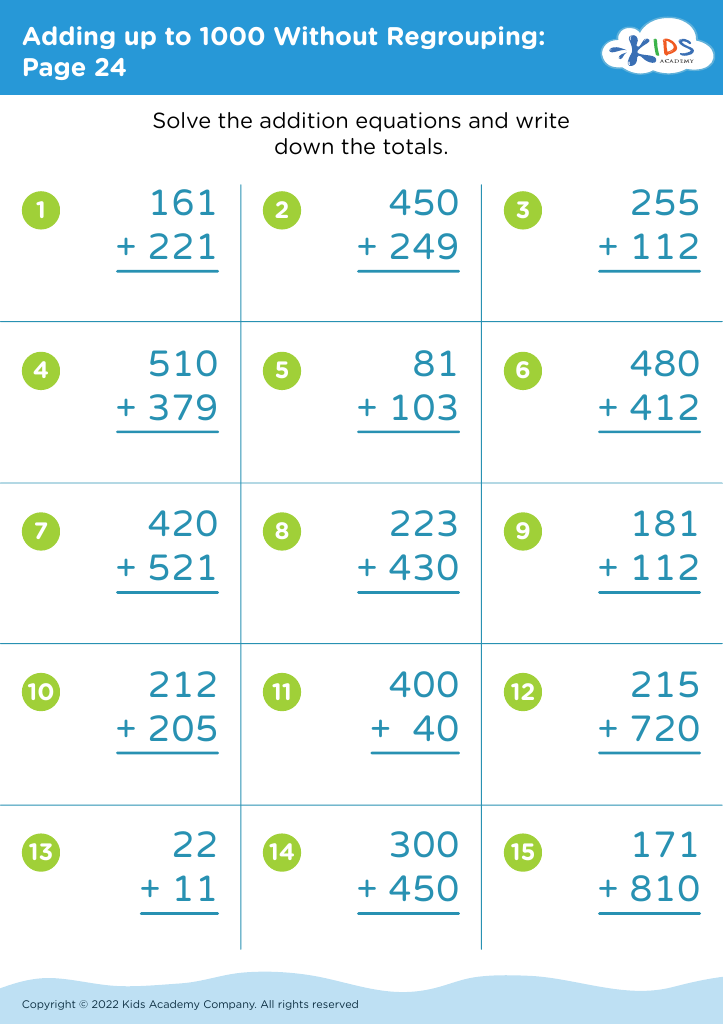
Explore our engaging "Simplifying Fractions Adding up to 1000 Without Regrouping Worksheets" designed for children aged 6-9. These interactive worksheets focus on teaching young learners the essential skill of simplifying fractions while enhancing their understanding of addition without regrouping. Students will enjoy practicing their math skills through fun activities that encourage critical thinking and problem-solving. Perfect for classroom use or at-home practice, these worksheets promote numerical fluency and help build a solid foundation for future math concepts. Encourage your child to master fractions and addition with our carefully crafted resources that make learning enjoyable and effective!


Parents and teachers should care about simplifying fractions and handling addition up to 1000 without regrouping, particularly for ages 6-9, as these foundational skills are crucial for young learners. Simplifying fractions helps children understand the concept of equivalence and provides them with a clearer grasp of how numbers relate to one another. Recognizing that (\frac{1}{2}) is the same as (\frac{2}{4}) builds their ability to compare, add, and subtract fractions in future math problems. This skill enhances critical thinking and problem-solving abilities, empowering children in their overall math journey.
Adding numbers up to 1000 without regrouping reinforces basic addition competencies, which are essential for more complex calculations later on. When children master this skill, they gain confidence and fluency in arithmetic, which are vital for later stages of mathematics. Age 6-9 is a crucial period for developing a love for math; simplicity in learning can prevent fear or anxiety around the subject.
Furthermore, these skills are practical in everyday situations, such as measuring ingredients for a recipe or sharing equally among friends. Therefore, equipping children with these skills provides a strong mathematical foundation that will benefit them academically and in real-world applications throughout their lives.