
Logical thinking Addition Worksheets for Ages 6-9
9 filtered results
Difficulty Level
Grade
Age
-
From - To
Subject
Activity
Standards
Enhance your child's mathematical skills with our engaging Logical Thinking Addition Worksheets designed for ages 6-9! These thoughtfully crafted worksheets focus on developing logical reasoning while practicing basic addition. Each activity combines fun puzzles and challenges that encourage critical thinking, enabling young learners to not only solve problems but also understand underlying concepts. Perfect for classroom use or at-home practice, our worksheets airily integrate enjoyment with education, making math learning interactive and effective. With varied designs and difficulty levels, these resources are ideal for enhancing cognitive abilities and preparing your child for future math challenges. Start fostering a love for math today!
Favorites
With answer key
Interactive
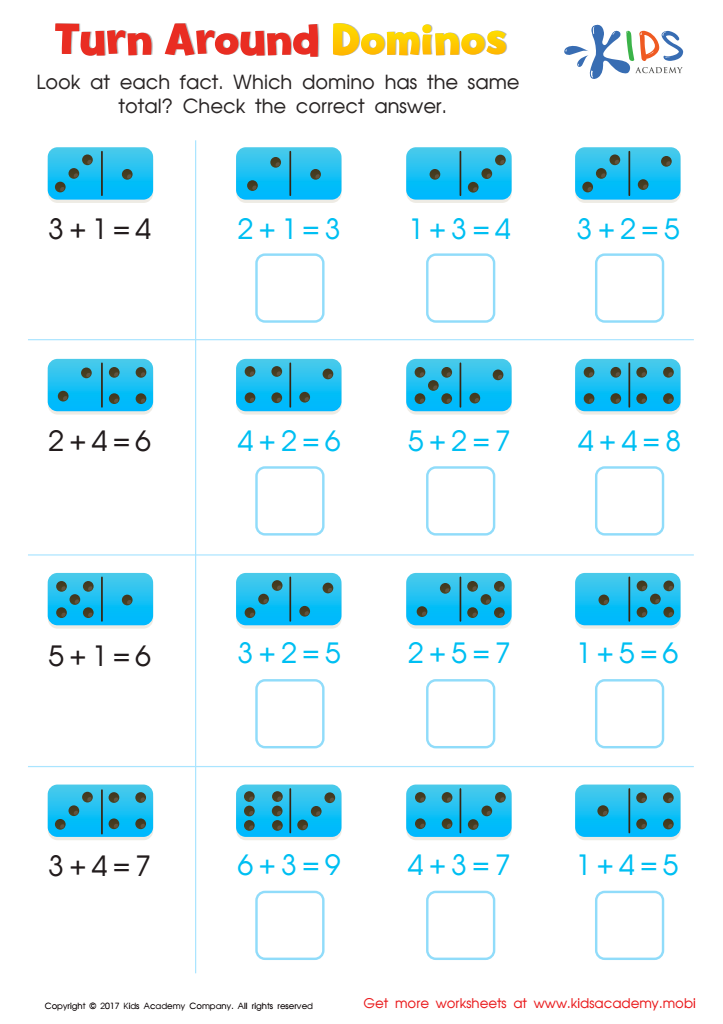
Turn Around Dominos Worksheet
Encourage your child to flex their mental muscles with this math worksheet. Look through the left side's dominos and their values and then check the three boxes on the right. Ask your child if any of the right box's dominos are similar. This requires focus and careful observation.
 Assign to My Students
Turn Around Dominos Worksheet
Worksheet
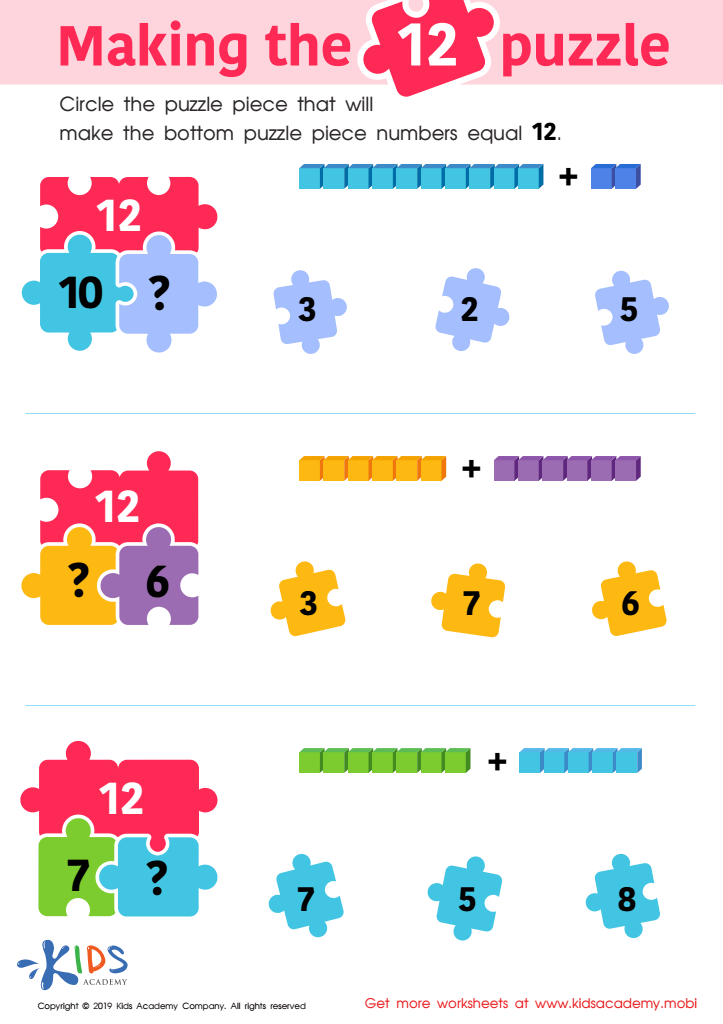
Making the 12 Puzzle Worksheet
Engage preschoolers in learning with this fun and colorful worksheet. Ask them to look at the picture and identify the missing equation on each puzzle piece; then help them solve the problems. When all the puzzle pieces make the bottom numbers equal 12, have them circle it. This is a great way to combine learning and fun!
Making the 12 Puzzle Worksheet
Worksheet
Join Kids Academy for Free
Who is primarily going to use this learning content?








Logical thinking and addition skills are crucial for children aged 6-9 as they serve as foundational elements for mathematics and critical reasoning. During these formative years, children are developing cognitive abilities that help them understand and manipulate numbers. Fostering logical thinking through addition encourages not only fluency in mathematical operations but also enhances problem-solving skills and analytical reasoning.
Parents and teachers should care because strong logical thinking lays the groundwork for more complex mathematical concepts encountered later in schooling, such as multiplication, division, and fractions. When children grasp the relationships between numbers and can approach addition systematically, they build confidence that influences their overall academic performance.
Moreover, logical thinking in addition encourages a growth mindset, helping them learn that challenges and mistakes are opportunities for learning. Engaging children in real-life problem-solving scenarios, such as estimating costs during grocery shopping or evaluating scores while playing games, reinforces these concepts practically.
Ultimately, nurturing logical thinking alongside addition fosters a lifelong love for learning and equips children with valuable skills for future academic and personal success. Ensuring that children master these skills early on prepares them for the challenges of higher-level math and everyday decision-making.








