
Pattern identification Addition Worksheets for Ages 6-9
3 filtered results
Difficulty Level
Grade
Age
-
From - To
Subject
Activity
Standards
Boost your child's math skills with our Pattern Identification Addition Worksheets for Ages 6-9! Specifically designed for young learners, these engaging worksheets combine fun and learning by helping kids recognize and complete patterns using addition. By identifying sequences and understanding numerical relationships, children not only enhance their addition prowess but also develop critical thinking and problem-solving abilities. Perfect for both classroom use and homeschool practice, our worksheets provide a solid foundation for more advanced math concepts. Strengthen your child's mathematical confidence and make learning enjoyable with our expertly crafted, colorful resources!
Favorites
With answer key
Interactive
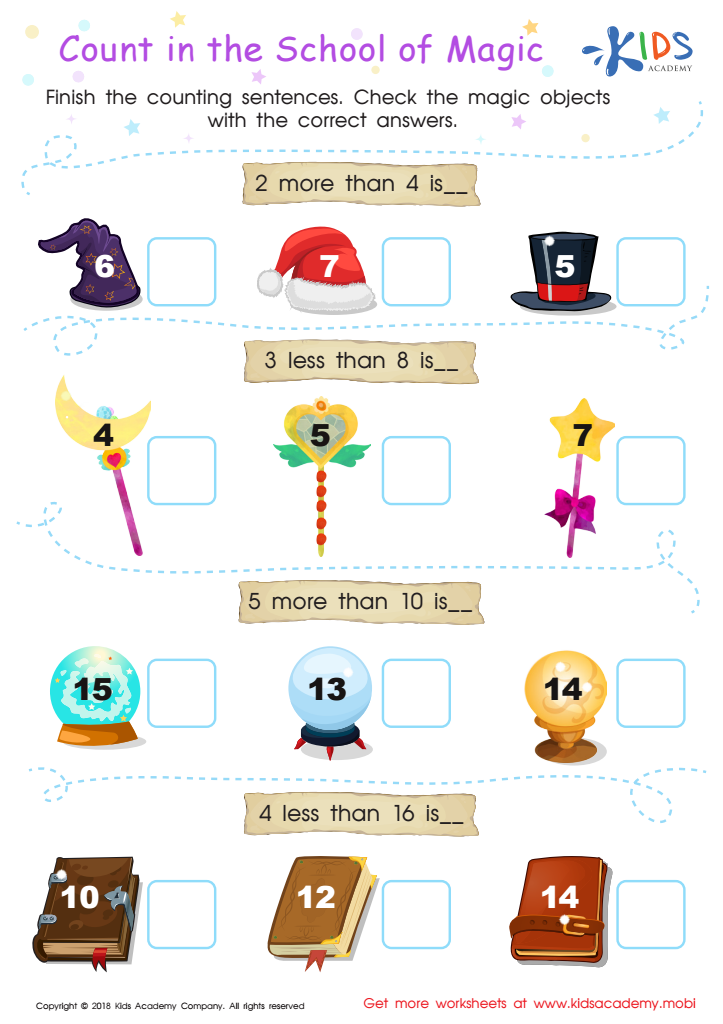
Count in the School of Magic Worksheet
Your math learners can explore the School of Magic with this worksheet. They'll read equations with addition and subtraction numbers under 20, count back and forth to find the answer, then complete the counting sentences. Fun pictures and easy accuracy make it an enjoyable and successful learning experience.
 Assign to My Students
Count in the School of Magic Worksheet
Worksheet
Join Kids Academy for Free
Who is primarily going to use this learning content?








Pattern identification in addition is crucial for children aged 6-9 as it lays the foundational thinking skills for more advanced mathematics and learning processes. This age range is a critical period for brain development and introducing children to patterns helps in shaping their cognitive abilities.
When children recognize and work with addition patterns, they develop an understanding of relationships and structures in numbers. This conceptual grasp goes beyond mere memorization, allowing deeper mathematical thinking and problem-solving skills. For instance, recognizing that adding 2 repeatedly creates a specific pattern helps children predict outcomes, understand even and odd numbers, and grasp the concept of sequences.
Furthermore, early engagement with patterns and addition fosters enthusiasm and confidence in math. When children see patterns, they experience a sense of discovery and achievement, which motivates further learning. This positive attitude towards math can influence their performance and interest in the subject in later years.
From a developmental perspective, pattern recognition also enhances other cognitive skills such as logical reasoning, spatial awareness, and even literacy. Being able to identify similarities, differences, and sequences in numbers translates to other areas of learning, making children more versatile thinkers.
In summary, caring about pattern identification in addition during ages 6-9 equips children with essential mathematical skills, fosters a positive learning attitude, and supports overall cognitive development.








