
Fraction identification Math Worksheets for Ages 6-9
6 filtered results
Difficulty Level
Grade
Age
-
From - To
Subject
Activity
Standards
Discover an engaging way to teach young learners about fractions with our Fraction Identification Math Worksheets for Ages 6-9. Designed to captivate and educate, these worksheets help children grasp essential concepts of fractions through fun exercises and colorful visuals. Kids will practice identifying fractions, understanding numerators and denominators, and comparing different fractions. Perfect for in-class activities or at-home learning, our worksheets align with early math standards and foster critical thinking skills. Whether you’re a teacher or a parent, these resources offer a valuable tool to help your child build a strong mathematical foundation. Start exploring fractions today!
Favorites
With answer key
Interactive
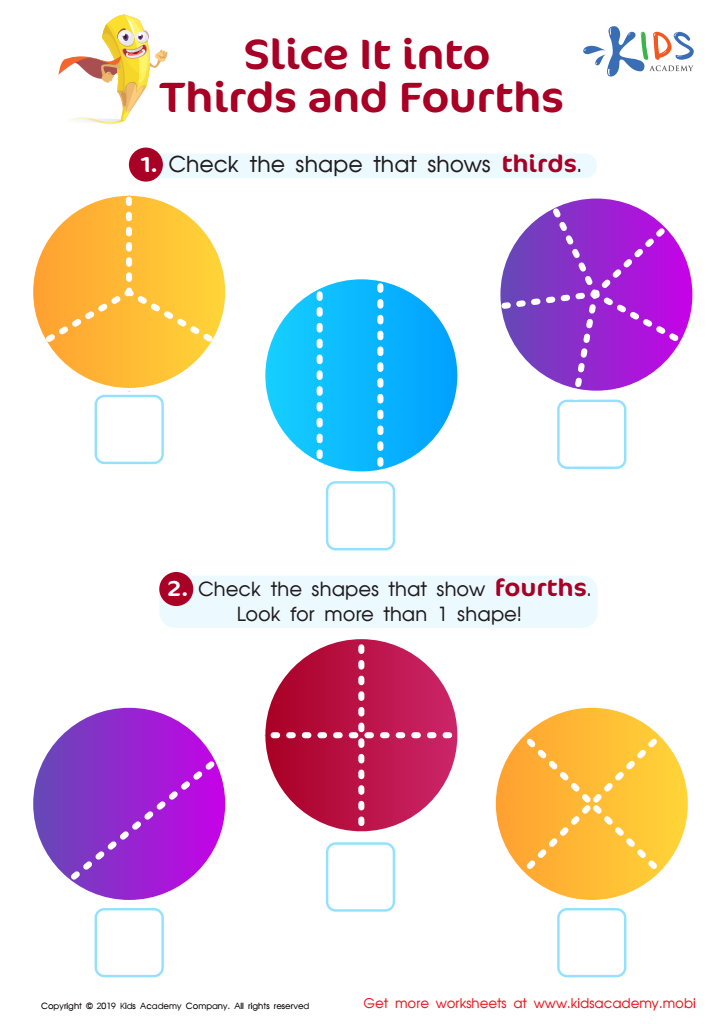
Slice in Thirds Fourths Worksheet
This worksheet helps kids learn fractions visually by dividing circles into thirds and fourths. They will learn that fractions must be equal parts, not just sets, by choosing the right colorful circles. It's an easy way to master fractions and have fun doing it!
 Assign to My Students
Slice in Thirds Fourths Worksheet
Worksheet
Join Kids Academy for Free
Who is primarily going to use this learning content?






Understanding fractions is a critical skill for children ages 6-9 as it lays the foundation for more advanced mathematical concepts. Parents and teachers should prioritize fraction identification for several reasons. First, mastering fractions enhances a child's number sense, helping them understand parts of a whole, which is essential for everyday tasks like cooking, shopping, and sharing.
Additionally, fractions serve as a bridge between basic arithmetic and more complex math, such as algebra and geometry. Recognizing and working with fractions fosters problem-solving skills, encouraging children to think critically and analytically.
Moreover, early exposure to fractions can build confidence in mathematics, making children more likely to engage with the subject positively in the future. The ability to identify, compare, and manipulate fractions is also key in encouraging perseverance when tackling challenging math problems.
In a society that values STEM education, equipping children with these skills early on prepares them for future academic success. Therefore, parents and teachers should actively involve children in fun, practical fraction activities to nurture an understanding and appreciation for this vital mathematical concept. This investment in their education will yield significant long-term benefits across various domains of learning and everyday life.








