
Improving observational skills Math Worksheets for Ages 6-9
3 filtered results
Difficulty Level
Grade
Age
-
From - To
Subject
Activity
Standards
Enhance your child's observational skills with our engaging math worksheets designed specifically for ages 6-9! These worksheets combine fun activities and vibrant illustrations to help young learners develop critical thinking and attention to detail. Each exercise encourages kids to observe patterns, compare quantities, and engage in problem-solving, all while nurturing their love for learning. Our user-friendly layout ensures a smooth experience for both children and parents. Perfect for home practice or classroom use, these worksheets empower kids to sharpen their observational skills and boost their confidence in math. Start their journey toward mathematical mastery today!
Favorites
With answer key
Interactive
The Force of the 4's Worksheet
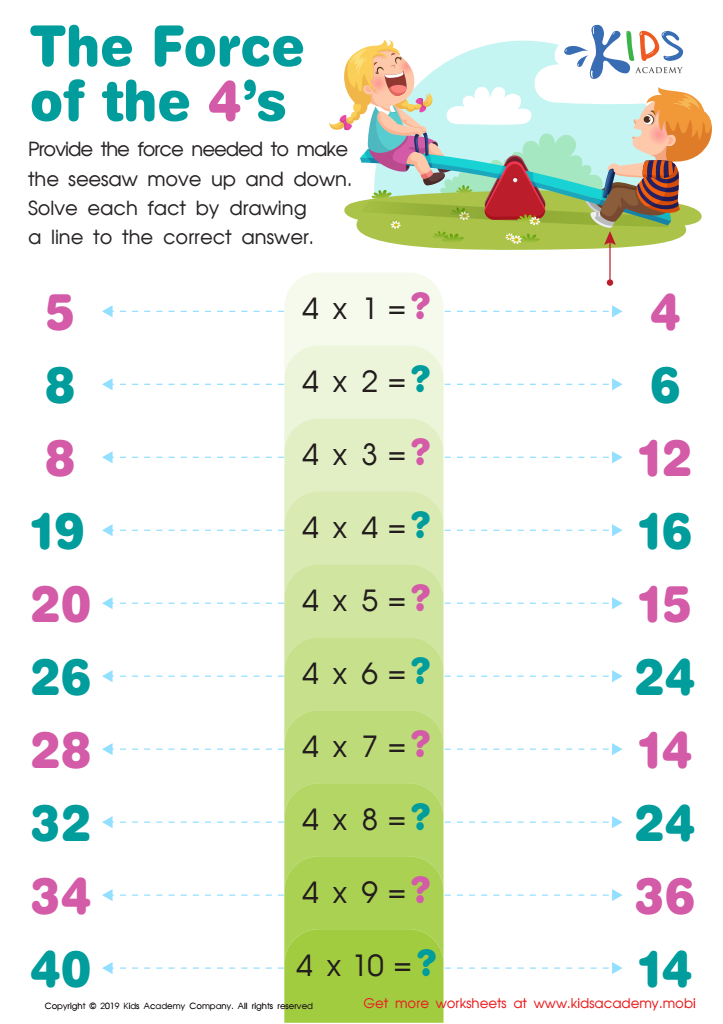
Ride a seesaw with your child and explore the physics behind it! Explain how it needs two people and how force makes it go up and down. Use the memories of the pleasurable experience to teach your kid a lesson in force. Show them how to solve the worksheet by drawing a line to the correct answer. This way, they'll learn the force needed for the seesaw to move.
 Assign to My Students
The Force of the 4's Worksheet
Worksheet
Join Kids Academy for Free
Who is primarily going to use this learning content?








Improving observational skills in math for children ages 6-9 is crucial for several reasons. First, this age group is at a pivotal stage in their cognitive development where they begin to make connections between mathematical concepts and the real world. By honing their observation skills, children can recognize patterns, shapes, and numbers in their environment, which enhances their understanding and retention of mathematical principles.
Moreover, strong observational skills foster critical thinking. When students learn to observe and analyze details, they can approach problems more effectively, leading to better problem-solving abilities. This foundational skill also supports other subjects beyond math, multidisciplinary learning, thereby enriching a child's overall education.
Additionally, Children who develop keen observational skills tend to exhibit higher levels of curiosity and engagement in learning. Parents and teachers can facilitate this by encouraging activities that involve exploration and discovery, such as math scavenger hunts or hands-on experiments.
Finally, encouraging observational skills can address diverse learning styles. Some children grasp concepts more readily through visual stimuli and active participation. Supporting these skills not only aids children's arithmetic abilities but also promotes a lifelong love for learning, paving the way for success in future educational endeavors.








