Recognizing equal parts Math Worksheets for Ages 6-9
3 filtered results
-
From - To
Welcome to our "Recognizing Equal Parts" Math Worksheets designed for children aged 6-9! These fun and engaging worksheets help young learners grasp the concept of equal parts through colorful visuals and interactive exercises. Students will explore fractions, symmetry, and partitioning through various activities that promote critical thinking and problem-solving skills. Our printable resources are perfect for classroom or home use, making math both enjoyable and accessible. Encourage your child to discover the world of shapes and fractions while building a solid foundation in mathematics. Start their journey to mastering equal parts today with our thoughtfully crafted worksheets!
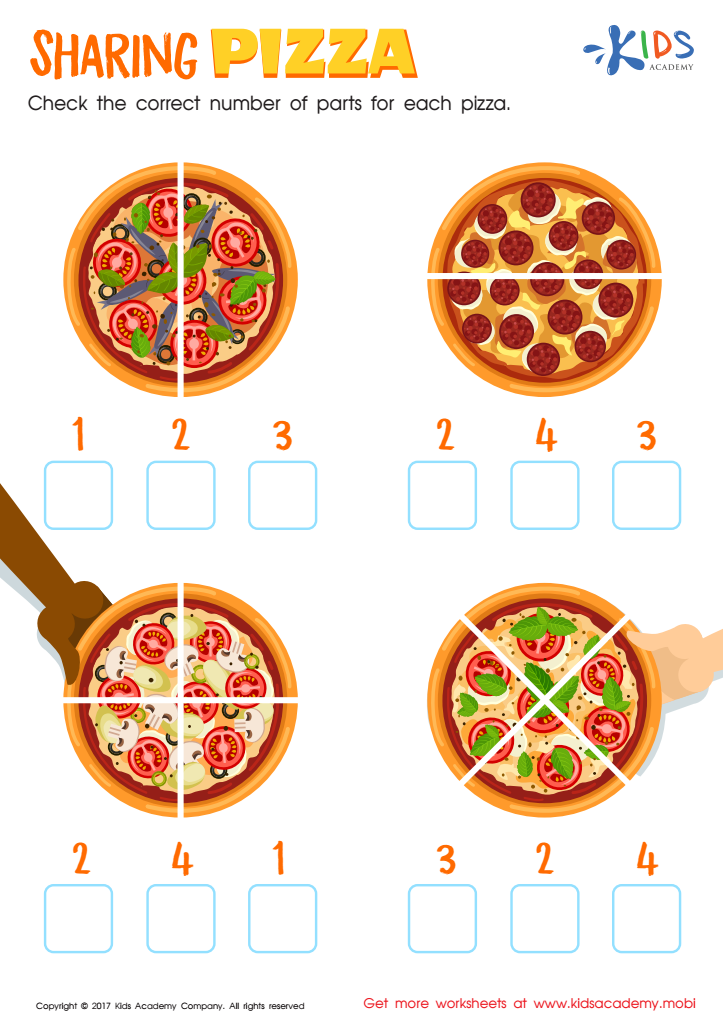
Sharing Pizza Worksheet
 Assign to My Students
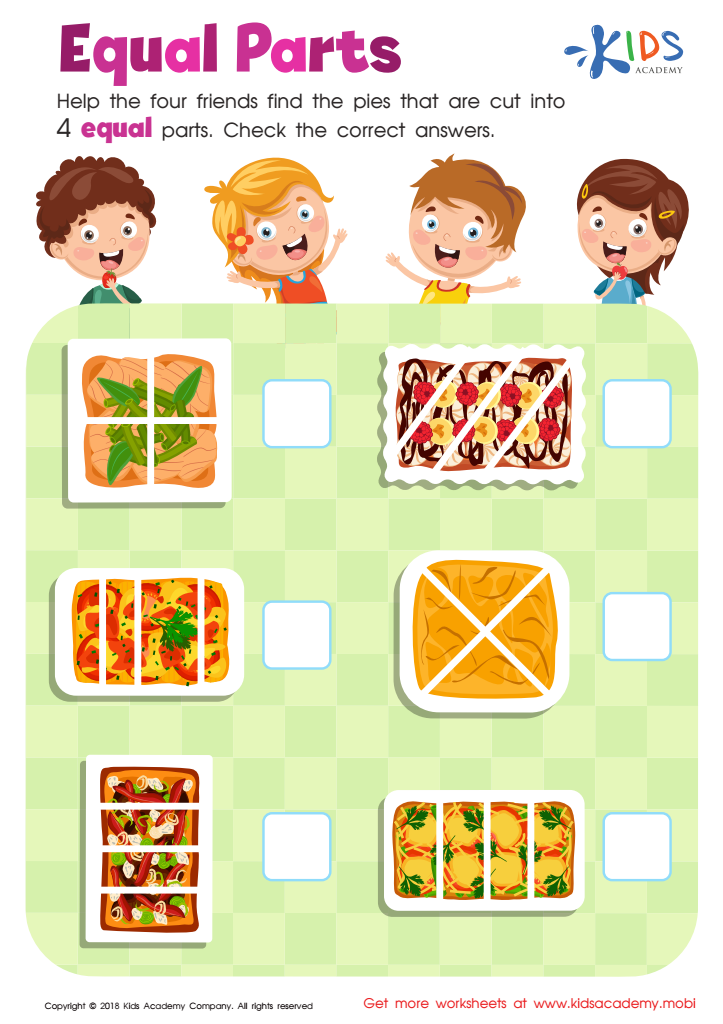
Equal Parts: Food Worksheet






Recognizing equal parts is a foundational concept in mathematics that is crucial for children aged 6-9. At this developmental stage, children are beginning to understand fractions and the importance of division in both mathematical contexts and everyday life. When parents and teachers emphasize the recognition of equal parts, they help children cultivate a deeper understanding of how to share quantities fairly, compare sizes, and engage in basic problem-solving.
This concept also connects to real-world experiences, such as sharing a pizza or dividing a set of toys, allowing children to see the practical application of math. By engaging with tasks that involve equal parts, children can develop spatial awareness and critical thinking. This is essential for building a strong mathematical foundation that will support more complex concepts later on.
Furthermore, recognizing equal parts fosters collaboration as children often work in pairs or groups, learning to discuss and reason together. This social aspect nurtures communication skills and supports a positive attitude towards learning math. By focusing on this critical area, parents and teachers can inspire confidence, enhance logical reasoning, and promote a lifelong appreciation for mathematics, ultimately positioning children for future success in academics and beyond.








