Telling time Math Worksheets for Ages 6-9
4 filtered results
-
From - To
Our "Telling Time Math Worksheets for Ages 6-9" offer a fun and educational way to teach kids how to read analog and digital clocks. These worksheets are designed to enhance children's understanding of hours, minutes, and the overall concept of time. Engaging exercises boost their confidence and skills, providing ample practice through a variety of interactive activities. Perfect for classroom use or homeschooling, each worksheet aligns with common core standards, ensuring a solid foundation in time-telling. Foster your child's learning journey and make mastering this essential math skill enjoyable and rewarding with our expert-crafted resources.
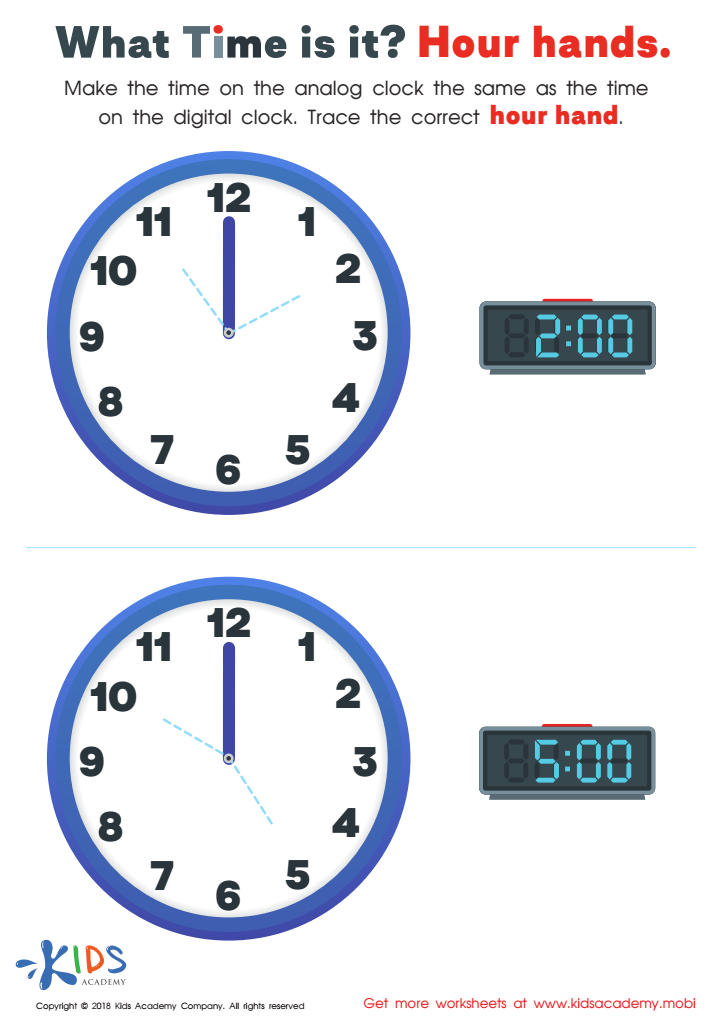
What Time Is it? Hour Hands Worksheet
 Assign to My Students




.jpg)



Learning to tell time is a fundamental skill that holds significant importance for children aged 6-9, and it’s essential for both parents and teachers to closely support this learning. At this age, children are highly receptive and begin to grasp the concept of time, which is a critical component of both daily life and overall cognitive development.
Understanding time helps children develop a sense of order and structure, enabling them to comprehend and manage routines, schedules, and deadlines effectively. This skill fosters independence, as children learn to anticipate and prepare for upcoming events, such as bedtime, school hours, and playtime, which enhances their time management abilities.
Moreover, telling time strengthens mathematical skills. It promotes an understanding of numbers, addition, and subtraction, as well as fraction concepts, particularly when they grasp the units of time such as hours and minutes. This mathematical underpinning extends to other areas of learning and builds a foundation for more advanced math concepts.
Socially, being able to tell time helps children participate more fully in group activities, fostering responsibility and punctuality. Over time, as they internalize these skills, they improve their abilities to meet societal expectations and navigate the world around them more effectively. Thus, for holistic development in both academic and life skills, the role of parents and teachers is crucial in guiding these young learners.








