
Mathematical reasoning Skip Counting Worksheets for Ages 6-9
3 filtered results
Difficulty Level
Grade
Age
-
From - To
Subject
Activity
Standards
Enhance your child’s mathematical reasoning with our Skip Counting Worksheets for Ages 6-9. Our printable worksheets are designed to teach young learners essential skip counting skills, vital for developing strong numerical fluency and receptive problem-solving abilities. Each sheet is meticulously crafted to offer engaging and interactive exercises that make learning to skip count fun and effective. With bright visuals and age-appropriate challenges, these worksheets guide your child step-by-step through the fundamentals and advanced techniques of skip counting. Perfect for building a solid math foundation, these resources are a must-have for any young mathematician. Download now and watch their skills soar!
Favorites
With answer key
Interactive
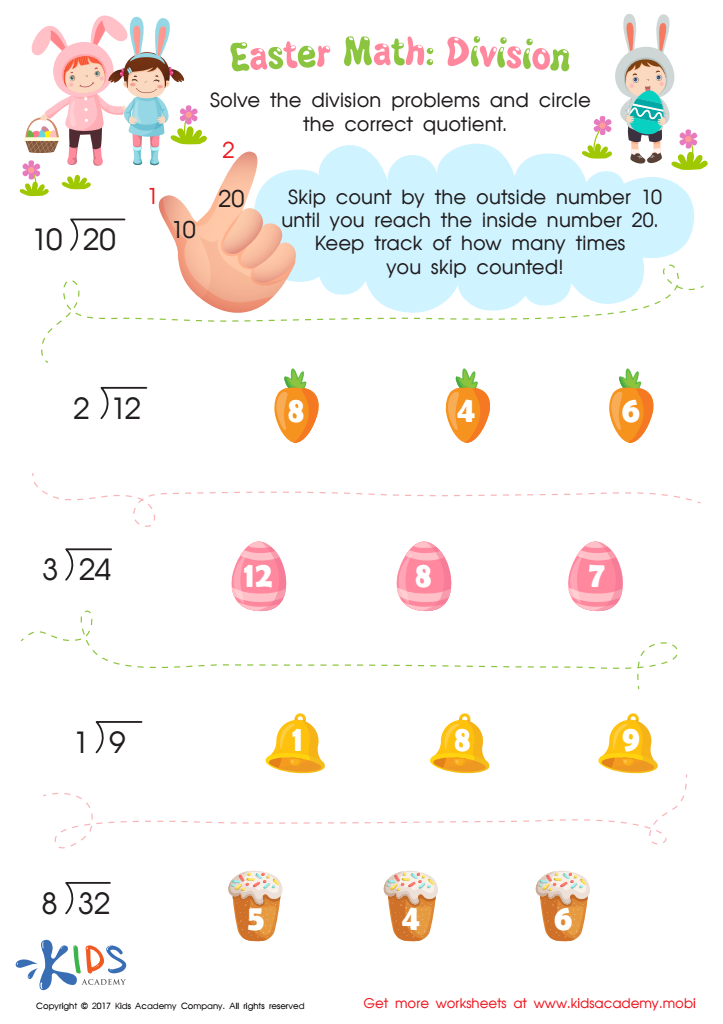
Division Worksheet
Try this Easter-themed PDF worksheet for grade 3: perfect for teaching division with a fun, new trick! It's full of bright, colorful pictures your child will love, and it's as easy as skip counting to solve the problems.
 Assign to My Students
Division Worksheet
Worksheet
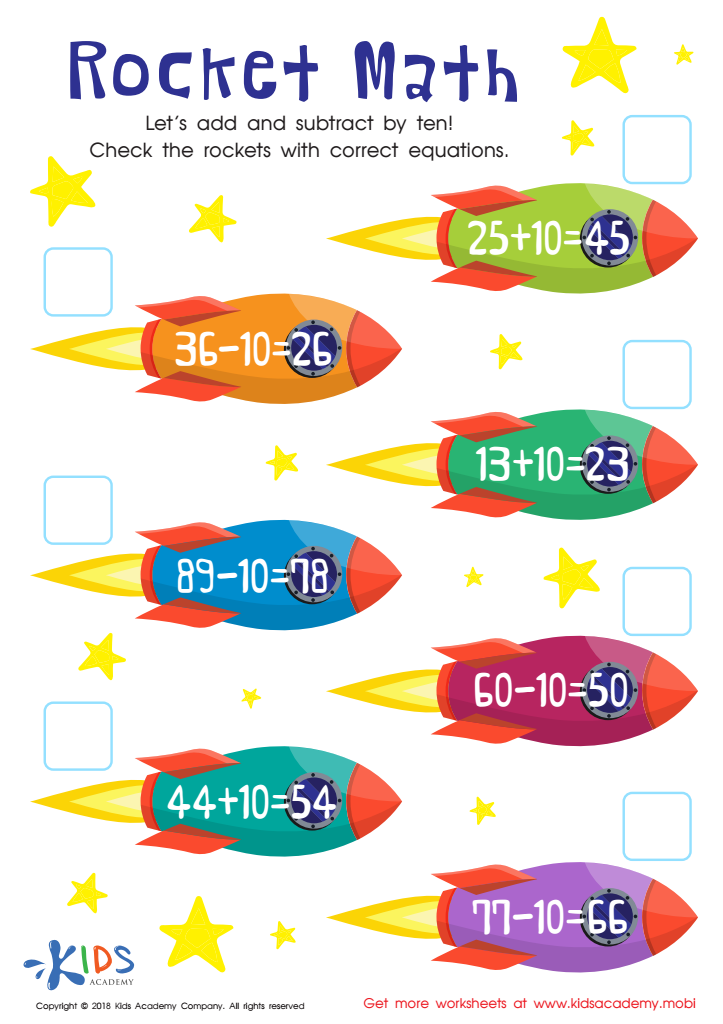
Rocket Math Worksheet
Your students will be math wizards in no time as they blast off on this exciting and colorful PDF worksheet. They'll use the 10s strategy to practice addition and subtraction, and they'll learn to skip count forwards and backwards. Keep them engaged and make learning fun!
Rocket Math Worksheet
Worksheet
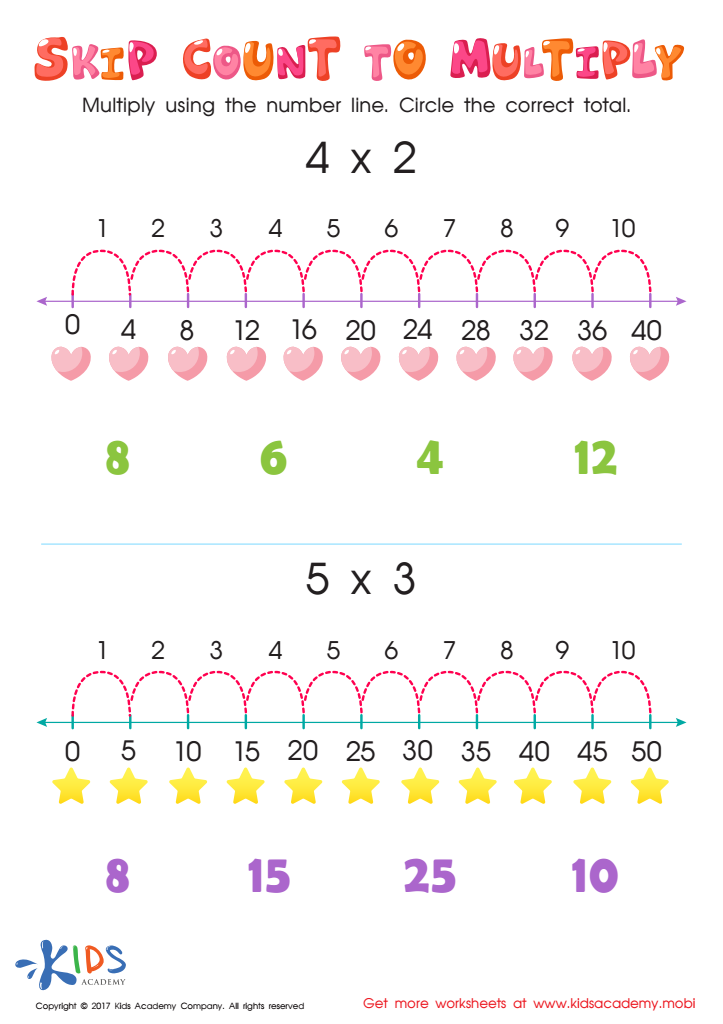
Skip Count Multiplication Worksheet
This colorful worksheet helps kids multiply by skip counting on a number line. Kids gain a better understanding of multiplication by seeing how the answer is calculated.
Skip Count Multiplication Worksheet
Worksheet
Join Kids Academy for Free
Who is primarily going to use this learning content?



%20(1).jpg)




Mathematical reasoning and skip counting are foundational skills crucial for children aged 6-9 as they pave the way for more advanced mathematical concepts. During this early developmental stage, children's minds are highly receptive, and solidifying these basic skills sets the stage for future academic success.
Skip counting, the practice of counting by numbers other than one (e.g., by twos, fives, or tens), helps kids grasp the structure of our number system. It enhances their understanding of numerical patterns and relationships, which are essential for arithmetic operations like addition, subtraction, multiplication, and division. For example, skip counting by tens makes the concept of multiples more intuitive and directly supports learning the multiplication table later on.
Moreover, engaging in mathematical reasoning helps develop critical thinking skills. When children make connections between numbers and understand why certain patterns occur, they are not just performing rote memorization but are actually learning to think logically and solve problems. This form of reasoning fosters independence and confidence in their ability to tackle new challenges both inside and outside the classroom.
Overall, prioritizing these skills turns abstract concepts into tangible understanding, enabling a smoother transition into higher-level mathematics and bolstering their overall cognitive development. Therefore, parents and teachers play a crucial role in creating a rich learning environment where mathematical reasoning and skip counting are valued and encouraged.








