
Logical thinking development Subtraction Worksheets for Ages 6-9
3 filtered results
Difficulty Level
Grade
Age
-
From - To
Subject
Activity
Standards
Our "Logical Thinking Development Subtraction Worksheets for Ages 6-9" offer an engaging way to enhance kids' math skills. Designed to challenge young minds, these printable worksheets focus on subtraction while promoting logical thinking and problem-solving abilities. Ideal for both classroom and home use, the exercises are carefully curated to suit children within this age group, progressively increasing in difficulty. Students will not only master subtraction but also improve cognitive abilities and critical thinking. Perfect for parents and teachers seeking quality educational resources, these worksheets make learning math fun and rewarding. Explore now and watch your child's confidence grow with every page!
Favorites
With answer key
Interactive
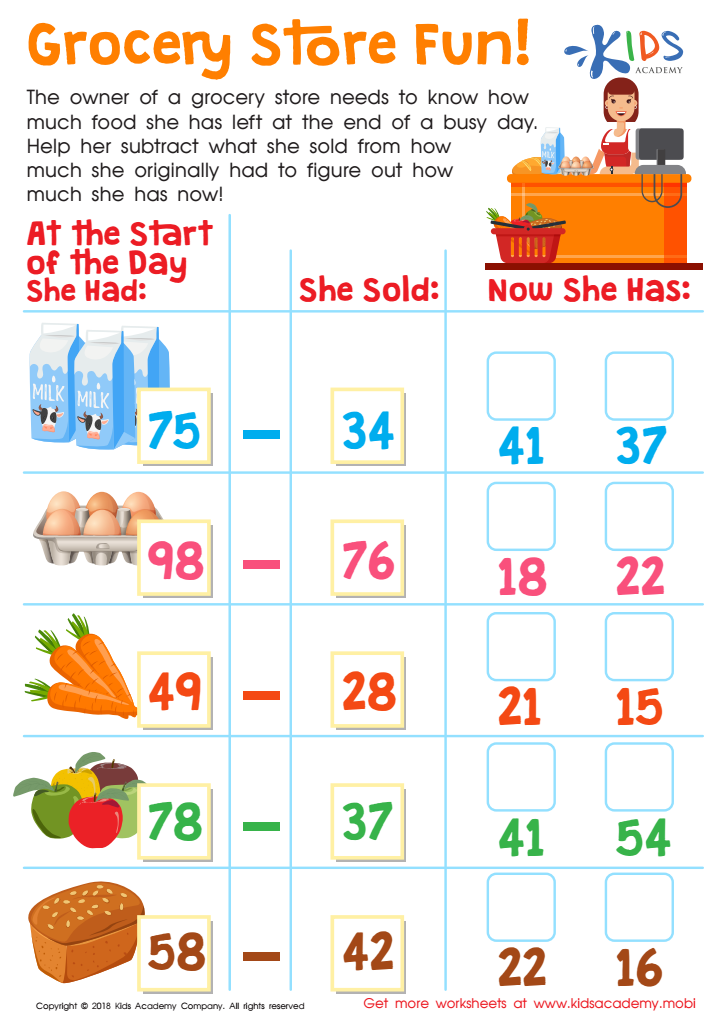
Grocery Store Fun! Worksheet
Let your kids have fun with this store worksheet. It requires them to help the owner by subtracting what she has sold from the original amount to figure out how much is left. Have them read and solve the equations in the printout to give the store owner the answer.
 Assign to My Students
Grocery Store Fun! Worksheet
Worksheet
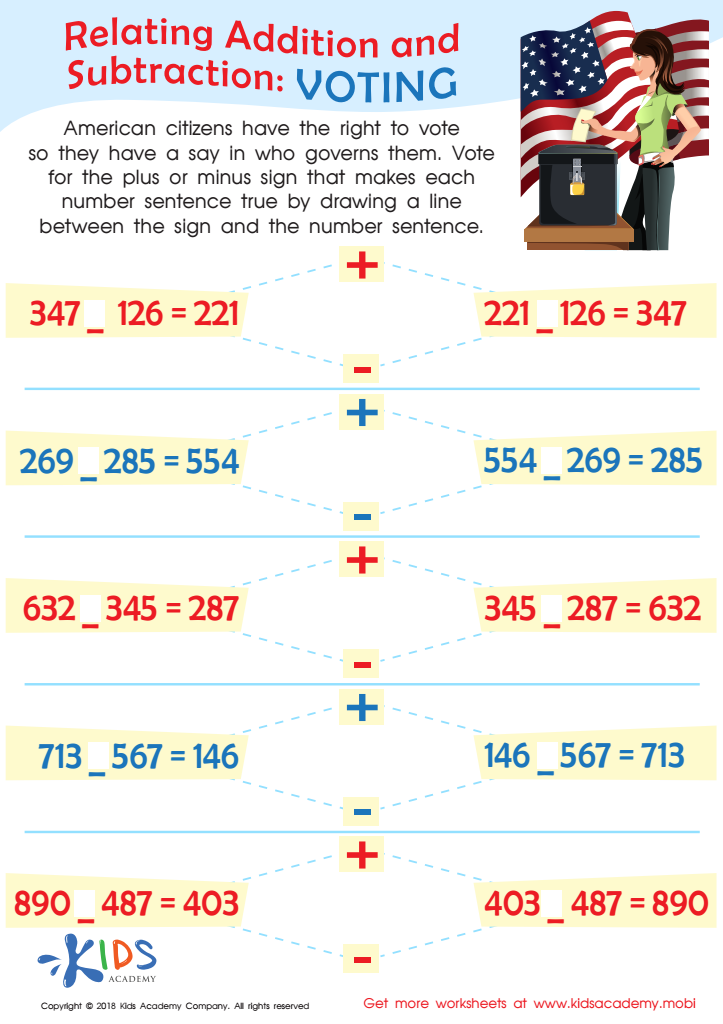
Voting Worksheet
This worksheet combines Social Studies and Math, teaching kids the democratic concept of voting. Guide learners to observe the problem, and decide if it needs a plus or minus. They "vote" for the correct answer by drawing a line from the problem to the correct operation symbol. Tally up the votes to check the answers!
Voting Worksheet
Worksheet
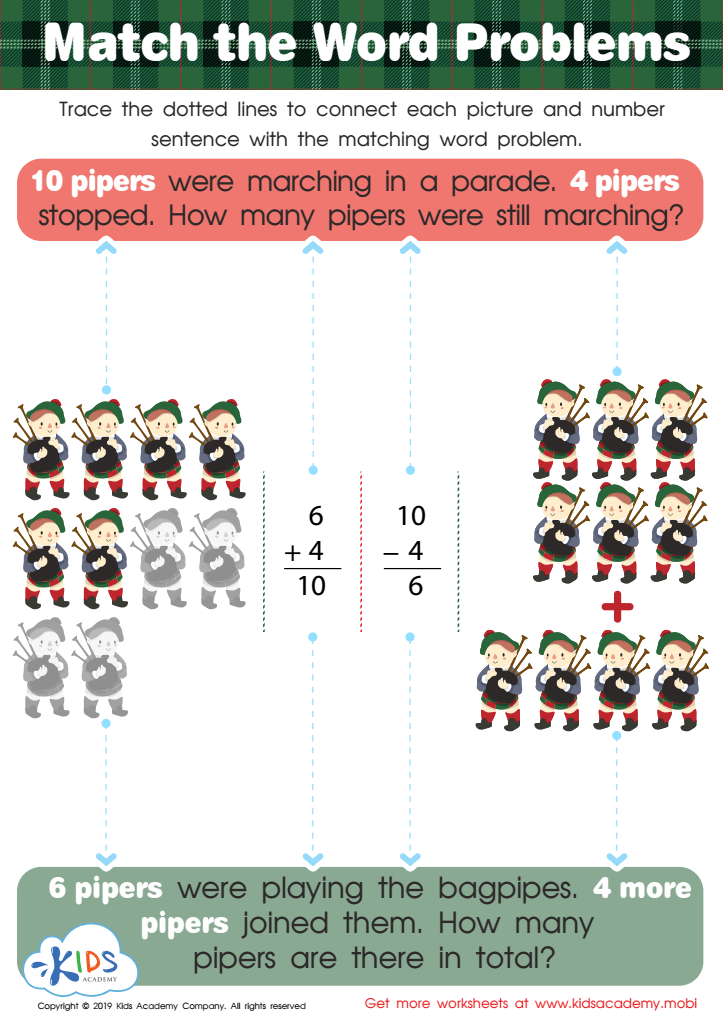
Match the Word Problems Worksheet
Read this word problem to your kids: Help them understand how it can be translated into a number problem. Trace the dotted lines to see how each picture and number sentence match the problem. With this worksheet, you can show your kids how easy it is to transform a word problem into a number problem.
Match the Word Problems Worksheet
Worksheet
Join Kids Academy for Free
Who is primarily going to use this learning content?








Parents and teachers should care deeply about the development of logical thinking and subtraction skills for children ages 6-9, as these foundational aspects significantly influence their overall cognitive and academic growth. Logical thinking enables children to reason systematically, solve problems effectively, and understand the relationship between various concepts. Subtraction, a fundamental arithmetic skill, is a critical component of early mathematics that not only enhances numerical proficiency but also helps in developing logical thinking.
When children practice subtraction, they engage in exercises that require them to make reasoned decisions, predict outcomes, and recognize patterns, all of which are key elements of logical thinking. For example, understanding how to borrow in subtraction involves a step-by-step process that strengthens sequential thinking and reinforces the importance of accuracy.
Moreover, strong subtraction skills are indispensable for future mathematical learning and everyday problem-solving. Subtraction is used in various real-life situations, such as making transactions, measuring differences, and evaluating options, making its understanding essential for practical life.
Supporting children in honing these skills between the ages of 6-9 establishes a solid foundation for more complex mathematical concepts and enhances their ability to think analytically. By focusing on this developmental period, parents and teachers contribute to fostering a child’s long-term success in academics and beyond.








