
Improve counting skills Building Vocabulary Worksheets for Ages 6-9
5 filtered results
Difficulty Level
Grade
Age
-
From - To
Subject
Activity
Standards
Boost your child's counting skills while expanding their vocabulary with our engaging "Improve Counting Skills Building Vocabulary Worksheets" designed for ages 6-9. These expertly crafted worksheets combine essential math practice with targeted vocabulary building to create an enriched learning experience. Through a variety of fun and challenging activities, young learners will enhance their number sense, develop critical thinking, and discover new words in meaningful contexts. Perfect for classroom use or at-home practice, these worksheets lay a strong foundation in both counting and language arts, ensuring your child's academic growth while keeping learning fun and interactive. 有 Explore now for interactive, educational adventures!
Favorites
With answer key
Interactive
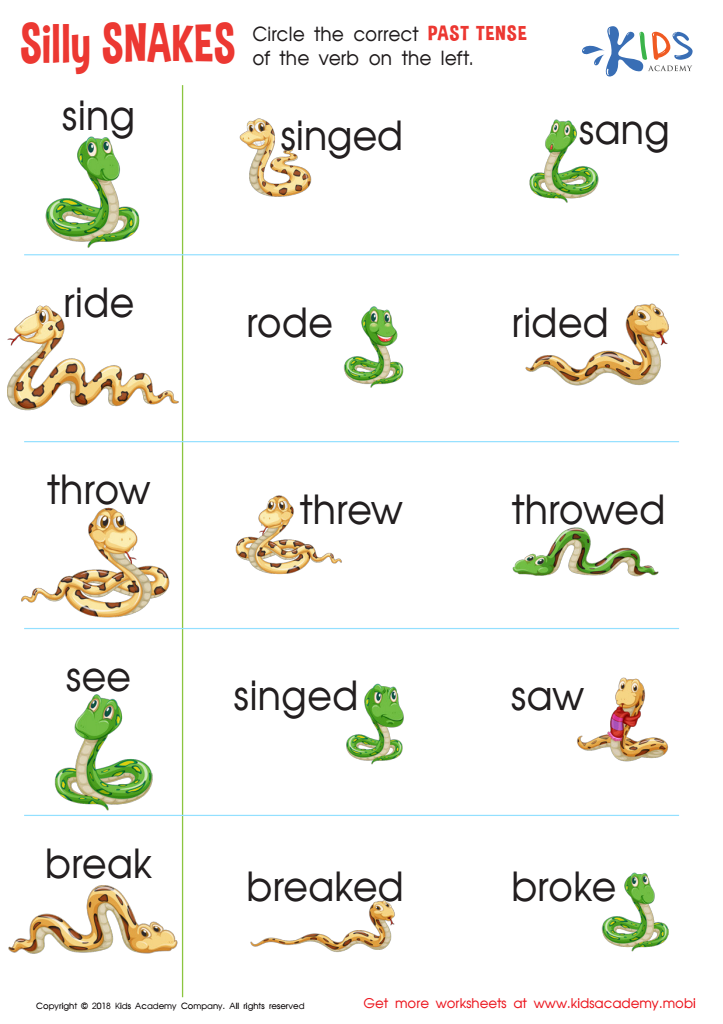
Silly Snakes Worksheet
Kids will get a giggle out of these silly snakes! They're helping to find past tense verbs in this fun worksheet. Have your child look at each snake in the left column and read the word. Then, choose the correct past tense verb from the two options in each row.
 Assign to My Students
Silly Snakes Worksheet
Worksheet











Join Kids Academy for Free
Who is primarily going to use this learning content?







.jpg)
At ages 6-9, children's brains are in a crucial developmental phase where foundational skills—both in mathematics and language—are established, creating a scaffold for future learning. Improving counting skills and building vocabulary are vital for several reasons:
For mathematics, solid counting skills provide a basis for virtually all later math concepts. At this age, children learn to recognize numbers, understand relationships between quantities, and perform basic arithmetic operations. Mastery of counting leads to improved problem-solving and logical reasoning abilities, which are essential life skills. Moreover, early proficiency in numeracy often correlates with higher academic achievement and confidence in tackling complex math problems later.
Building vocabulary is equally vital. A rich vocabulary boosts reading comprehension, which paves the way for academic success across all subjects. Children who possess a strong command of language can express themselves more clearly and confidently, whether in writing or speaking. Furthermore, a robust vocabulary enhances cognitive development, critical thinking, and social skills. Through an expansive vocabulary, children also gain a deeper understanding of the world around them and are better prepared to engage in more sophisticated learning.
In summary, actively engaging in improving counting skills and building vocabulary at an early age can exponentially enrich a child's cognitive abilities, academic performance, and overall personal growth, setting them on a positive trajectory for future success.








