
Hand-eye Coordination Cursive Letters Worksheets for Ages 6-9
6 filtered results
Difficulty Level
Grade
Age
-
From - To
Subject
Activity
Standards
Enhance your child’s writing skills with our "Hand-eye Coordination Cursive Letters Worksheets for Ages 6-9." These expertly designed worksheets help build strong hand-eye coordination, an essential skill for mastering cursive writing. Through engaging exercises, children will practice forming elegant cursive letters while refining their fine motor abilities. Ideal for young learners aged 6-9, these worksheets offer a fun and interactive way to boost confidence in writing and other daily tasks. Whether for classroom use or at-home learning, our printable sheets support your child’s journey toward becoming a proficient and neat writer. Download now to get started!
Favorites
With answer key
Interactive
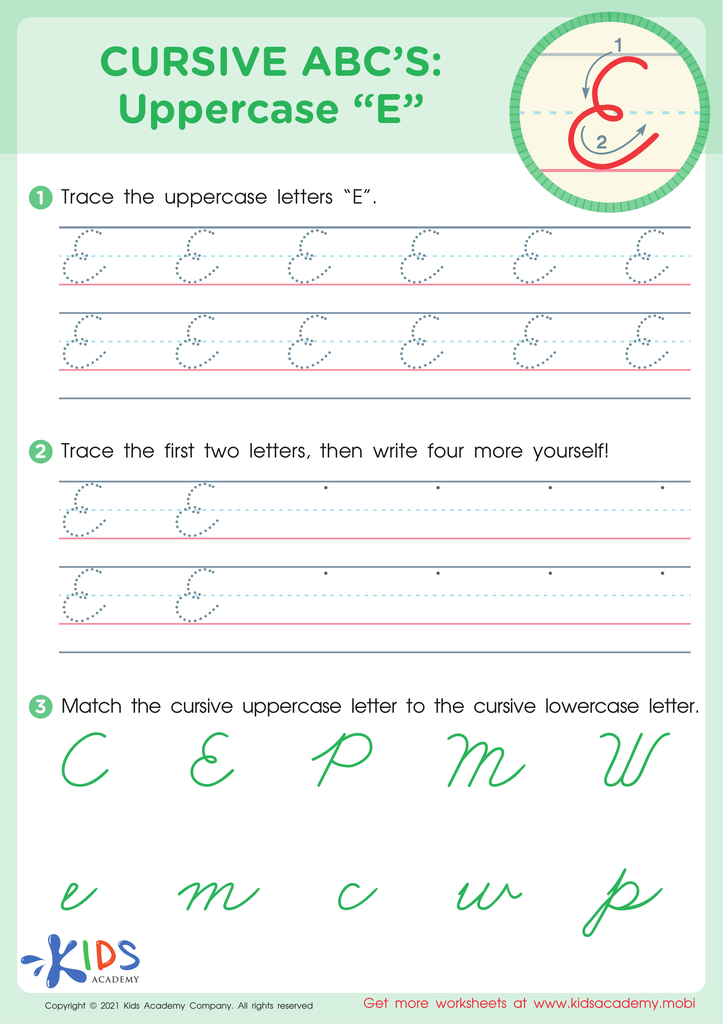
Cursive ABCs: Uppercase E
Ask your child if they can identify the letter 'E' and give examples. Each letter is unique, so provide coaching. Have them trace cursive 'E' to become familiar and boost confidence. Then, ask them to write it on their own.
Cursive ABCs: Uppercase E
Worksheet
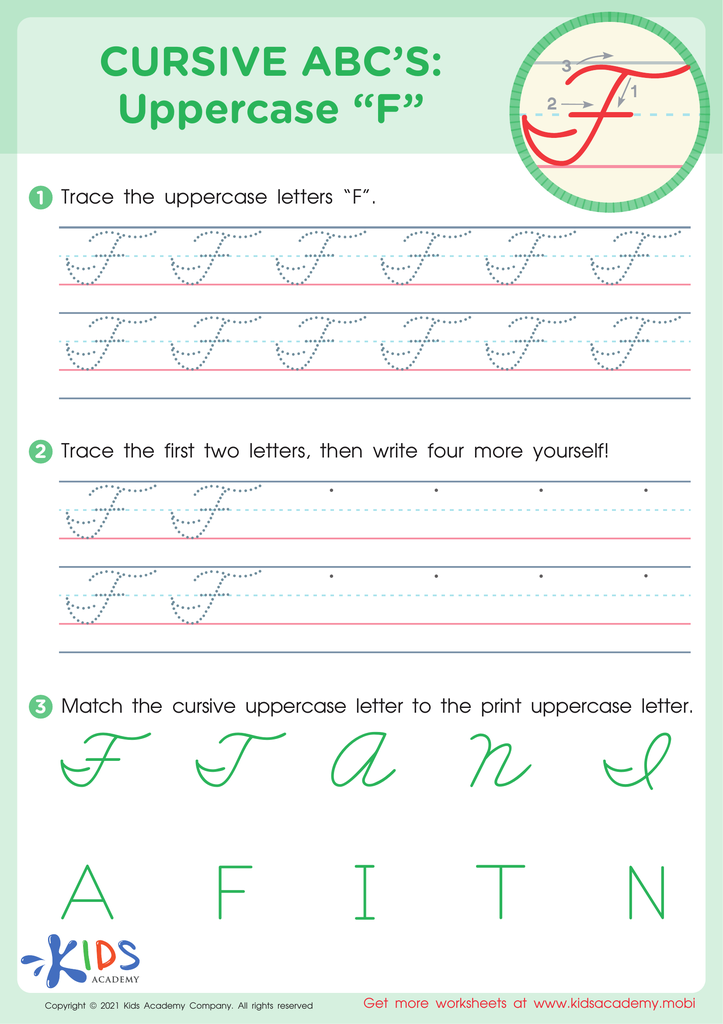
Cursive ABCs: Uppercase F
Help your kids trace the letters in these worksheets and watch their confidence grow as they learn to write cursive uppercase and lowercase letters. Ask them to identify the letters in words and give examples of words that start with an uppercase 'F', then have them write some letters on their own and assess their progress.
Cursive ABCs: Uppercase F
Worksheet
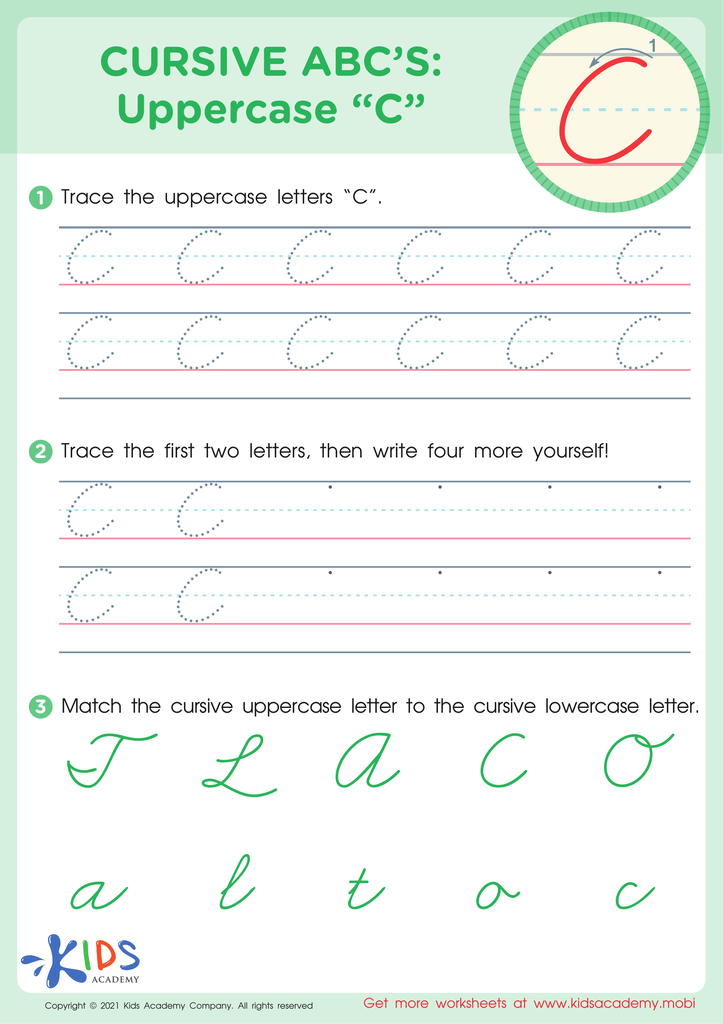
Cursive ABCs: Uppercase C
These worksheets are perfect for those wanting to improve their handwriting or learn letter recognition. The tracing exercises help younger students sharpen their writing skills and teach how to write the 'C' in cursive. First, they trace the given examples and then practice writing it solo. A letter recognition test is at the bottom of the page to check progress.
Cursive ABCs: Uppercase C
Worksheet
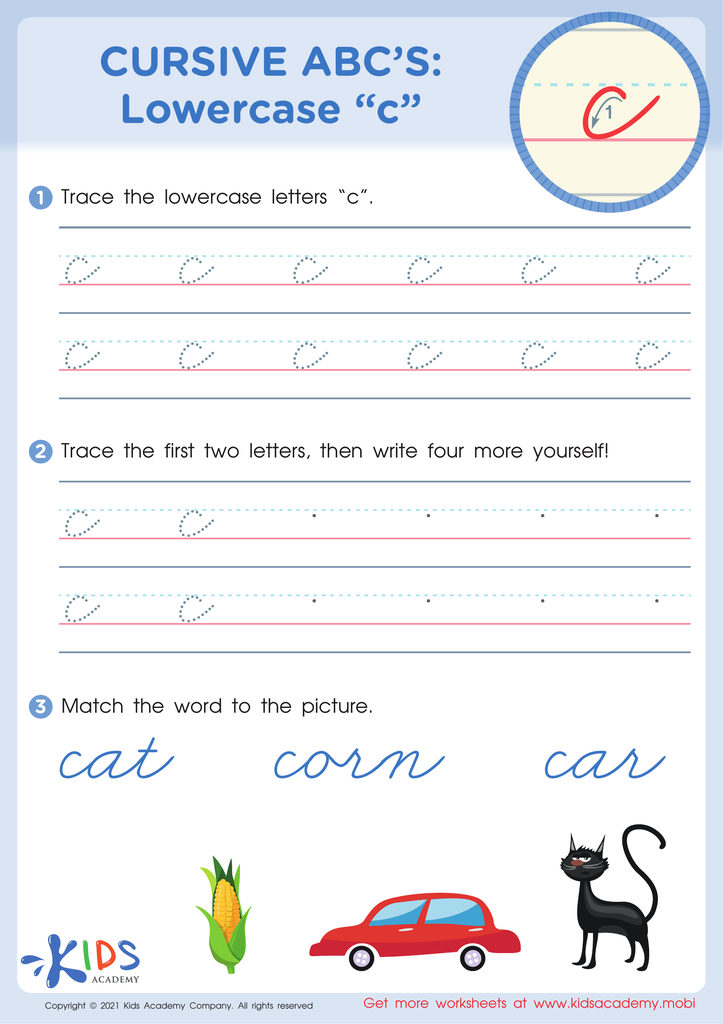
Cursive ABCs: Lowercase c
Once your child has successfully printed their letters, help them learn to recognize and write the alphabet in cursive. Struggling? This worksheet is perfect to assist them. Writing is an essential skill for kids to learn, so do all you can to help them. Use these tracing worksheets and guide them as they write the lowercase letter 'c' in cursive.
Cursive ABCs: Lowercase c
Worksheet
Cursive ABCs: Lowercase h
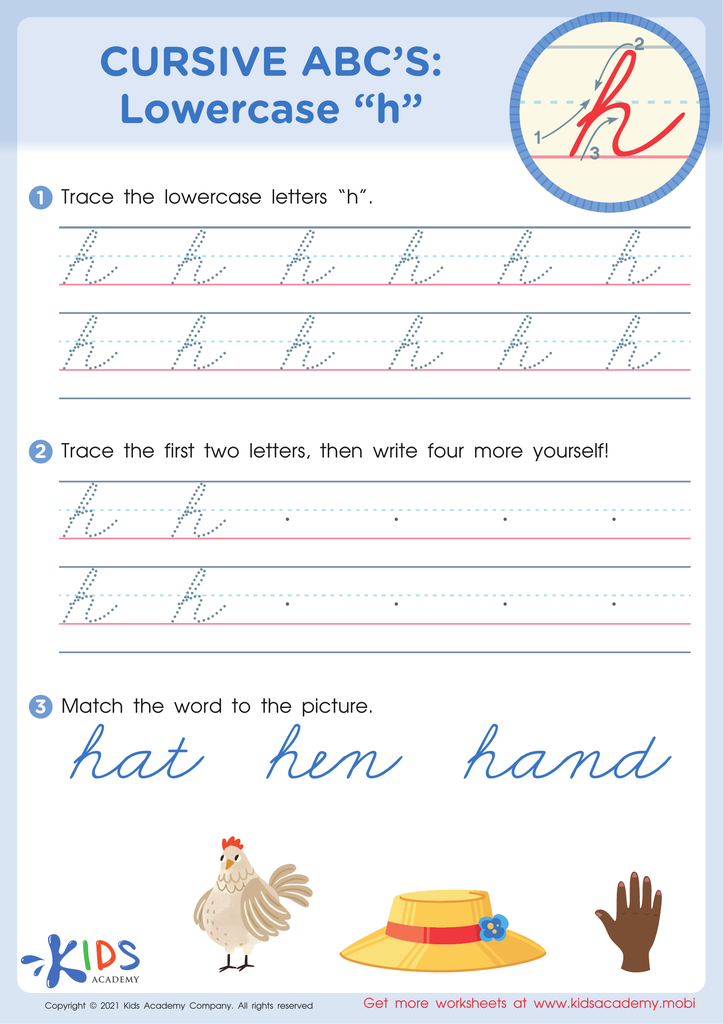
Your children will need more than just reciting the alphabet; they need to learn how to identify and write it. Cursive writing helps with neatness, and these tracing worksheets are great learning aids and offer exercises to practice writing lowercase 'h'. With these, your children get better writing skills and learn new words.
Cursive ABCs: Lowercase h
Worksheet
Cursive ABCs: Uppercase H
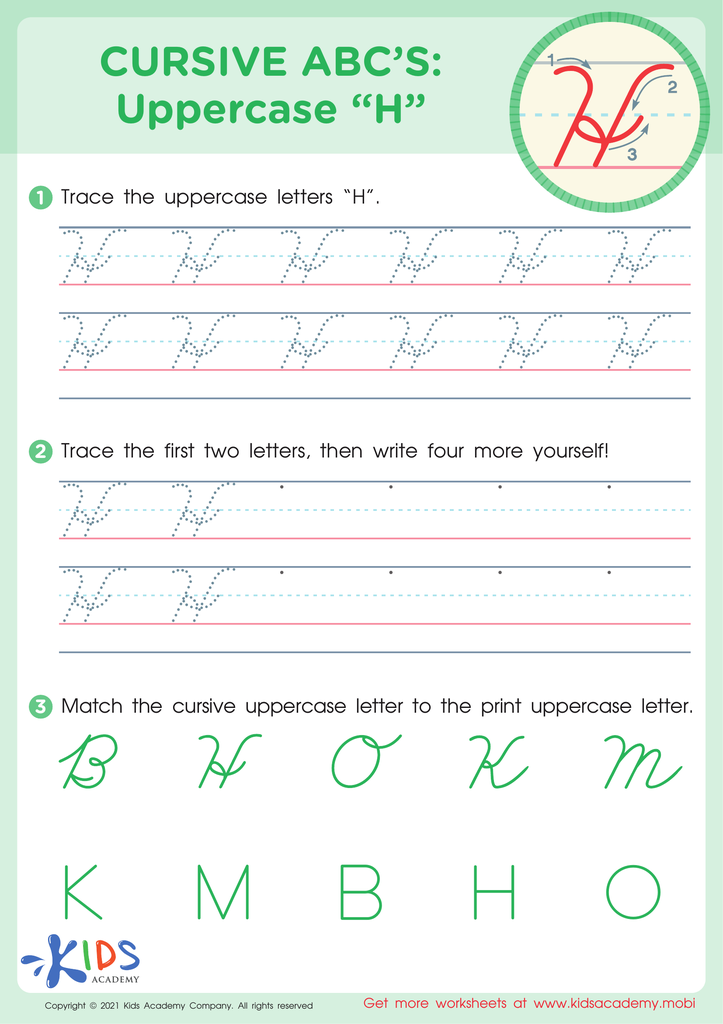
Have your child recite the alphabet and give you words beginning with H. This tracing sheet is perfect to help them improve their handwriting. Guide their hands as they trace the uppercase H, then have them practise writing it alone. At the bottom is an exercise to check their letter recognition.
Cursive ABCs: Uppercase H
Worksheet
Join Kids Academy for Free
Who is primarily going to use this learning content?







Hand-eye coordination is crucial in early childhood development, especially for children aged 6-9, as it forms the basis for many essential life skills. When parents and teachers focus on hand-eye coordination through cursive letter practice, they are fostering a variety of developmental benefits.
Firstly, developing hand-eye coordination facilitates fine motor skills, allowing children to perform everyday tasks more efficiently, such as using scissors, tying shoelaces, and of course, writing legibly. Cursive writing involves continuous fluid motion, which enhances dexterity and muscle memory in their hands and fingers.
Secondly, the process of learning cursive helps improve children's focus and concentration. Cursive writing demands attention to detail and persistence, thereby encouraging a stronger work ethic and better academic performance.
Moreover, engaging in cursive writing can enhance cognitive development. It connects language comprehension with physical movement, laying down neural pathways that further reading, spelling, and overall literacy skills.
Additionally, cursive writing promotes visual-motor integration. Identifying patterns in the letters and replicating them with precision improves a child’s ability to coordinate visual input with motor actions, critical for activities combining sight and movement like sports and playing musical instruments.
In summary, prioritizing hand-eye coordination through cursive letter practice provides children with critical developmental advantages that lay a strong foundation for future academic and personal success.







