
Differentiating push/pull Worksheets for 6-Year-Olds
3 filtered results
Difficulty Level
Grade
Age
-
From - To
Subject
Activity
Standards
Discover our engaging and educational push/pull worksheets designed specifically for 6-year-olds! These printable activities are perfect for helping young learners grasp the fundamental concepts of force and motion. Through interactive exercises, kids will learn to identify and differentiate between pushing and pulling actions in everyday scenarios. Our worksheets are crafted to make learning fun, reinforcing critical thinking and problem-solving skills. Ideal for both classroom use and at-home learning, these resources will give your child a solid foundation in understanding basic physics principles. Explore today and watch your child thrive with Kids Academy’s thoughtfully designed activities!
Favorites
With answer key
Interactive
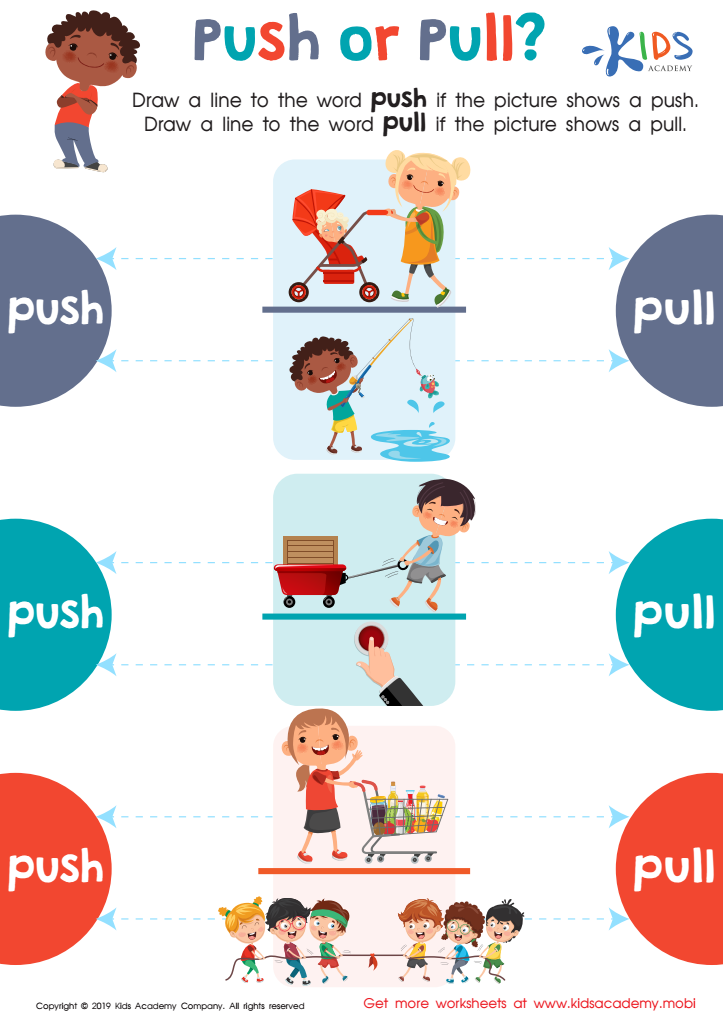
Push or Pull? Worksheet
Young kids may struggle to differentiate push and pull. When they start writing, they may use them interchangeably and wrongly. This worksheet clarifies the concepts: pushing means moving something away, pulling means bringing something closer. It provides pictures and traceable lines for kids to connect each image to the correct word. This helps them understand and remember the difference for future writing and reading.
 Assign to My Students
Push or Pull? Worksheet
Worksheet
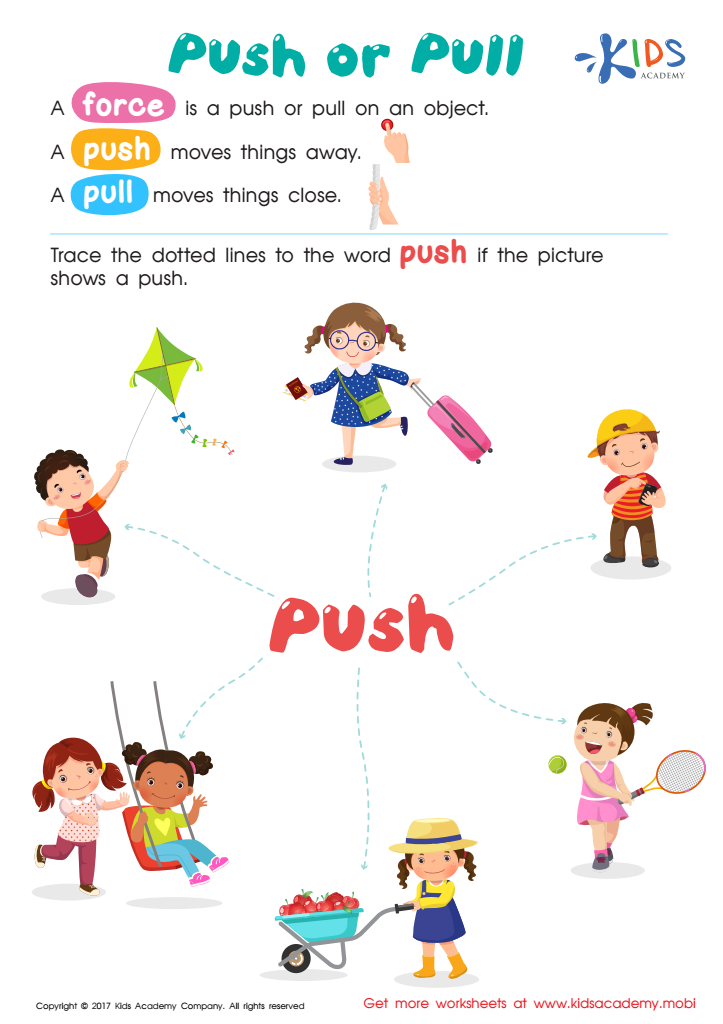
Push or Pull Worksheet
and which involve pulling! With this fun worksheet, your child will learn about force and its simple application in everyday activities. Get them started with Push or Pull! (80 words)
Push or Pull Worksheet
Worksheet
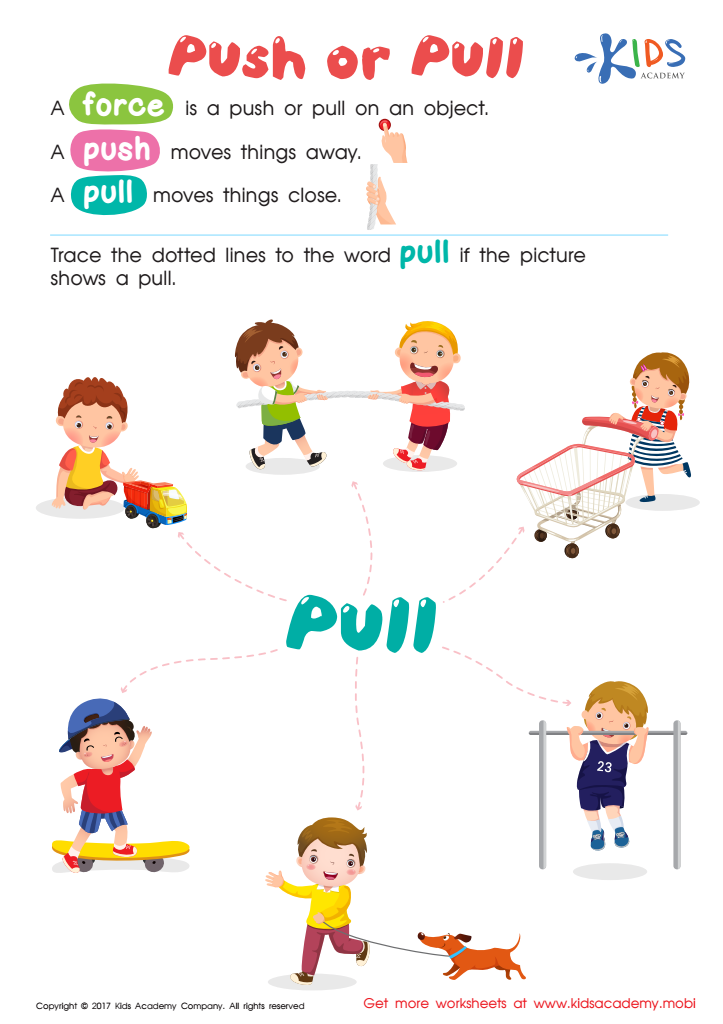
Pull or Push Worksheet
With this fun worksheet, they'll explore physics by sorting objects into categories according to their mode of motion. It's a great way to get them interested in science.
Pull or Push Worksheet
Worksheet
Join Kids Academy for Free
Who is primarily going to use this learning content?






Differentiating between push and pull concepts is fundamental for the cognitive and physical development of 6-year-olds. At this age, children are naturally curious about the world and how it works. Teaching them about push and pull helps lay the groundwork for understanding basic physics, promoting logical thinking and problem-solving skills. When kids grasp these concepts, they're better able to understand more complex scientific principles later on.
Moreover, differentiating between push and pull aids in refining motor skills. Activities that involve pushing or pulling can improve hand-eye coordination and overall physical dexterity. For instance, pushing a swing or pulling a wagon introduces children to the cause-and-effect relationship in a tangible way.
Incorporating these concepts in early education nurtures a love for learning by making science hands-on and engaging. This aligns with the holistic goal of education, which is to stimulate intellectual interest and practical understanding from a young age.
Additionally, knowledge of push and pull can reinforce language and vocabulary skills. Using specific terms accurately fosters communication abilities, enabling children to express their observations and experiences more precisely.
Overall, focusing on push and pull in early education enriches the child's developmental journey, preparing them for lifelong learning and curiosity.








