
Understanding number relationships Worksheets for 6-Year-Olds
3 filtered results
Difficulty Level
Grade
Age
-
From - To
Subject
Activity
Standards
Discover engaging "Understanding Number Relationships Worksheets for 6-Year-Olds" at Kids Academy! Designed for young learners, these worksheets help children grasp fundamental math concepts through interactive activities. Children will develop essential skills, such as counting, identifying patterns, and comparing numbers, making math enjoyable and educational. With colorful visuals and captivating exercises, these resources offer a comprehensive approach to understanding number relationships. Perfect for classroom or home use, our worksheets are crafted to support early math proficiency and instill a lifelong love for learning. Equip your child with the mathematical tools they need for future success. Explore now and make learning an adventure!
Favorites
With answer key
Interactive
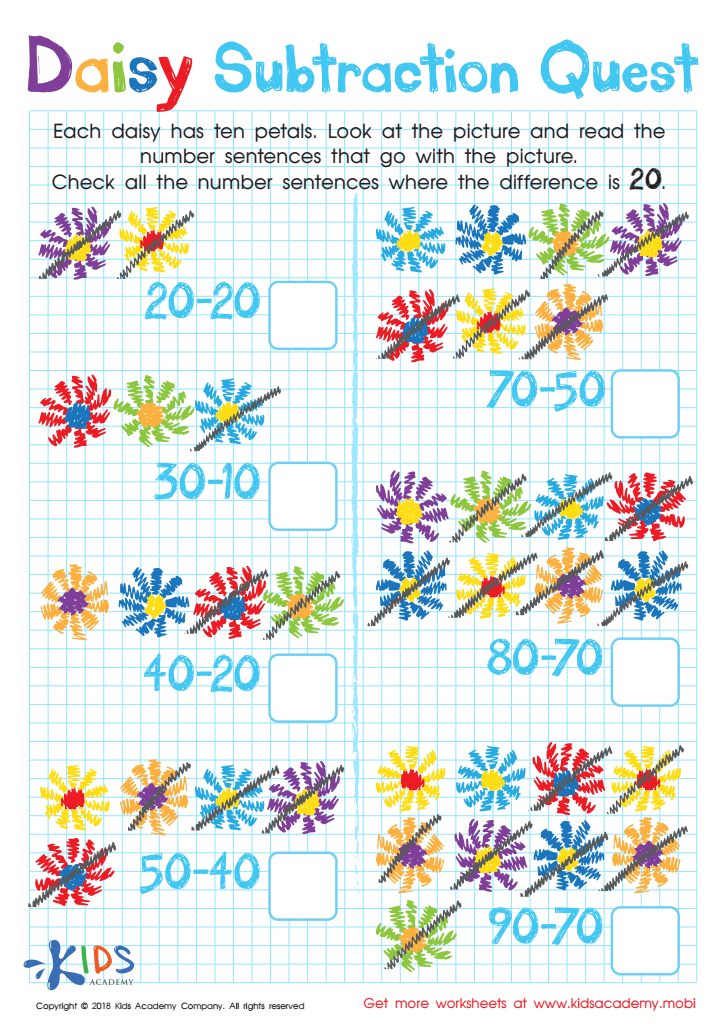
Daisy Subtraction Quest Worksheet
Ohh-la-la! These daisies are something special! With ten petals each, they're perfect for helping little math learners use tens to find number sentences that differ by 20. Our free worksheet is full of bright colors to engage and easy questions to strengthen math automaticity and confidence.
 Assign to My Students
Daisy Subtraction Quest Worksheet
Worksheet
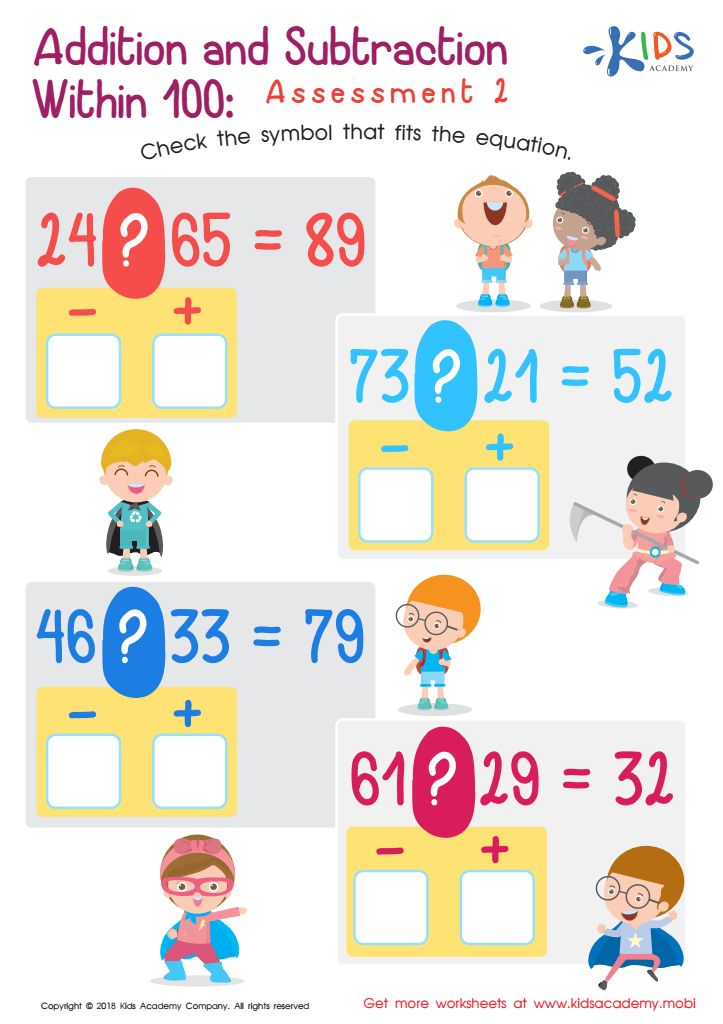
Addition and Subtraction Within 1: Assessment 2 Worksheet
This worksheet is a great tool to help your students learn addition and subtraction. It contains four equations in a printable pdf. Ask your students to review the equation and determine if the symbol between them is a '+' or '-'. Guide them in selecting the correct symbols for each equation.
Addition and Subtraction Within 1: Assessment 2 Worksheet
Worksheet
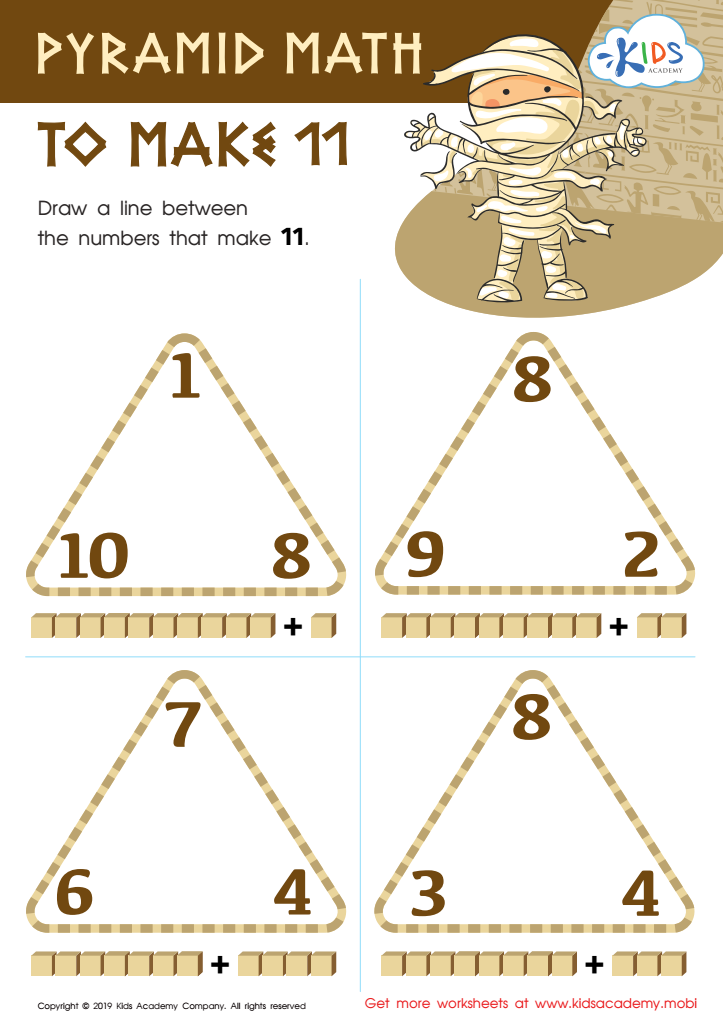
Pyramid Math to Make 11 Worksheet
Have your kids look at the picture of the Egyptian pyramids and tell you what they see. Then, help them do simple math by adding up the numbers in the pyramids and connecting those that make 11. This worksheet is perfect for teaching your kids about history, mathematics, and problem-solving.
Pyramid Math to Make 11 Worksheet
Worksheet
Join Kids Academy for Free
Who is primarily going to use this learning content?








Understanding number relationships is crucial for 6-year-olds because it lays the foundation for future math proficiency. At this age, children are in a critical period of cognitive development, and grasping basic number relationships enhances their ability to think logically and solve problems. When children comprehend how numbers relate to one another, such as through concepts like greater than, less than, addition, and subtraction, they are developing essential skills that will help them in more complex math tasks later on.
Parents and teachers play a vital role in nurturing this understanding by providing experiences that make learning engaging and meaningful. Activities that involve counting objects, playing with number lines, or using manipulatives like blocks and coins can transform abstract concepts into tangible learning experiences. This hands-on approach helps young children internalize these ideas, making the transition to more abstract arithmetic smoother.
Moreover, early number sense is linked to success in a wide array of academic subjects and practical life skills. For instance, understanding the relationship between numbers aids in day-to-day tasks such as measuring ingredients while cooking or managing time during activities. Fostering this understanding not only supports academic growth but also boosts a child’s confidence and enthusiasm in learning, promoting a positive attitude toward education as a whole.








