
Analyzing patterns Worksheets for Ages 7-8
3 filtered results
Difficulty Level
Grade
Age
-
From - To
Subject
Activity
Standards
Discover engaging and educational "Analyzing Patterns Worksheets" designed specifically for ages 7-8. These worksheets help young learners identify, create, and analyze patterns across various contexts, enhancing their critical thinking and problem-solving skills. With a variety of fun exercises, your child will explore visual, numerical, and auditory patterns while boosting their cognitive development. Ideal for home or classroom use, these worksheets empower children to recognize relationships and sequences, laying the foundation for advanced mathematical concepts. Free downloadable resources are available, making it easy to incorporate pattern analysis into your teaching routine. Support your child's learning journey today with our interactive worksheets!
Favorites
With answer key
Interactive
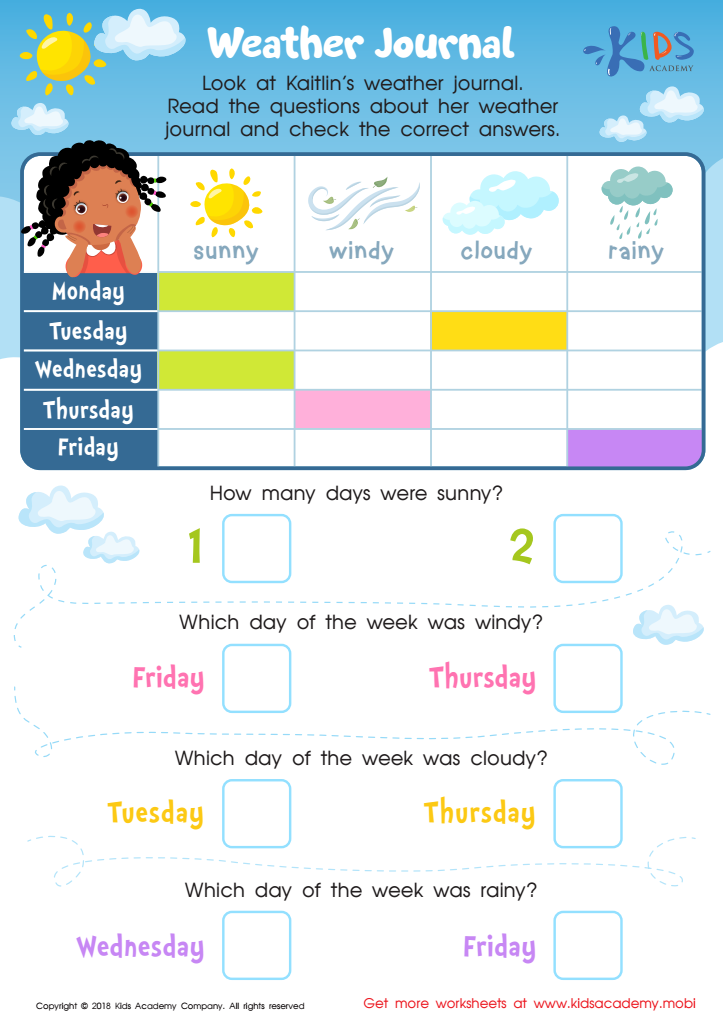
Weather Journal Worksheet
Kaitlin keeps a weather journal. Encourage your child to do the same! Look at Kaitlin's journal with them, and have them note the weather for each day. Read aloud the questions and check the correct answers.
 Assign to My Students
Weather Journal Worksheet
Worksheet
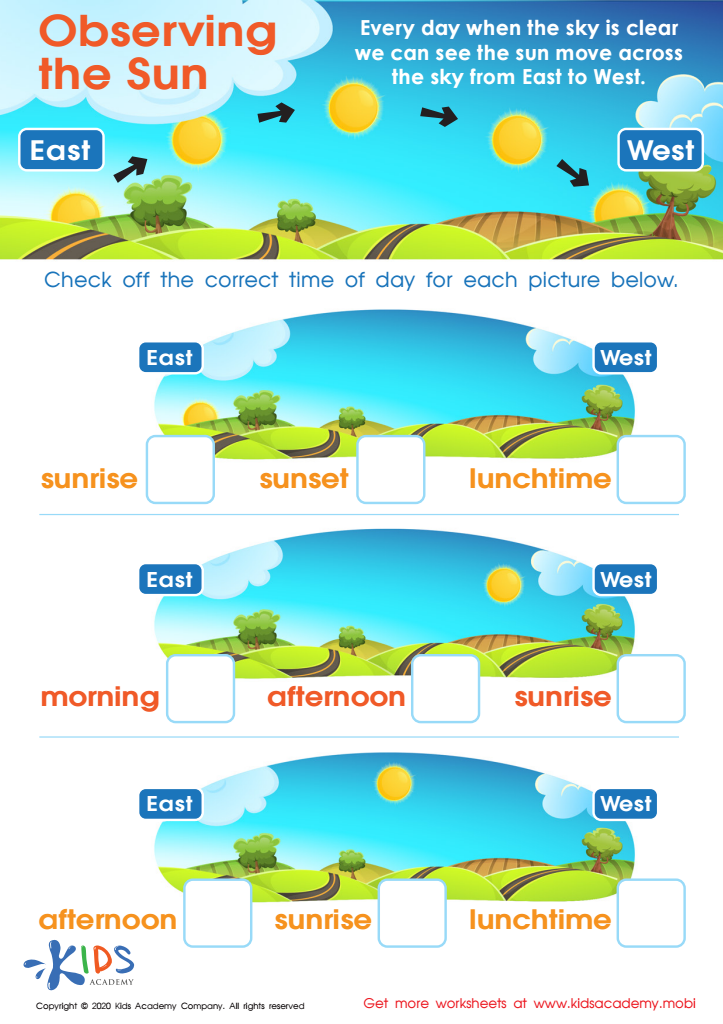
Observing the Sun Worksheet
Observe the image of the sun's progression with your child and use it to complete this free printable worksheet from Kids Academy. Have your kid look at the pictures on the left and check off the numbers in the correct order from sunrise to sunset! This will expand their science knowledge and help them understand when it's time to rise, reach its highest point during midday and set again in the West.
Observing the Sun Worksheet
Worksheet
Join Kids Academy for Free
Who is primarily going to use this learning content?








Analyzing patterns is a fundamental skill that plays a crucial role in the cognitive development of children aged 7-8. At this age, children are transitioning into more complex mathematical concepts and critical thinking abilities. Understanding patterns helps them recognize relationships and sequences, enhancing their problem-solving skills.
Parents and teachers should prioritize teaching pattern analysis because it lays the groundwork for future mathematical learning. Identifying and extending patterns fosters logical reasoning and mathematical thinking, encouraging children to predict outcomes, which is vital in subjects like math and science. Furthermore, recognizing patterns is not limited to mathematics; it also applies to reading, where children can make predictions about texts based on recurring themes and structures.
Additionally, analyzing patterns promotes engagement and participation in learning. It encourages curiosity as children explore and create their own patterns in art, music, and everyday activities. This exploration cultivates a love for learning and encourages collaborative work, as children often share and build on each other's ideas. Ultimately, when parents and teachers emphasize analyzing patterns, they are equipping children with essential skills for academic success and everyday problem-solving, supporting their overall development.








