Understanding Rhymes Worksheets for Ages 7-8
3 filtered results
-
From - To
Discover our "Understanding Rhymes Worksheets for Ages 7-8," designed to enhance children's phonemic awareness and reading fluency. These engaging worksheets promote creativity while helping young learners recognize rhyming patterns and sounds. Perfectly tailored for 2nd-grade students, each exercise combines fun illustrations with educational activities to make learning enjoyable and effective. Our worksheets support literacy development and encourage a love of reading by offering diverse, age-appropriate content. Ideal for both classroom use and at-home practice, these resources help solidify foundational language skills in a playful, interactive manner. Unlock your child's potential with our expertly crafted rhyme worksheets!
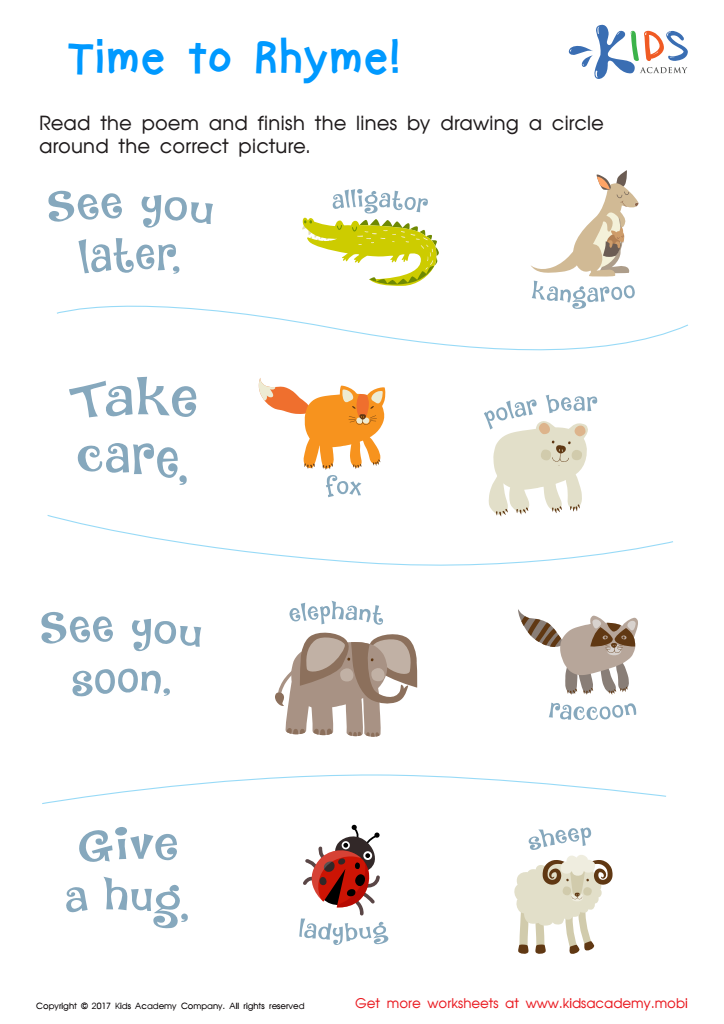
Time to Rhyme Rhyming Worksheet
 Assign to My Students
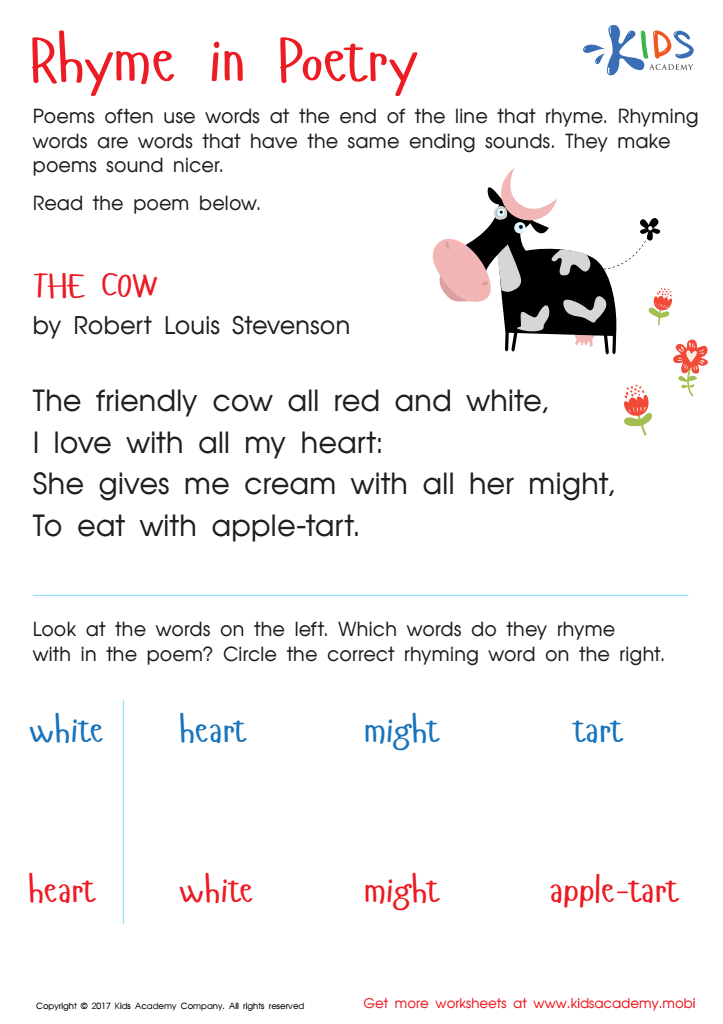
Rhyme In Poetry Worksheet








Understanding rhymes is crucial for children aged 7-8 as it significantly contributes to their literacy development. At this formative age, phonemic awareness, the ability to recognize and manipulate the sounds within words, is essential for reading and writing success. Rhyming exercises enhance children's understanding of sound patterns, making it easier for them to decode written words accurately. This not only helps in reading fluency but also in spelling.
Moreover, rhymes enrich vocabulary as children engage with new words in a memorable context. They also foster memorization skills—key for retaining information across subjects. Rhyming stories, poems, and songs are engaging, nurturing a love for language that can stimulate a lifelong interest in reading.
Rhymes also bridge phonological and auditory skills. Listening to and producing rhyming words require children to distinguish subtle sound differences, honing their listening abilities essential for effective communication. These activities can also be a confidence booster, making learning seem less intimidating and more playful, thus reducing children’s anxieties around reading.
Lastly, understanding rhymes has a social component; reading and reciting rhymes in a group or classroom setting encourages collaborative learning and improves social interaction skills. Rhymes are not mere fun—they are fundamental building blocks in a child’s literacy journey.








