Recognizing Patterns Adding 2-digit Numbers Worksheets for Ages 7-8
3 filtered results
-
From - To
Discover the fun and engaging "Recognizing Patterns Adding 2-digit Numbers Worksheets" for children aged 7-8. These printable worksheets are designed to help young learners build critical math skills by identifying and understanding patterns in addition. By working through structured exercises, kids will strengthen their ability to recognize numerical sequences, enhance their problem-solving abilities, and gain confidence in adding 2-digit numbers. Perfect for classroom use or at-home practice, these worksheets offer a practical and enjoyable approach to mastering essential math concepts. Boost your child’s math proficiency and pattern recognition with these expertly crafted resources!
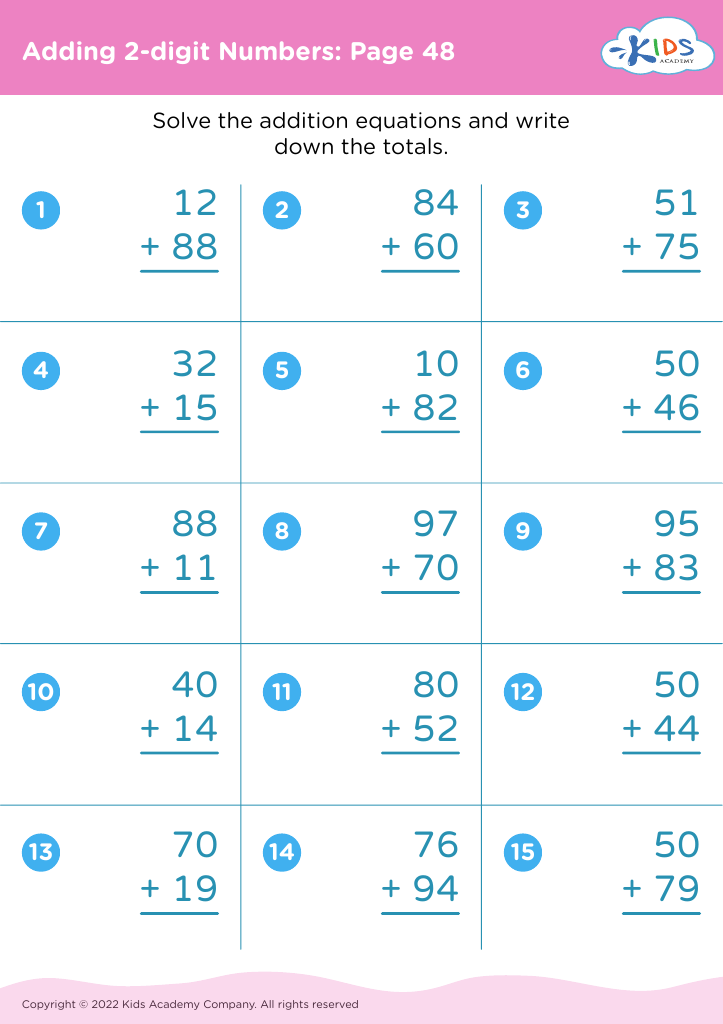
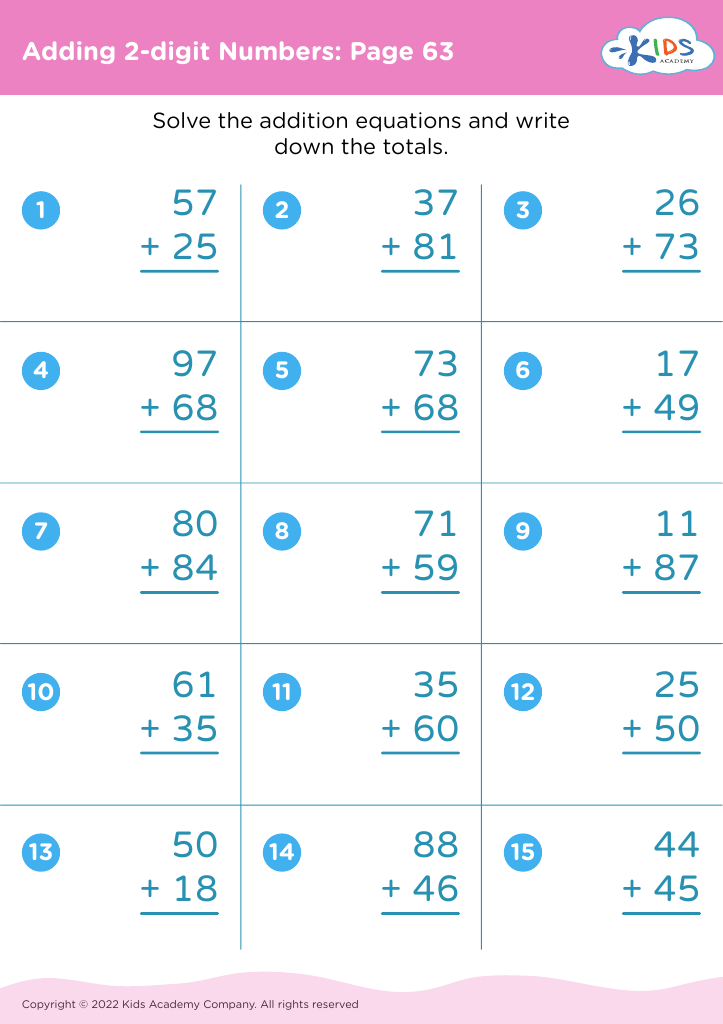
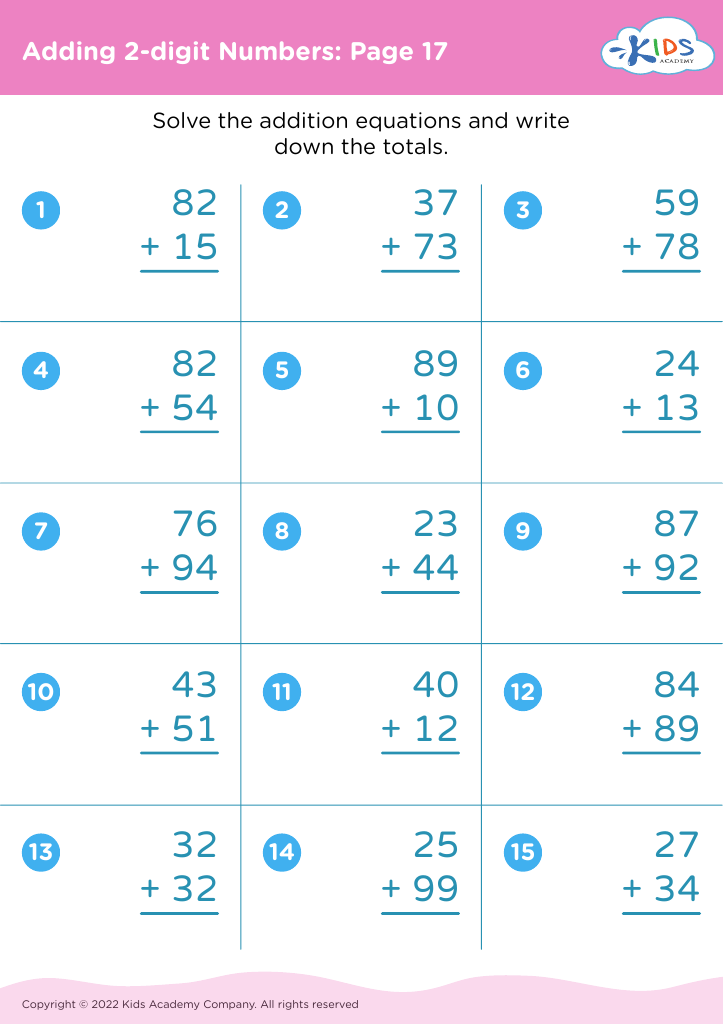








Recognizing patterns while adding 2-digit numbers is crucial for children ages 7-8 as it lays the foundation for higher-level math skills and logical thinking. At this critical stage, children transition from basic arithmetic to more complex operations, and spotting patterns helps them understand mathematics more deeply.
When children recognize patterns in adding 2-digit numbers, they develop number sense, ensuring they comprehend how numbers work rather than just memorizing facts. It fosters mental math abilities, reducing dependence on calculators and written computations. For instance, spotting that 23 + 34 is the same as 20 + 30 and 3 + 4 simplifies their thinking and boosts confidence.
Patterns also promote problem-solving skills, enabling children to approach math tasks systematically, identify shortcuts, and enjoy mathematics. This engagement is vital for cultivating a positive attitude towards math, reducing anxiety, and increasing perseverance.
Moreover, early exposure to discovering and understanding patterns is a precursor to algebra and geometry. It helps children grasp the notion of relationships between numbers, preparing them for future academic success.
Parents and teachers observing and encouraging this essential skill not only support children's mathematical growth but also enhance cognitive skills like concentration, memory, and analytical thinking, all of which are essential across academic disciplines and in daily life.








