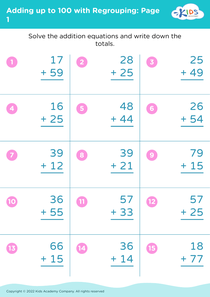
Mathematical reasoning Adding up to 100 Without Regrouping Worksheets for Ages 7-8
3 filtered results
-
From - To
Our "Mathematical Reasoning: Adding up to 100 Without Regrouping Worksheets" are designed for children aged 7-8. These engaging worksheets help young learners enhance their math skills by focusing on addition problems within 100 that do not require regrouping. Through thoughtful exercises crafted to boost computational fluency and logical thinking, kids practice addition in a structured yet fun manner. The worksheets aim to build a strong foundation in mathematical reasoning, leading to greater confidence in handling more complex math tasks in the future. Ideal for classroom activities or extra practice at home, they offer clear, step-by-step problems that make learning enjoyable.
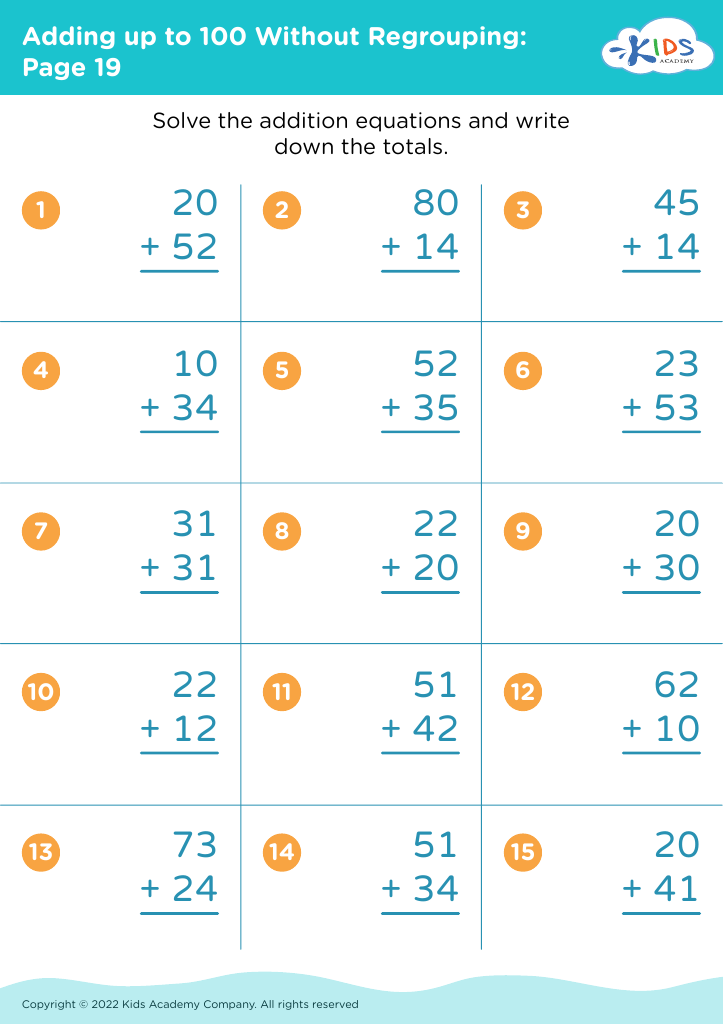
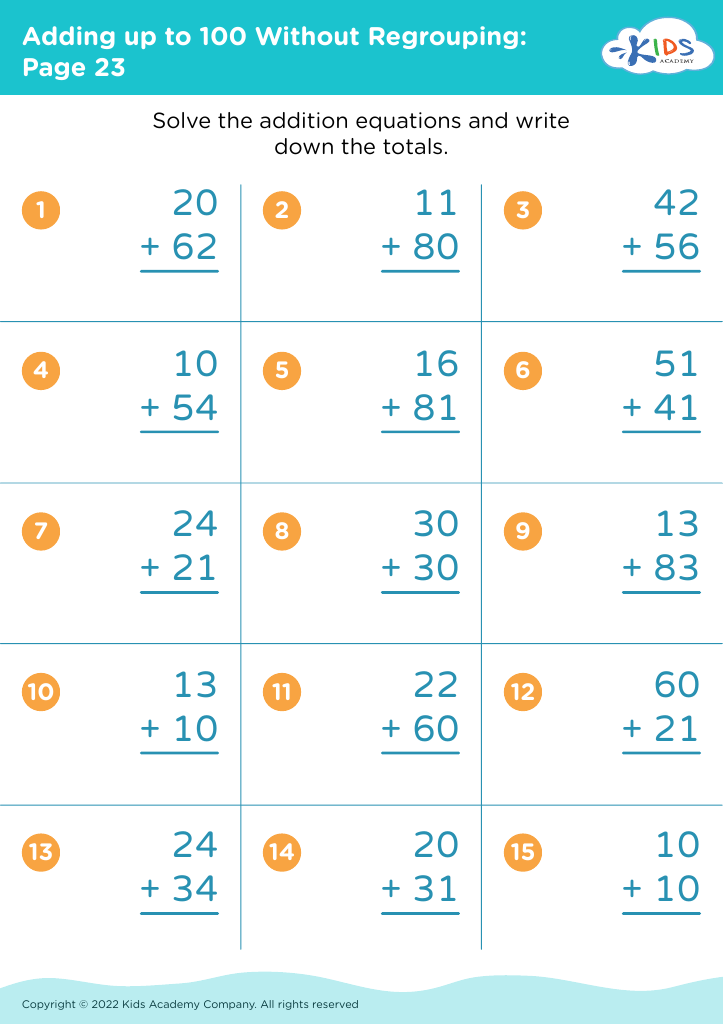
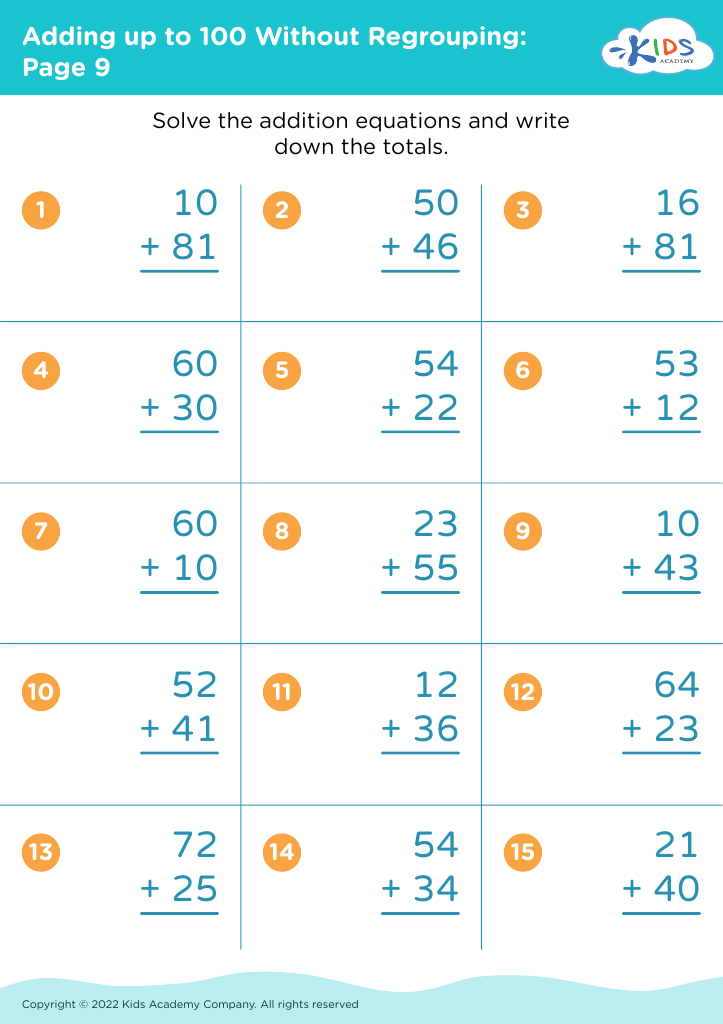




Parents and teachers should prioritize mathematical reasoning for adding up to 100 without regrouping in 7- to 8-year-old children because it establishes a critical foundation for more advanced math skills and cognitive development. This math concept enhances number sense, helping children understand relationships between numbers and how they can be combined. Such understanding is essential for their confidence and competence in mathematics, which influences future academic performance in various subjects, not just math.
When children master adding up to 100 without regrouping, they develop accuracy and fluency, both of which are vital for tackling more complicated operations like regrouping, subtraction, multiplication, and division that will come later. Ability with these basic arithmetic skills also forms the bedrock for solving real-life problems requiring quick, mental calculations or estimations.
Beyond academics, mastering this skill bolsters self-esteem and promotes cognitive attributes such as problem-solving and logical thinking. It encourages a growth mindset by showing that continual practice leads to improvement. Furthermore, integrating these math practices in daily activities, like shopping or cooking, makes learning relevant and fun, fostering a positive attitude towards mathematics. Therefore, investing time and effort into these fundamental skills at an early age enriches children's overall education and life skills.