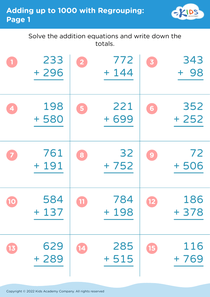
Enhance comprehension Adding up to 1000 Without Regrouping Worksheets for Ages 7-8
4 filtered results
-
From - To
Boost your child’s math skills with our engaging "Adding up to 1000 Without Regrouping" worksheets, tailored for ages 7-8. Designed to enhance comprehension, these worksheets offer a fun and educational way to practice addition without the complexity of regrouping. Kids will gain confidence in their math abilities through clear instructions and colorful, age-appropriate exercises. Ideal for both classroom use and at-home practice, these worksheets will not only reinforce arithmetic skills but also promote a strong foundation in mathematics. Help your child master addition up to 1000 confidently and effectively with our expertly crafted resources.
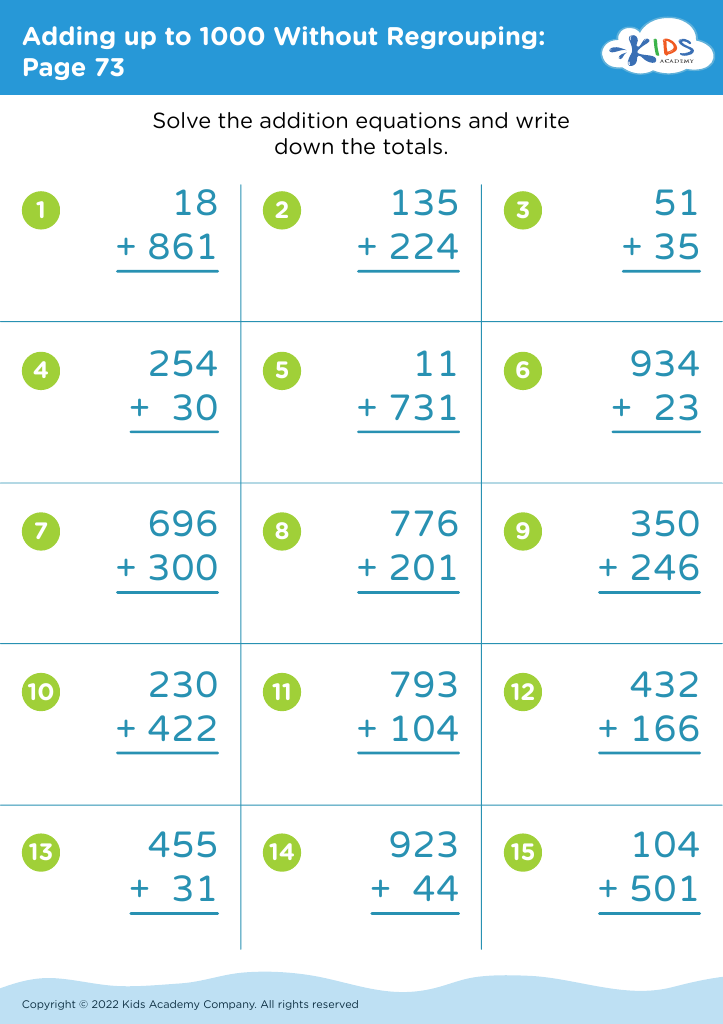
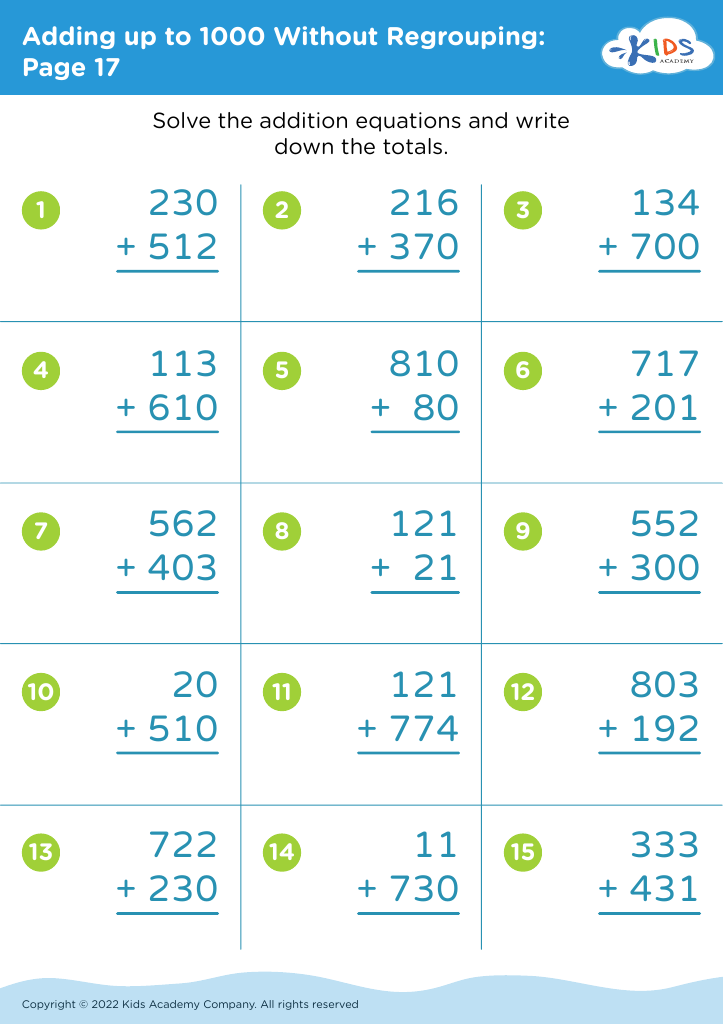
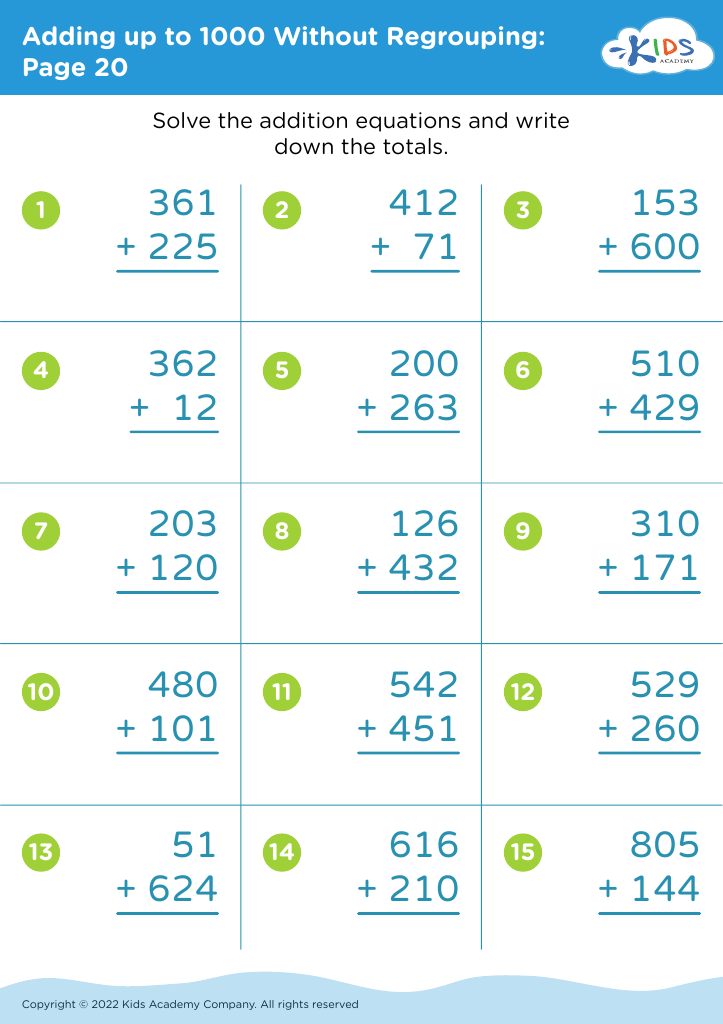
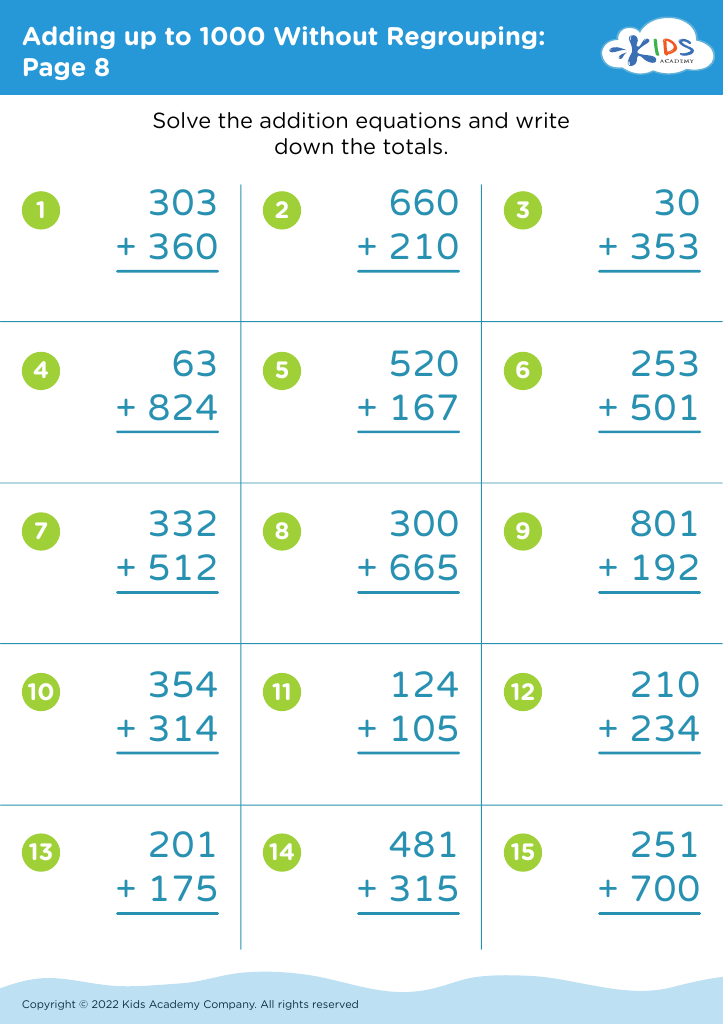


Enhancing comprehension in adding up to 1000 without regrouping for ages 7-8 is crucial for several reasons. First, mastering addition without regrouping builds a strong mathematical foundation. At this stage, children are transitioning from basic arithmetic to more complex problems. Understanding how to add large numbers without needing to regroup (or "carry over") helps solidify their grasp on place value and number sense.
Second, it fosters confidence and reduces math anxiety. Success in adding up to 1000 without regrouping provides a sense of achievement, making it likelier that children will approach future mathematical challenges with a positive mindset.
Third, it is a practical skill that has real-life applications. In everyday scenarios such as shopping or managing pocket money, being able to perform accurate arithmetic quickly is invaluable.
Moreover, enhancing comprehension at this level encourages cognitive development, including concentration, analytical thinking, and problem-solving skills. Understanding and proficiency in addition lay the groundwork for subsequent concepts in mathematics, not only in primary school but throughout their educational journey.
Lastly, it aligns with academic standards. Meeting school curriculum goals helps ensure students are on track with their peers, supporting academic success and ease of transition to more complex concepts. For parents and teachers, focusing on this aspect of math education ensures children's overall growth and preparedness for future challenges.