Enhancing problem-solving abilities Adding up to 50 Worksheets for Ages 7-8
3 filtered results
-
From - To
Enhance your child’s problem-solving abilities with our meticulously designed "Adding Up to 50" worksheets for ages 7-8. These worksheets offer young learners a perfect blend of fun and educational activities, essential for mastering addition. By practicing with these engaging problems, kids develop crucial analytical skills and build a strong mathematical foundation. Our worksheets are crafted to challenge and inspire, fostering confidence and proficiency in solving math problems independently. With a step-by-step approach, children will progress at their own pace, ensuring a thorough understanding of addition concepts up to 50. Empower your child’s learning journey with our expertly curated resources!
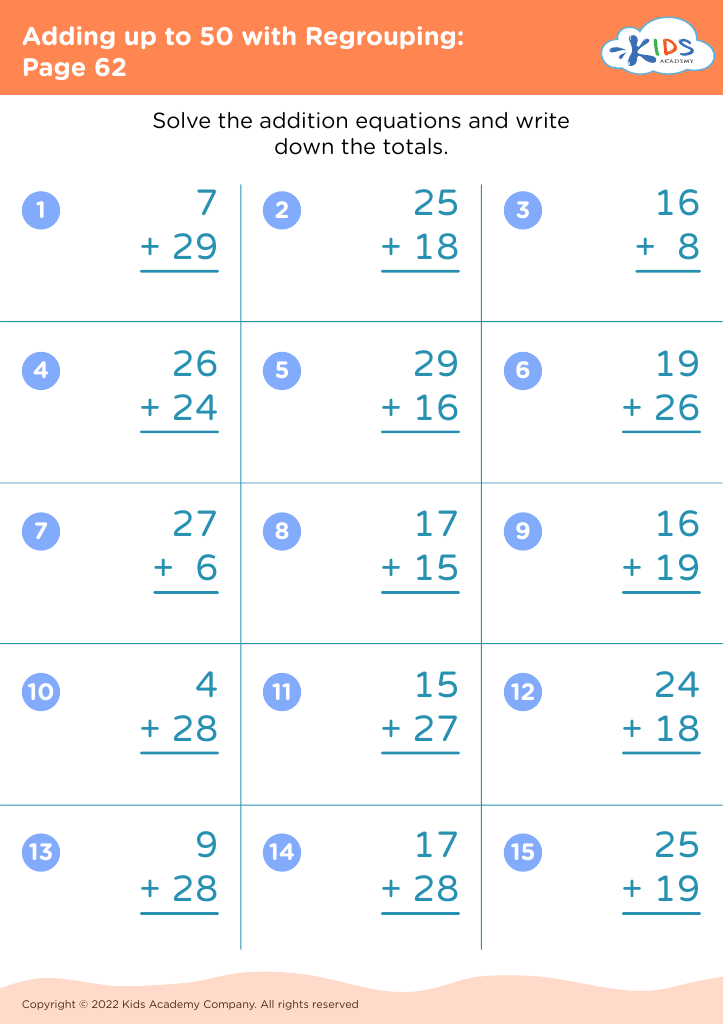
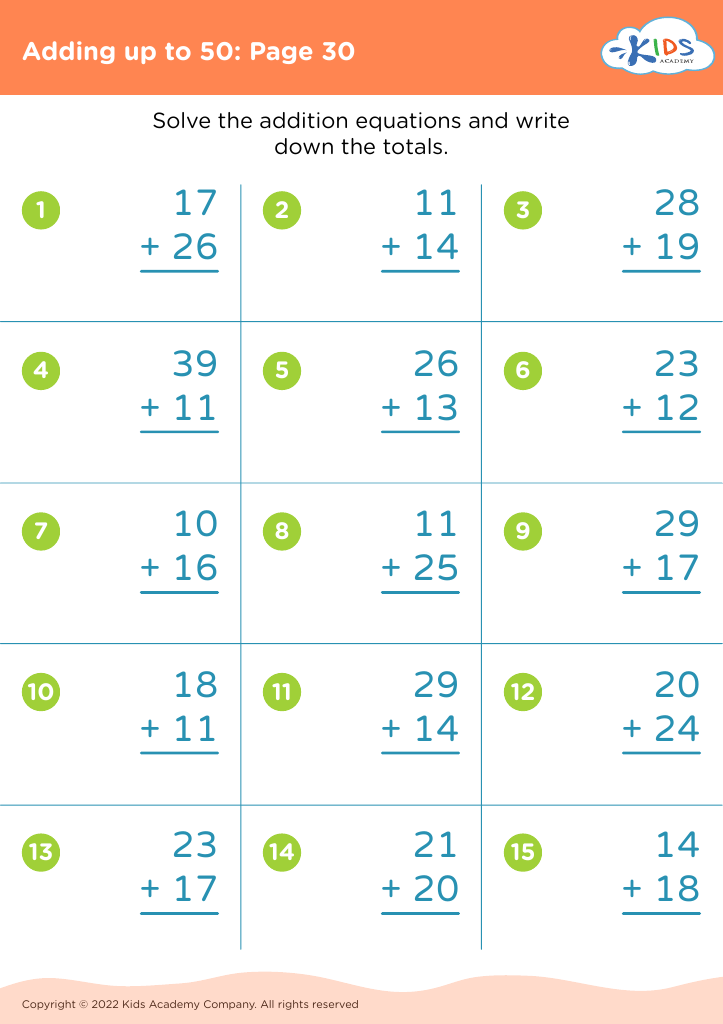
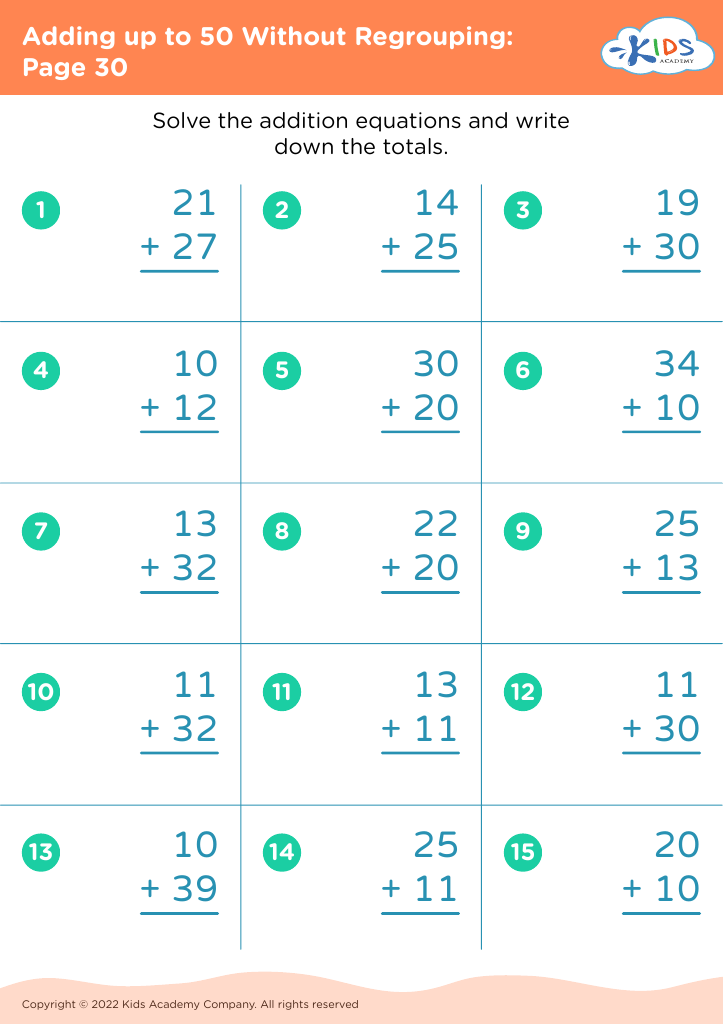




Enhancing problem-solving abilities for children aged 7-8, specifically about adding up to 50, is crucial for several important reasons. At this developmental stage, children are building the foundational skills that will support their academic growth and everyday life experiences. Fostering problem-solving skills lays the groundwork for logical thinking and analytical abilities, which are vital across all subjects in the school curriculum and life scenarios.
Adding up to 50 involves not just basic arithmetic, but the cognitive processes of planning, executing, and evaluating a strategy—core components of robust problem-solving capabilities. For instance, understanding how to break down complex problems into manageable steps, identifying patterns, and refining solutions through practice. These skills develop neural pathways that enhance cognitive development and increase children's capacity to handle more complex mathematical concepts in the future.
Moreover, success in problem-solving promotes a sense of achievement and confidence in young learners, leading to a positive attitude toward learning and tackling challenges. This intrinsic motivation can translate into a lifelong love of learning and resilience in the face of difficult problems, both academically and personally. Therefore, focusing on these skills during early education sets up children for long-term success, equipping them with vital life skills needed in an increasingly complex world.








