
Improving mental math Addition & Subtraction Worksheets for Ages 7-8
3 filtered results
Difficulty Level
Grade
Age
-
From - To
Subject
Activity
Standards
Enhance your child’s mental math skills with our engaging Addition and Subtraction Worksheets designed specifically for ages 7-8. These interactive resources focus on improving mental calculation abilities, helping students tackle math problems confidently and efficiently. Our worksheets encourage quick thinking, enhance number sense, and promote the use of mental strategies through a variety of fun and challenging exercises. Perfect for practice at home or in the classroom, these materials foster independent learning. Help your child discover the joy of math while building essential skills that lay the foundation for future success. Start improving their mental math today!
Favorites
With answer key
Interactive
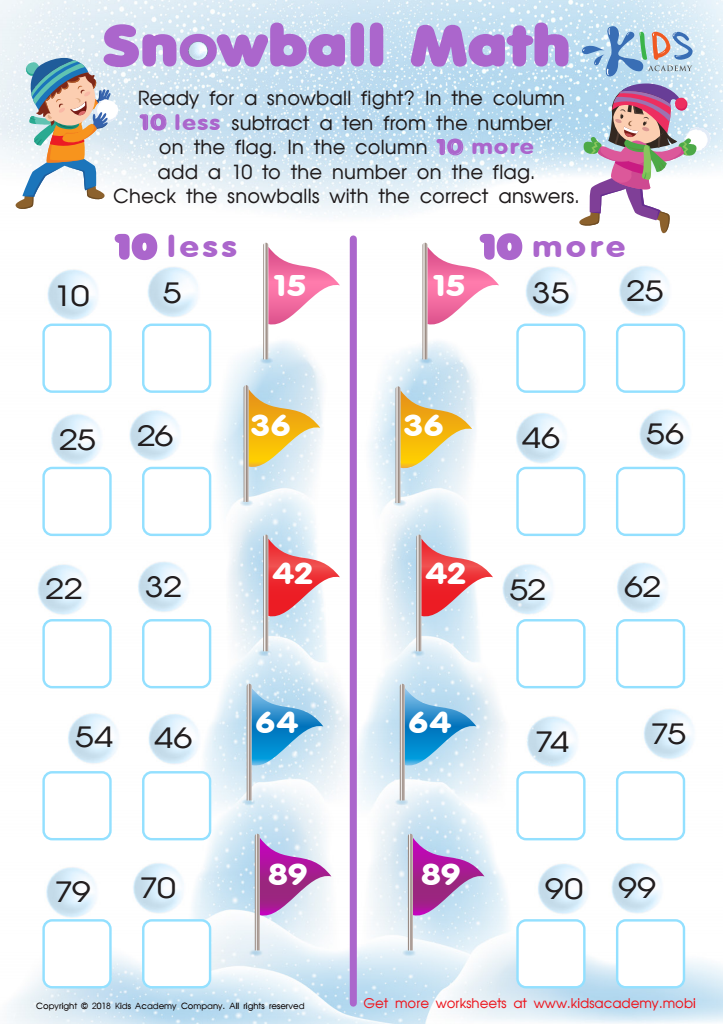
Snowball Math Worksheet
Kids can have a snowball fight and build math skills at the same time with this free worksheet. Kids can use tens to add and subtract for quick math equations and select the correct answers. No need to worry about getting cold either - these snowballs won't chill you!
 Assign to My Students
Snowball Math Worksheet
Worksheet
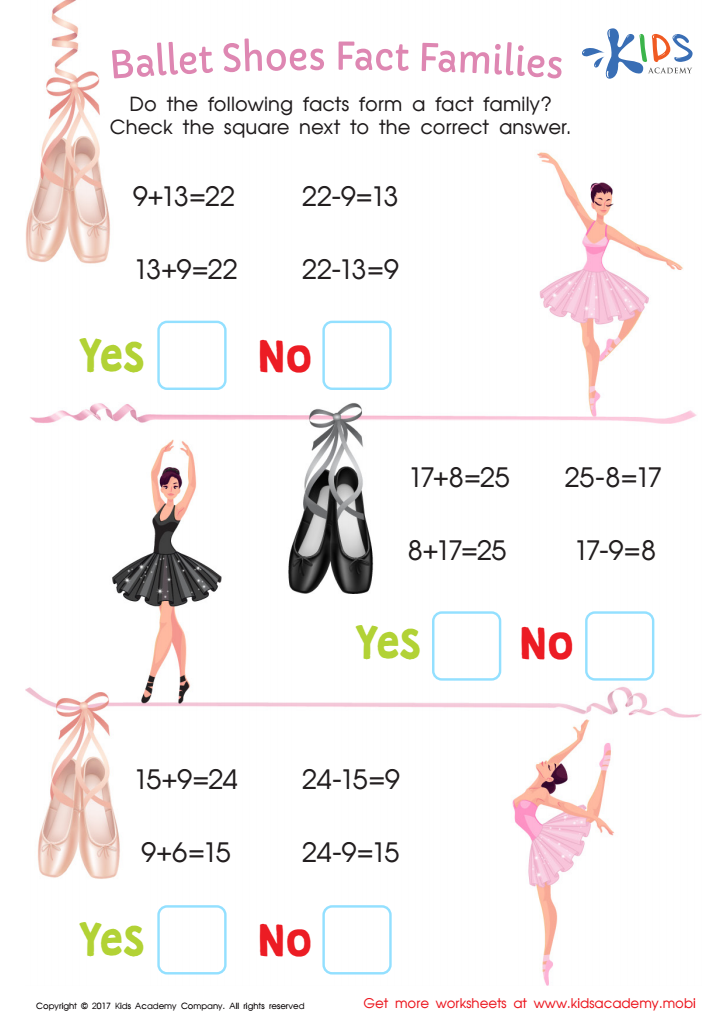
Ballet Shoes Fact Family Printable
Have them observe the equations and determine which groupings are fact families for a delightful learning experience. It encourages critical thinking, showing how addition and subtraction are related.
Ballet Shoes Fact Family Printable
Worksheet
Join Kids Academy for Free
Who is primarily going to use this learning content?








Improving mental math skills for addition and subtraction in children aged 7-8 is crucial for their overall educational development. At this age, students are transitioning from concrete understanding to more abstract mathematical concepts. Strengthening mental computation abilities enhances their confidence and competence in mathematics, laying a foundational skill set that is essential for higher-level math in the future.
Mental math promotes quick thinking and problem-solving, allowing children to easily navigate everyday situations, such as adding prices or calculating change during shopping. These skills foster independence, as children become less reliant on calculators and tools.
Furthermore, strong mental math skills are linked to better performance in standardized testing, as they help students efficiently manage time and accurately complete problems under pressure. Parents and teachers play a vital role in nurturing these abilities through engaging activities, games, and real-life scenarios that make learning fun.
Ultimately, by focusing on mental math at this formative stage, parents and teachers can help children develop resilience, adaptability, and a positive attitude towards math, steering them toward a successful academic journey and instilling lifelong skills that extend beyond the classroom. Investing time in improving mental math today will yield far-reaching benefits for children’s futures.








