
Multiplication practice Addition & Subtraction Worksheets for Ages 7-8
6 filtered results
Difficulty Level
Grade
Age
-
From - To
Subject
Activity
Standards
Boost your child's math skills with our engaging Multiplication Practice Addition and Subtraction Worksheets, specifically designed for ages 7-8. These worksheets offer a fun way to reinforce essential arithmetic concepts, helping students to master multiplication while solving addition and subtraction problems. Each worksheet is crafted to challenge young learners and enhance their problem-solving abilities. With colorful illustrations and interactive activities, your child will enjoy practicing math in an exciting way. Great for homework, classroom activities, or extra practice at home, these resources are perfect for developing foundational math skills. Download today and watch your child's confidence in math grow!
Favorites
With answer key
Interactive
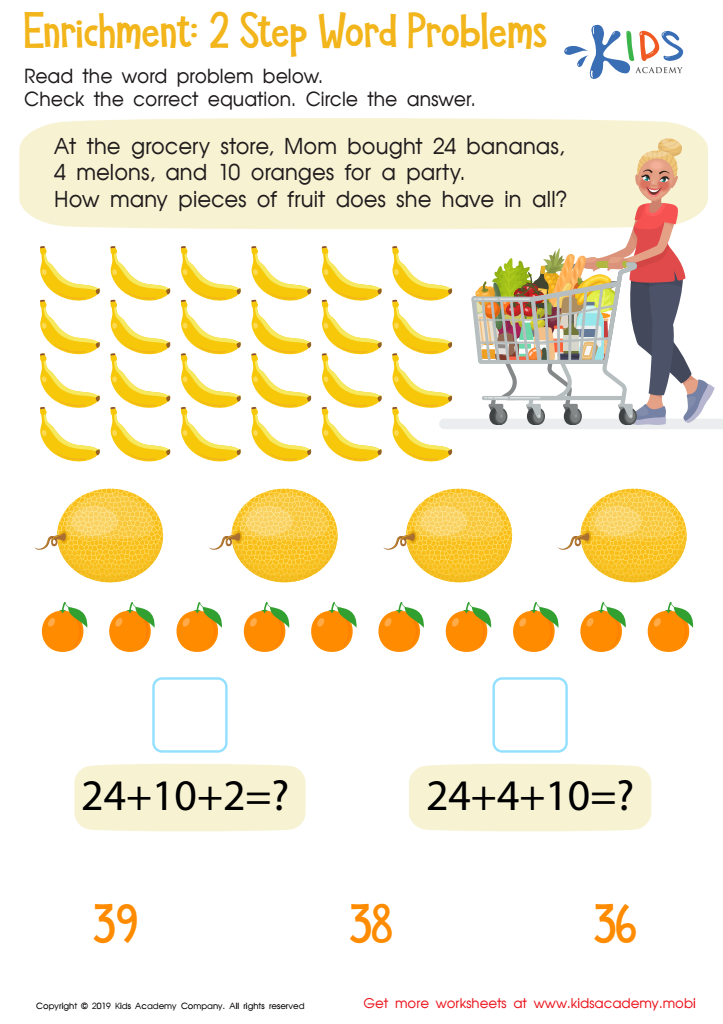
Enrichment -2 Step Word Problems Worksheet
Help your students learn math easier and faster with this colorful worksheet. Read the word problem and then guide them in checking the correct equation and finding the answer. Your students will benefit from the extra help, as they work through new concepts each day.
 Assign to My Students
Enrichment -2 Step Word Problems Worksheet
Worksheet
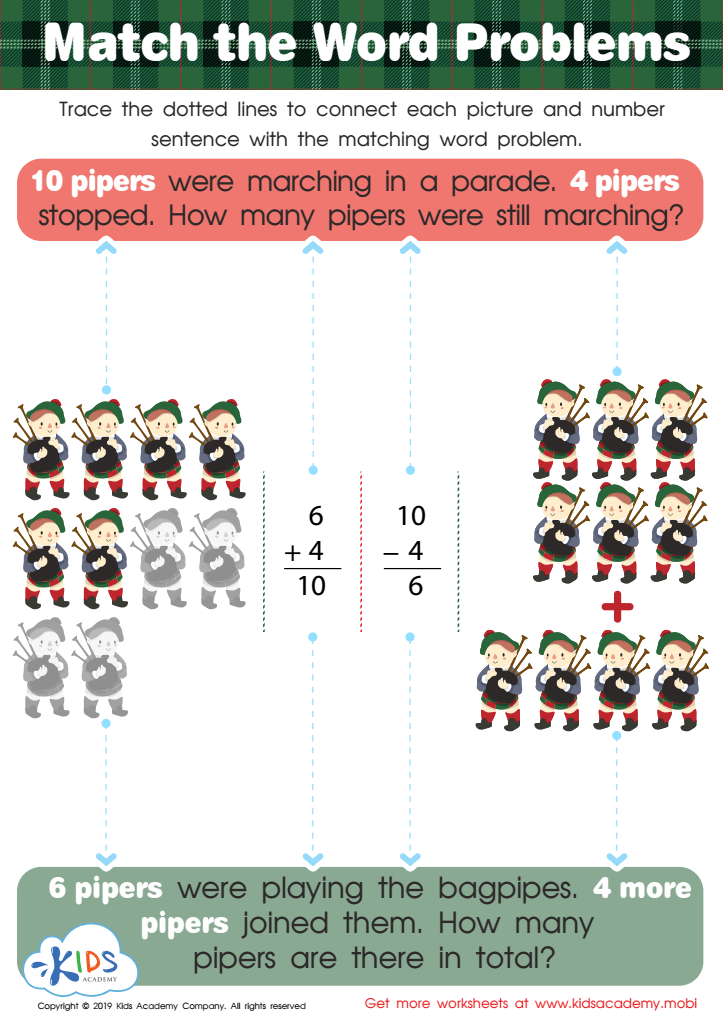
Match the Word Problems Worksheet
Read this word problem to your kids: Help them understand how it can be translated into a number problem. Trace the dotted lines to see how each picture and number sentence match the problem. With this worksheet, you can show your kids how easy it is to transform a word problem into a number problem.
Match the Word Problems Worksheet
Worksheet
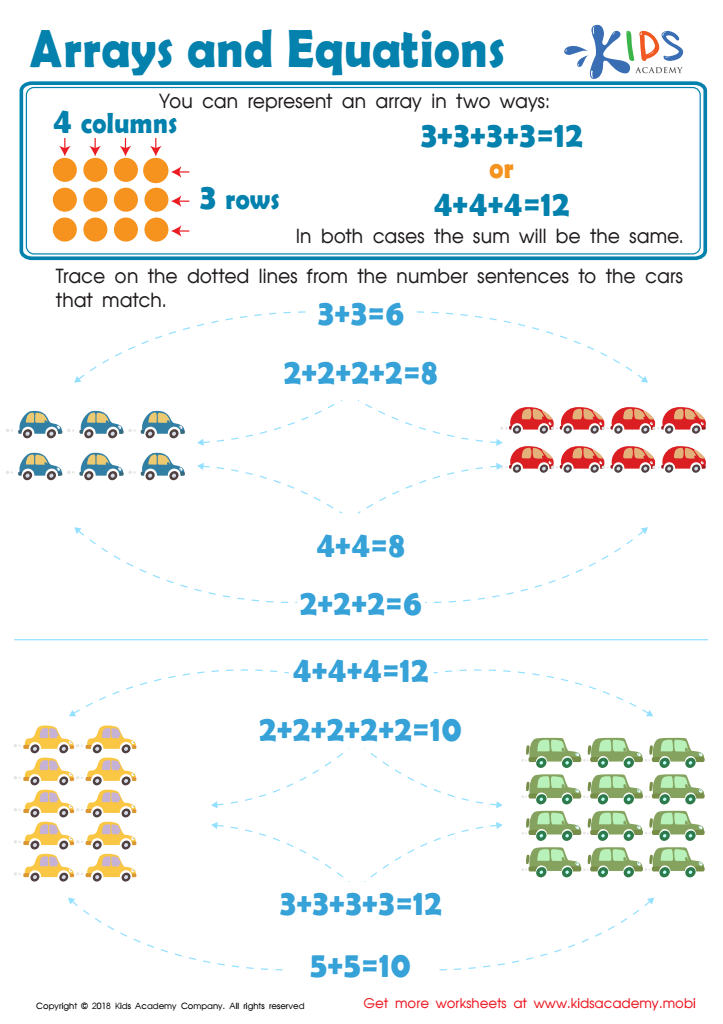
Arrays and Equations Worksheet
An array is objects, pix, or numbers organized in rows and columns. Show kids two ways to interpret this: 3 rows in 4 places = 12 and 4 columns in 3 places = 12. Help your child trace the number sentences to the matching cars. All equations always add up to the same amount.
Arrays and Equations Worksheet
Worksheet
Join Kids Academy for Free
Who is primarily going to use this learning content?








Parents and teachers should prioritize multiplication practice alongside addition and subtraction for children aged 7 to 8, as this is a critical period in their mathematical development. Mastering these foundational skills builds confidence and lays the groundwork for more complex math concepts.
At this age, children are transitioning from simple arithmetic to more abstract reasoning, making it essential to develop a robust number sense. Multiplication, being a form of repeated addition, enhances their understanding of relationships between numbers, reinforcing what they’ve learned in addition and subtraction. By regularly practicing these operations, students improve their computational fluency, enabling quicker problem-solving skills in everyday situations.
Moreover, familiarity with multiplication can assist children in tackling word problems, which often combine various operations. This cross-practice encourages them to see connections between different areas of mathematics, thus fostering critical thinking and logic.
Finally, engagement in group activities or games that incorporate addition, subtraction, and multiplication can make learning enjoyable and less intimidating. This positive attitude towards math is essential for lifelong learning. In summary, integrating multiplication practice into early math education not only strengthens arithmetic skills but also enhances confidence and fosters a love for learning mathematics.








