Basic Arithmetic Addition Worksheets for Ages 7-8
4 filtered results
-
From - To
Discover our engaging Basic Arithmetic Addition Worksheets designed specifically for children aged 7-8! These interactive resources help young learners grasp essential addition concepts through a variety of fun and stimulating exercises. Our worksheets provide a balanced mix of straightforward problems and challenging tasks, ensuring that students develop both confidence and proficiency in addition skills. Whether at home or in the classroom, these worksheets promote critical thinking and cultivate a solid mathematical foundation. Perfect for reinforcing classroom learning or serving as additional practice, our addition worksheets make math accessible and enjoyable. Unlock your child's potential and make learning math a rewarding adventure!
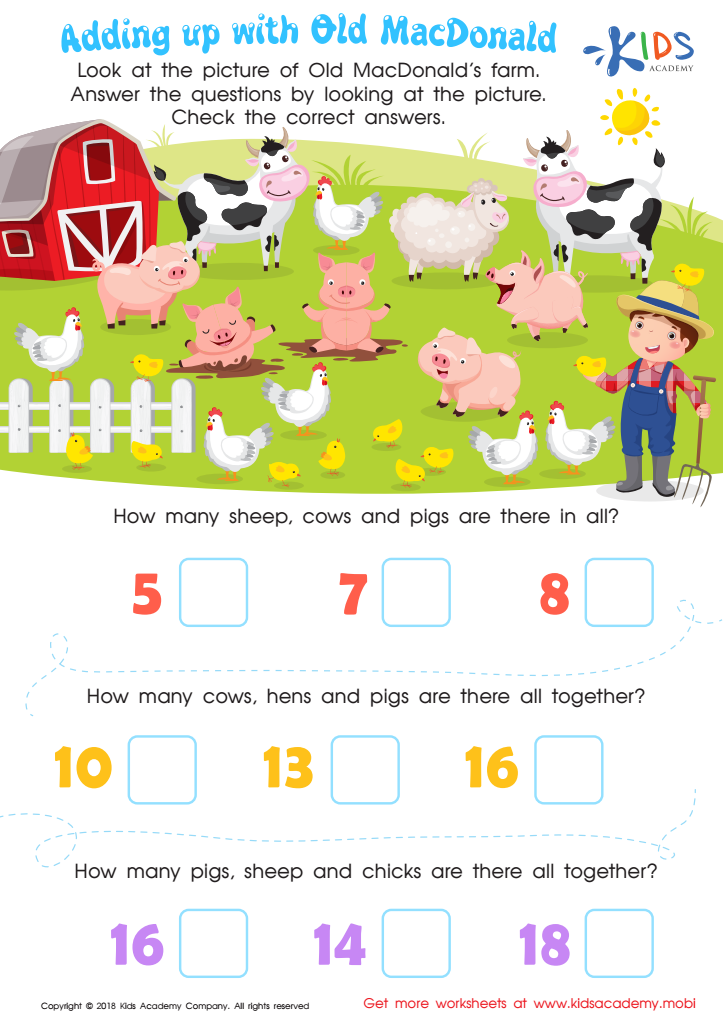
Adding Up with Old MacDonald Worksheet
 Assign to My Students








Basic arithmetic addition is a foundational skill crucial for children aged 7-8, as it not only forms the building blocks for more complex mathematics but also enhances critical thinking and problem-solving abilities. At this age, children are typically in second or third grade, where addition becomes more than just memorizing facts; it involves understanding concepts such as grouping and carrying over.
Parents and teachers should care about this stage as it directly impacts a child’s confidence and attitude towards mathematics. Mastery of addition fosters a sense of accomplishment, encouraging kids to engage with higher-level math concepts in the future. Furthermore, these skills are necessary for everyday tasks, such as budgeting, shopping, or measuring, embedding mathematical reasoning into daily life.
Additionally, learning through engaging methods, such as games or practical applications, can rekindle excitement about learning. When children struggle with addition at an early age, they may develop anxiety towards math that can persist, limiting their academic potential. Building a solid foundation in basic addition thus empowers children, promoting overall educational success and cultivating a lifelong appreciation for learning. Collaboration between parents and teachers can ensure that children receive the support they need to flourish in their mathematical journey.








