Multiplication practice Arrays Worksheets for Ages 7-8
4 filtered results
-
From - To
Help your 7-8-year-old master multiplication with our specially designed Arrays Worksheets! Focusing on visual learning, these worksheets use arrays to make multiplication concepts clear and understandable. Your child will enjoy engaging exercises that transform abstract equations into visual and hands-on activities. By arranging objects into rows and columns, young learners will grasp the relationship between multiplication and addition, boosting their problem-solving skills and confidence. Perfect for reinforcing classroom learning or additional at-home practice, our arrays worksheets are a fun, effective way to build a strong math foundation. Download now to pave the way for your child’s success in math!
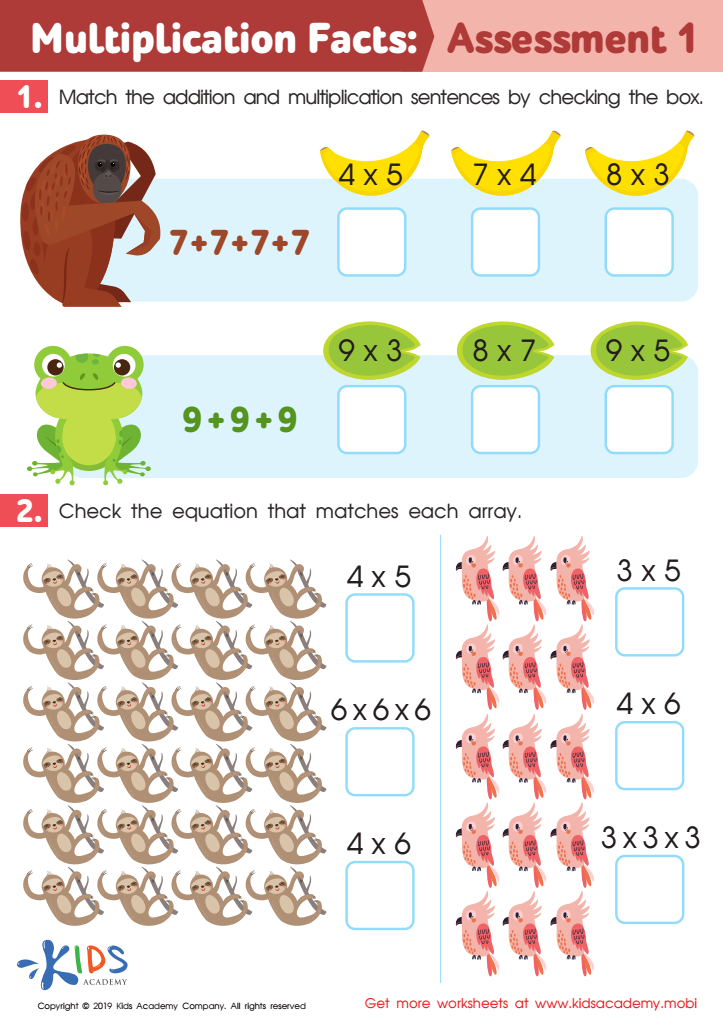
Multiplication Facts: Assessment 1 Worksheet
 Assign to My Students
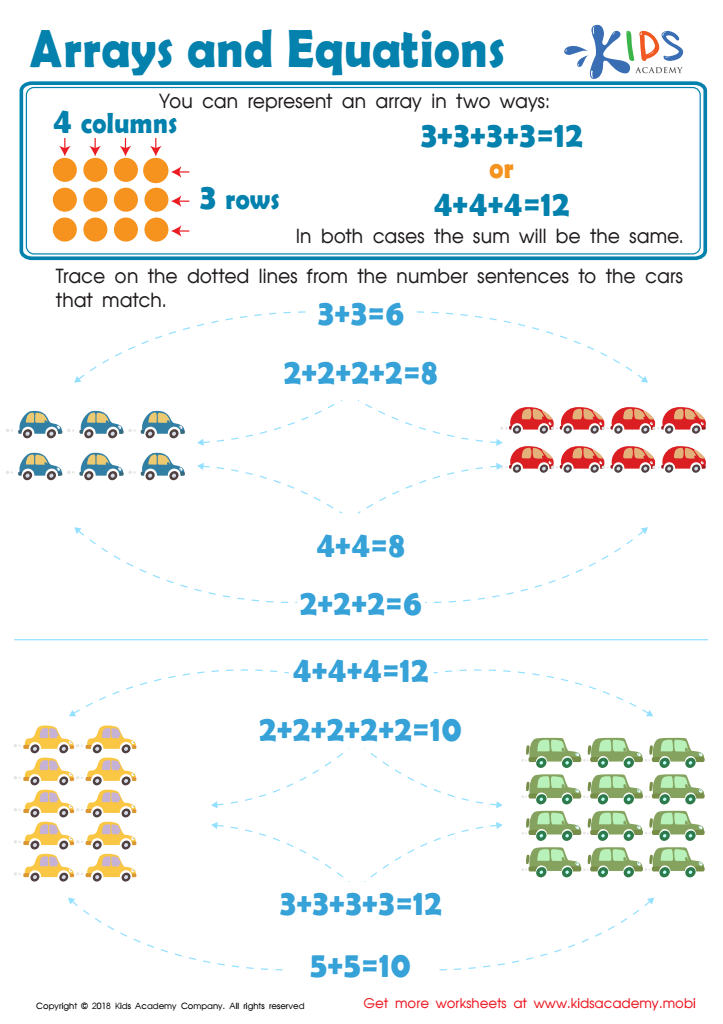
Arrays and Equations Worksheet
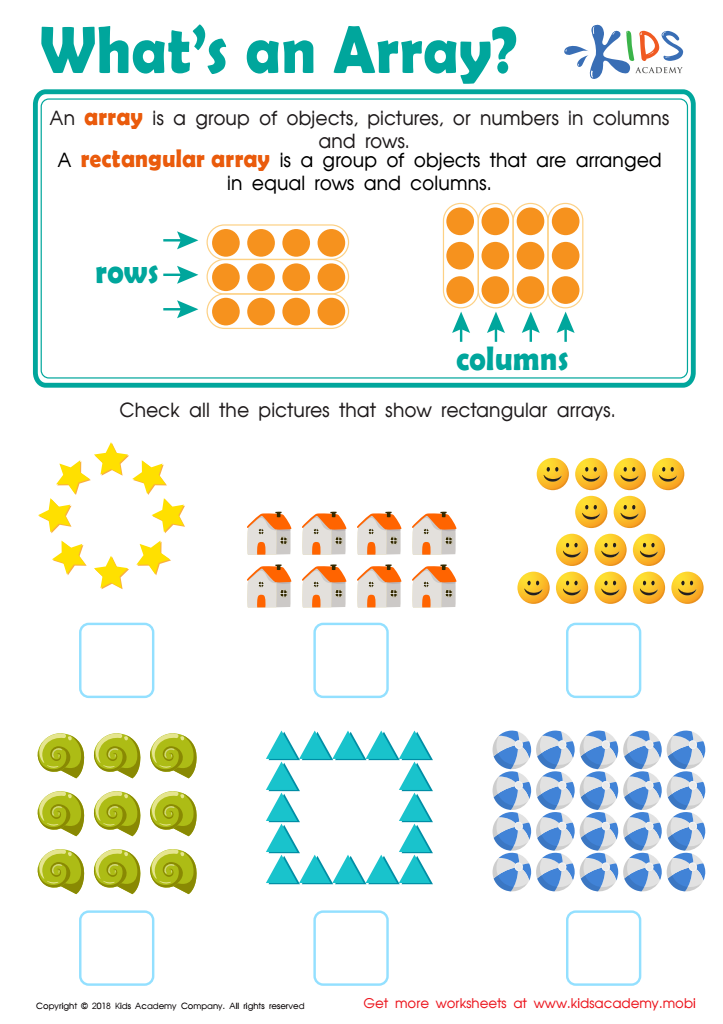
What's an Array? Worksheet
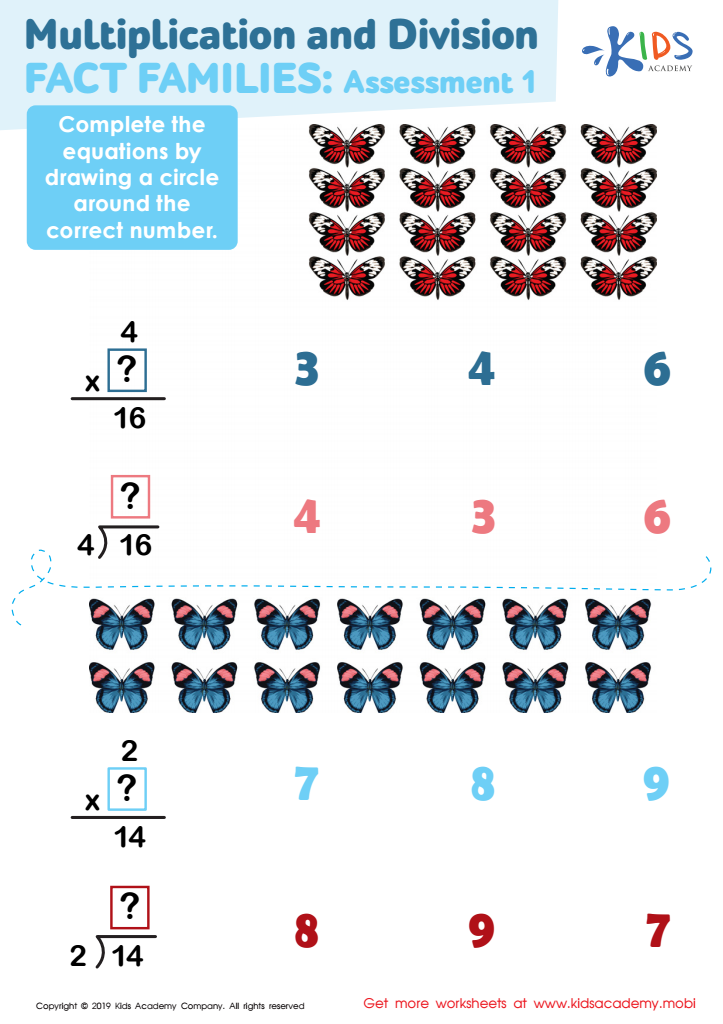
Multiplication and Division Fact Families Assessment 1 Worksheet







Parents and teachers should highly prioritize the use of multiplication practice arrays for children aged 7-8 because this method offers an intuitive and visual way for children to understand the concept of multiplication. At this age, children are transitioning from basic addition and subtraction to more complex mathematical operations, and arrays help make this leap more manageable.
Multiplication arrays organize objects into rows and columns, providing a concrete representation of abstract numbers. This visual aid helps children grasp that multiplication is essentially repeated addition. For example, a 3x4 array demonstrates that 3 groups of 4 objects is the same as adding four three times. Seeing this visually can deepen a child's understanding and retention.
Framing multiplication visually also aligns with varied learning styles; many children are visual learners and benefit greatly from seeing mathematical concepts rather than just hearing or reading about them. Such interactive learning engages students more effectively than rote memorization.
Moreover, consistent practice with arrays enhances problem-solving skills and critical thinking. As children learn to construct and deconstruct arrays, they gain confidence and proficiency in multiplication, which forms a foundation for other mathematical concepts like division, fractions, and area.
In sum, incorporation of multiplication arrays in early education promotes a solid, visual, and hands-on understanding of multiplication, setting a groundwork for future math success and fostering numerical literacy at a crucial learning stage.








