
Comparing quantities Math Worksheets for Ages 7-8
9 filtered results
Difficulty Level
Grade
Age
-
From - To
Subject
Activity
Standards
Enhance your child’s math skills with our "Comparing Quantities Math Worksheets for Ages 7-8" from Kids Academy! These expertly designed worksheets make learning fun and interactive, focusing on essential skills such as greater than, less than, and equal to exercises. Perfectly suited for early learners, each worksheet combines colorful visuals with engaging activities to keep students motivated. Whether at home or in the classroom, these resources provide the perfect practice to build a solid math foundation. Watch your child gain confidence and proficiency in comparing quantities—key concepts crucial for future math success! Download now and boost your child’s learning journey.
Favorites
With answer key
Interactive
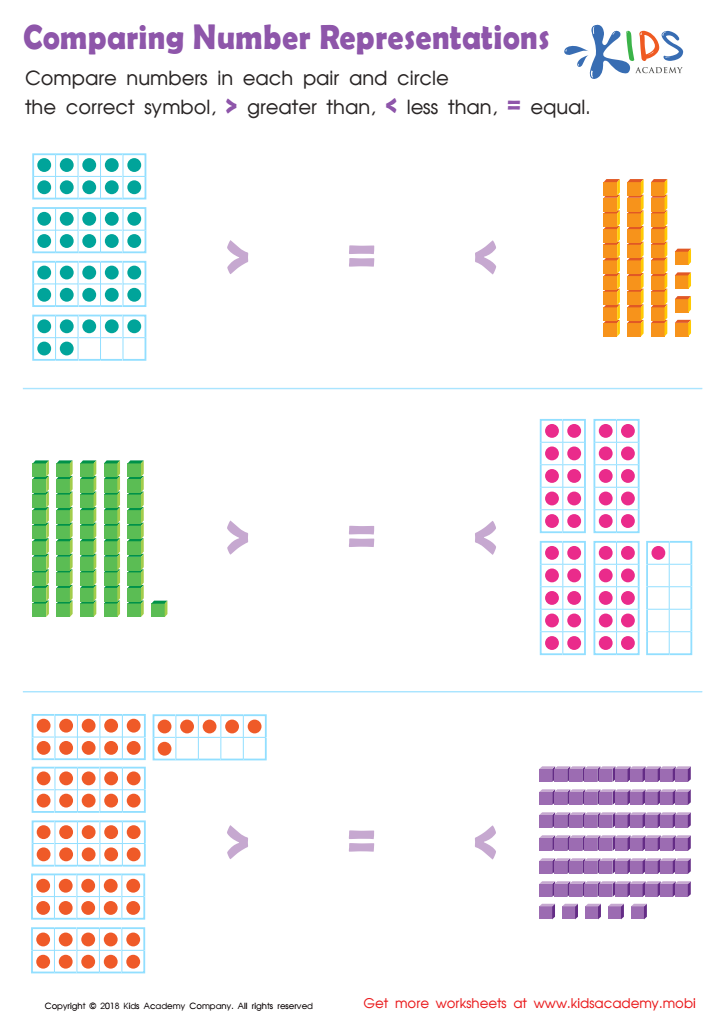
Comparing Number Representations Worksheet
Children need number representation skills to develop efficient computation and number sense. This free worksheet gives them practice with ten frames and place value blocks. They compare numbers and select the right comparative symbol: <, > or =. This helps them build a solid foundation for math.
 Assign to My Students
Comparing Number Representations Worksheet
Worksheet
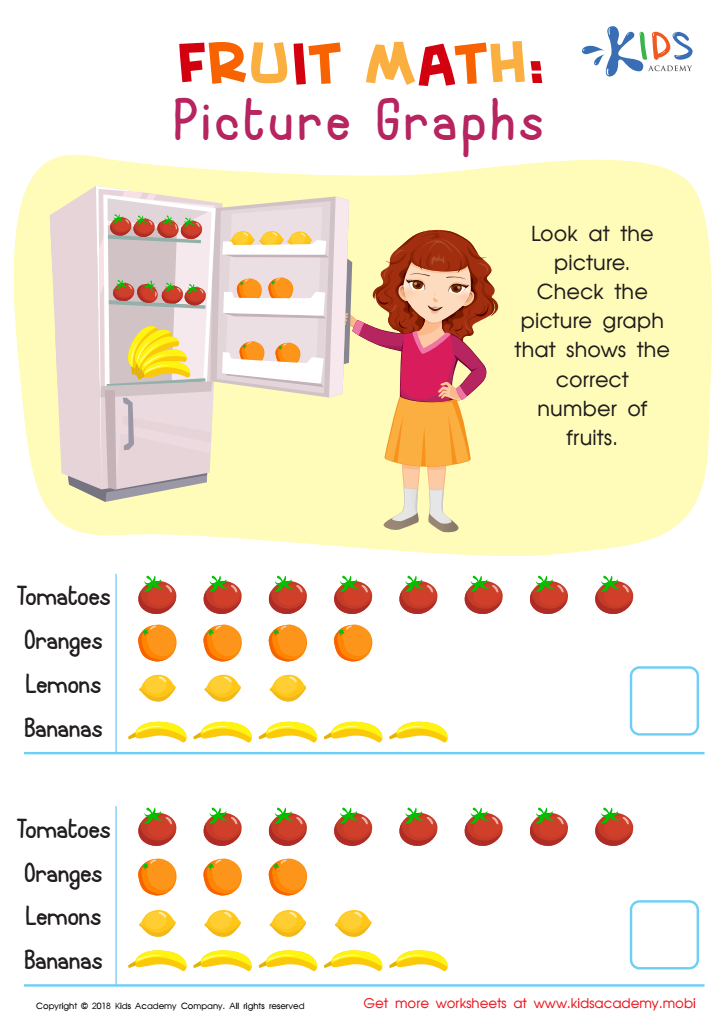
Fruit Math: Picture Graphs Worksheet
Help your child learn to draw graphs by having them look at pictures. Ask them to identify a graph that accurately portrays the data and have them explain why. This will prepare them to easily draw more complex graphs in the future. For example, have them look at the picture with the number of fruits in the colorful worksheet and explain why the graph is accurate.
Fruit Math: Picture Graphs Worksheet
Worksheet
Recycling - More or Less Worksheet
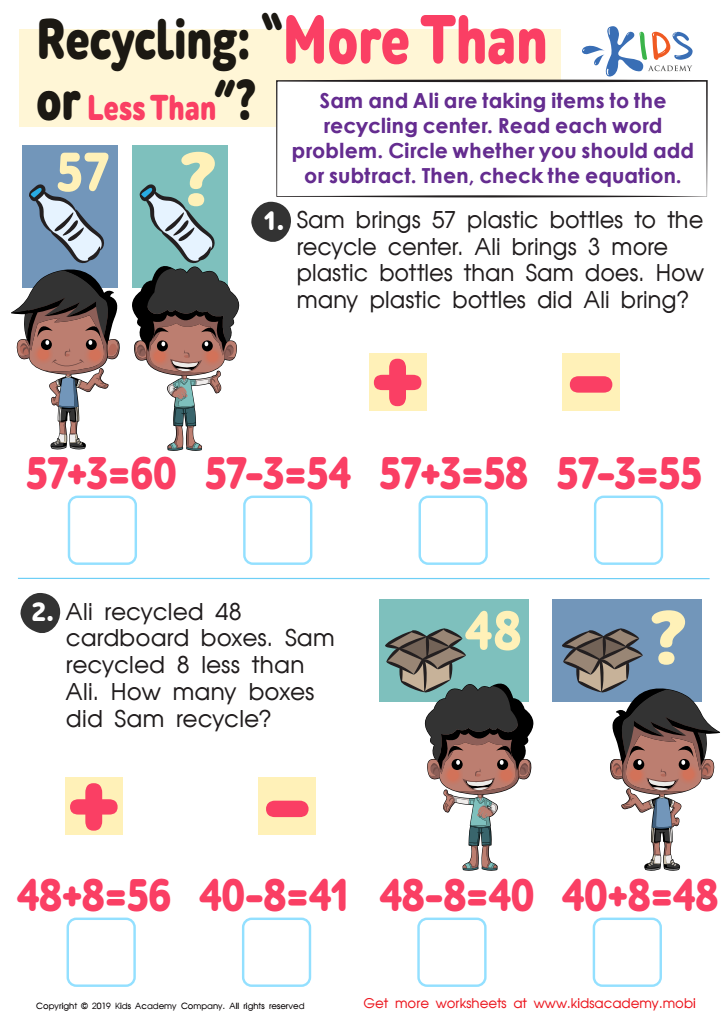
Your child can compare numbers and solve word problems with this free worksheet. Help them understand what's being asked as Sam and Ali take items to the recycling center. They can choose the correct equation to match the word problem and apply their skills in reading and pulling out the appropriate information.
Recycling - More or Less Worksheet
Worksheet
Join Kids Academy for Free
Who is primarily going to use this learning content?







At ages 7-8, children are developing foundational math skills that are crucial for their future academic success and daily life problem-solving. Understanding and comparing quantities is one of these key skills.
Firstly, when children learn to compare quantities, they gain a better understanding of basic number concepts and relationships. This prepares them for more complex mathematical operations such as addition, subtraction, multiplication, and division. For instance, recognizing that 8 is greater than 6 helps set the stage for understanding that 8 - 6 = 2.
Additionally, comparing quantities enhances critical thinking and reasoning skills. Children learn to evaluate, analyze, and make decisions based on different sets of data or objects. This kind of mathematical thinking can extend beyond the classroom into everyday situations, such as figuring out if there are enough cookies for everyone at a party or how much money they need to buy a toy.
Furthermore, these skills promote confidence and independence. As children master comparing quantities, they become more self-assured in their ability to solve problems, which can lead to increased academic motivation and a positive attitude toward learning.
Overall, caring about comparing quantities provides a strong mathematical foundation, fosters analytical skills, and helps children build the confidence they need for lifelong learning and problem-solving.








