
Comparing weights Math Worksheets for Ages 7-8
3 filtered results
Difficulty Level
Grade
Age
-
From - To
Subject
Activity
Standards
Discover an engaging collection of "Comparing Weights" math worksheets ideal for children aged 7 to 8! These interactive worksheets focus on developing essential math skills as young learners compare the weights of various objects. Perfectly designed for second graders, these activities foster critical thinking and problem-solving abilities in a fun and educational manner. Whether your child is learning at home or in the classroom, our worksheets offer comprehensive practice, promoting an understanding of measurement, weight, and data interpretation. Start enriching your child's mathematical journey today with our age-appropriate, easy-to-understand resources!
Favorites
With answer key
Interactive
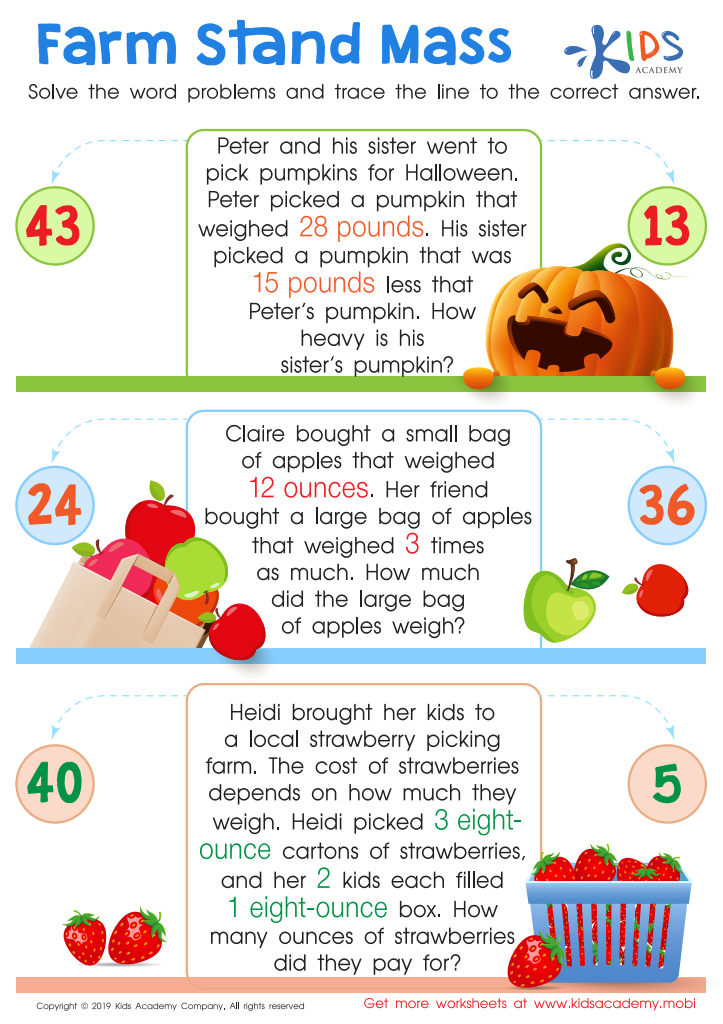
Farm Stand Mass Worksheet
Engage your kids in a fun learning adventure! Encourage them to practice what they learn in school using this worksheet. Look at the picture and read the problem together. Help them solve it and trace the line to the answer. Make learning enjoyable and your kids will be more motivated!
 Assign to My Students
Farm Stand Mass Worksheet
Worksheet
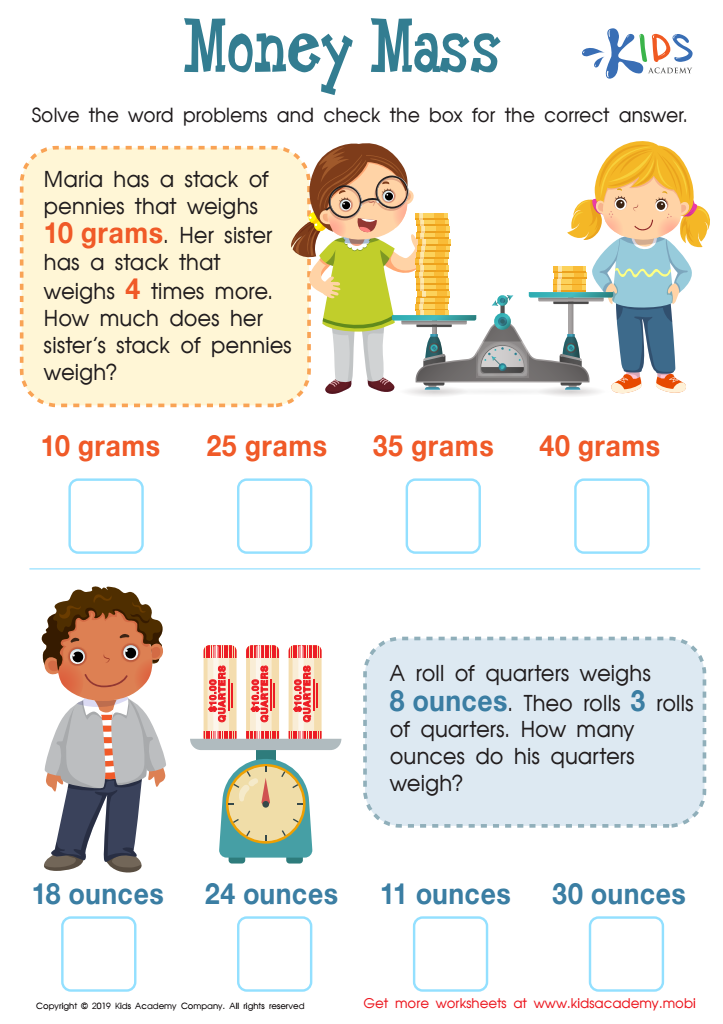
Money Mass Worksheet
By regularly working on math with your kids, they will become more confident. Ensure they understand the word problems in this printout, and help them solve it. Check the box for the correct answer of each to verify their work. With this practice, they will gradually get used to math and make progress.
Money Mass Worksheet
Worksheet
Join Kids Academy for Free
Who is primarily going to use this learning content?







Comparing weights is a foundational math concept crucial for children aged 7-8 as it enhances their understanding of measurement and paves the way for future mathematical learning. Engaging with weight comparison helps develop critical thinking and problem-solving skills; these abilities are essential for recognizing patterns, making logical predictions, and applying math to real-life situations.
At this developmental stage, children are naturally curious about the world around them. Learning to compare weights provides a tangible, hands-on way to explore and manipulate objects, which strengthens their observation and analytical capabilities. This fundamental skill also introduces basic arithmetic operations like addition and subtraction in a practical context, reinforcing their numerical understanding.
Moreover, mastering weight comparison contributes to a child's ability to follow instructions and understand sequence, which are essential skills in everyday activities, from cooking to playing sports. Early exposure to such concepts fosters confidence and encourages a positive attitude towards math, which is crucial given that attitudes towards learning often form in early childhood.
In essence, comparing weights is not just about learning a single mathematical concept; it's about nurturing a child’s cognitive development, contributing to their overall academic success, and helping them make sense of the world. Parents and teachers should prioritize this to build a strong math foundation.








