Recognizing shapes Math Worksheets for Ages 7-8 - Page 2
34 filtered results
-
From - To
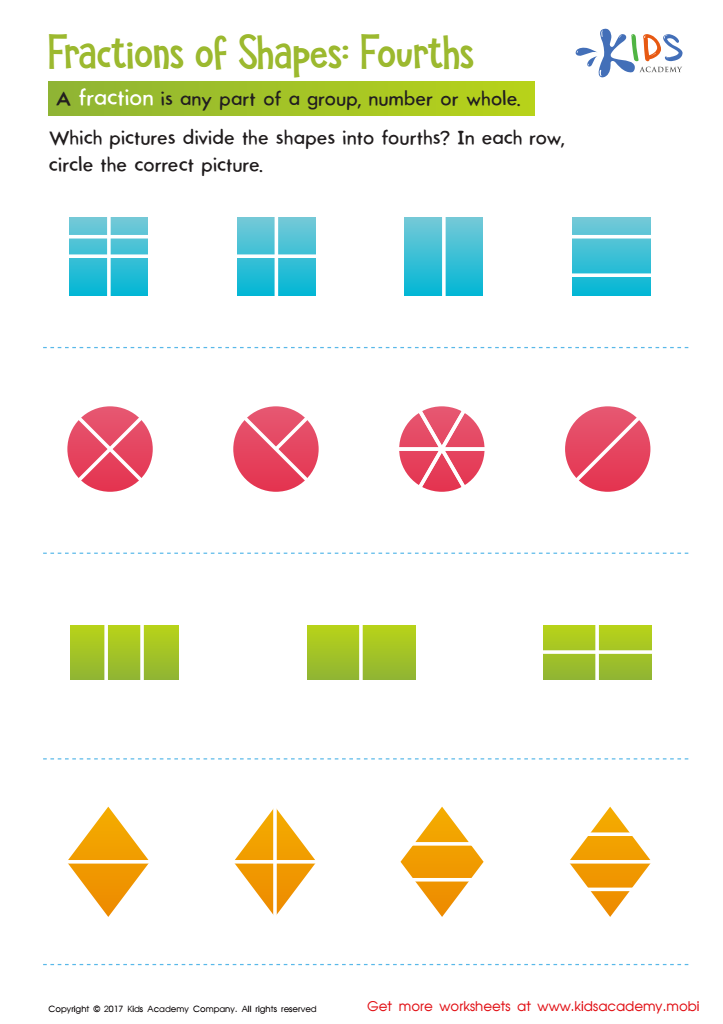
Fractions of Shapes Worksheet
 Assign to My Students
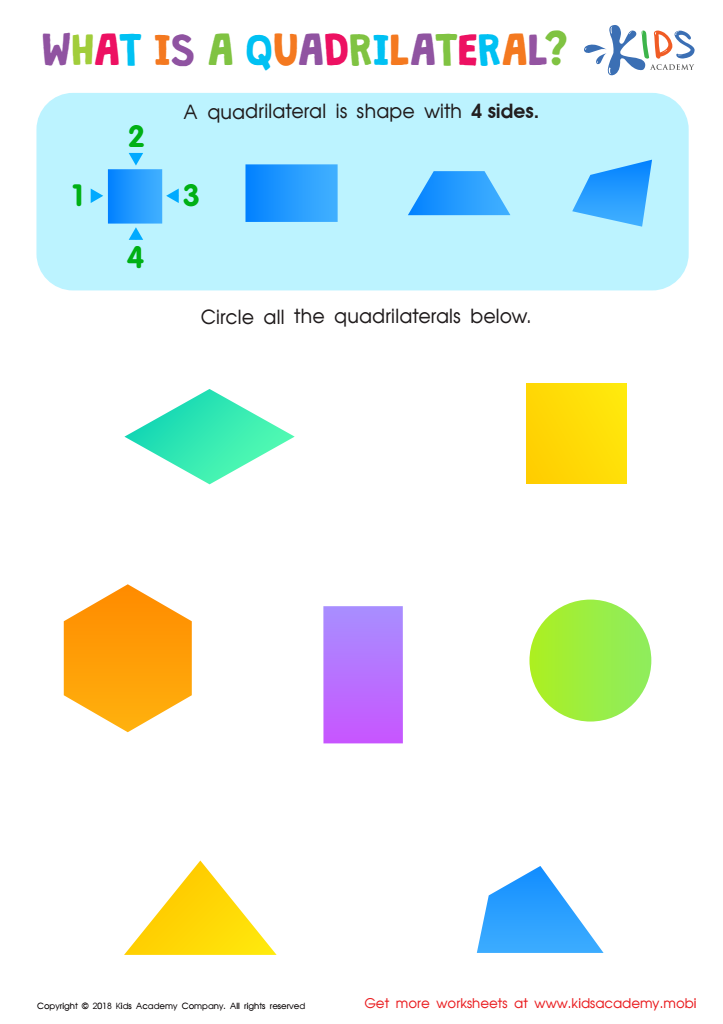
What Is a Quadrilateral? Worksheet






Recognizing shapes is a fundamental skill for children aged 7-8, serving as the foundation for their mathematical understanding and critical thinking skills. At this age, children are developing spatial awareness, which is crucial for everyday tasks and advanced math concepts. By recognizing and distinguishing between different shapes—such as circles, squares, triangles, and more—they begin to understand their properties, such as vertices and edges, laying the groundwork for geometry.
Moreover, recognizing shapes enhances problem-solving abilities. When children can identify shapes in their environment, they build the confidence needed to tackle more complex mathematical ideas, such as measurement, symmetry, and area. This skill also promotes logical reasoning, allowing them to make connections between geometric concepts and their real-world applications.
For parents and teachers, encouraging shape recognition is vital as it can spark children's interest in math and foster a love for learning. Engaging activities that involve shapes—such as art, building, and creating—can make math enjoyable, contributing to a positive attitude toward the subject. By prioritizing shape recognition, parents and teachers play a crucial role in paving the way for future academic success and lifelong learning.








