Telling time Math Worksheets for Ages 7-8
4 filtered results
-
From - To
Discover our engaging Telling Time Math Worksheets designed for children aged 7-8! Perfect for developing essential time-telling skills, these worksheets seamlessly combine fun with learning. Through a variety of captivating exercises, kids will master reading both analog and digital clocks, understand AM and PM, and practice calculating elapsed time. Our activities build confidence and enhance problem-solving abilities. Ignite your child's passion for math with colorful graphics and age-appropriate challenges. Set the foundation for lifelong time management skills while making learning both interactive and enjoyable. Transform the way your child learns to tell time with our expertly crafted resources!
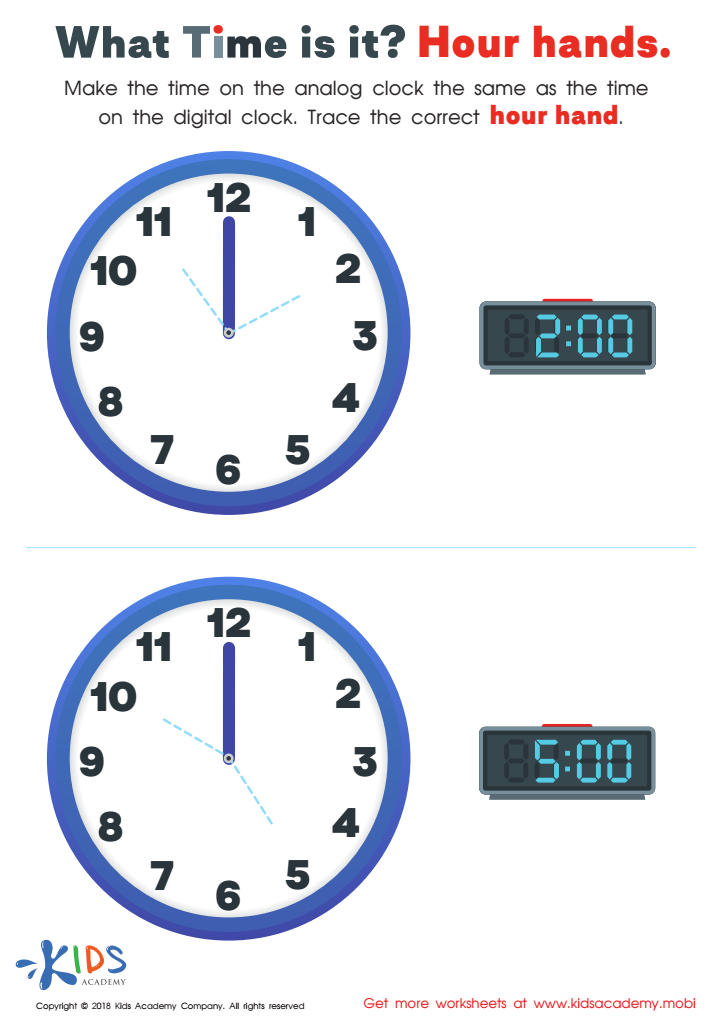
What Time Is it? Hour Hands Worksheet
 Assign to My Students







Telling time is an essential skill that forms a foundational aspect of a child's daily life and academic growth, making it important for parents and teachers to invest in teaching it to children ages 7-8. Mastering the concept of time improves a child's ability to manage their day more effectively. They can begin to understand schedules, the duration of activities, and the importance of time management, aiding in routine adherence.
From an academic standpoint, learning to tell time helps reinforce various math skills, including numbers, addition, subtraction, and the concept of fractions, as a clock face naturally introduces these concepts in a real-world context. This helps children make tangible connections between abstract mathematical concepts and practical applications.
Socially and cognitively, telling time fosters independence and responsibility. Children learn the value of punctuality and develop an awareness of temporal sequences, such as understanding that reading time can happen after lunch and before playtime. This temporal understanding aligns closely with their cognitive developmental strides at this age.
By valuing the skill of telling time, parents and teachers set children up for success, providing them with life skills that enable meaningful participation in structured environments both at school and in daily life activities. Thus, telling time is not just about reading a clock—it encompasses broader learning that is pivotal for young minds.








