
Understanding base ten Math Worksheets for Ages 7-8
3 filtered results
Difficulty Level
Grade
Age
-
From - To
Subject
Activity
Standards
Discover our engaging "Understanding Base Ten Math Worksheets" designed specifically for children ages 7-8. These worksheets aim to build a strong foundational knowledge of the base ten number system, essential for mastering mathematics. Filled with various activities, including visual aids, interactive exercises, and real-life examples, they simplify concepts such as place value, grouping, and counting. Our resources encourage critical thinking and enhance problem-solving skills while making learning fun! Perfect for classroom use or at-home practice, these worksheets ensure that your child gains confidence and proficiency in their numerical abilities, paving the way for future math success. Explore today!
Favorites
With answer key
Interactive
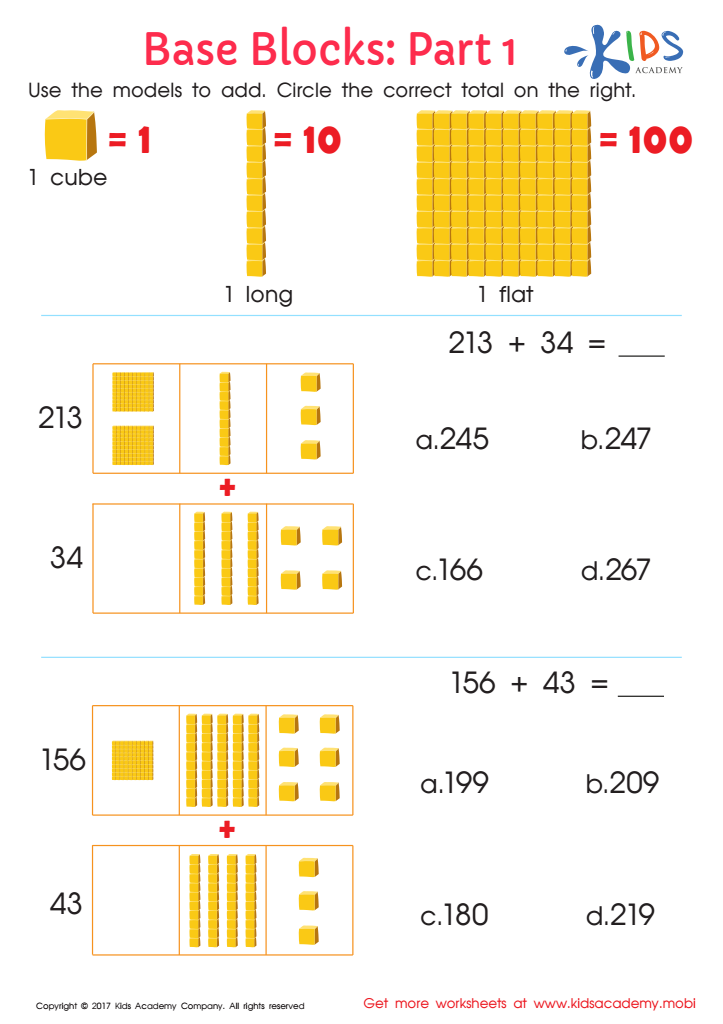
Base Ten Blocks Worksheet: Part 1
They promote numeracy and are a great substitute when kids don't have access to physical blocks.
 Assign to My Students
Base Ten Blocks Worksheet: Part 1
Worksheet
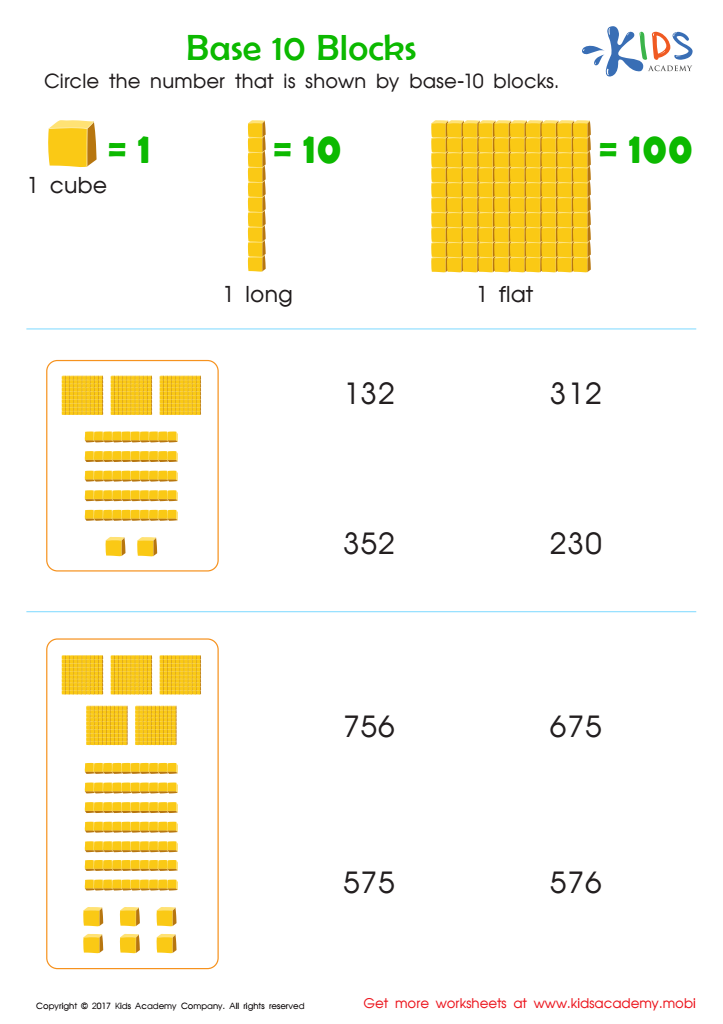
Base Ten Blocks Worksheet
When school ends, your child can still practice place value at home with this base ten blocks worksheet. They'll count and circle the right number, gaining mastery of the concept. It's a fun, easy way to hone their skills!
Base Ten Blocks Worksheet
Worksheet
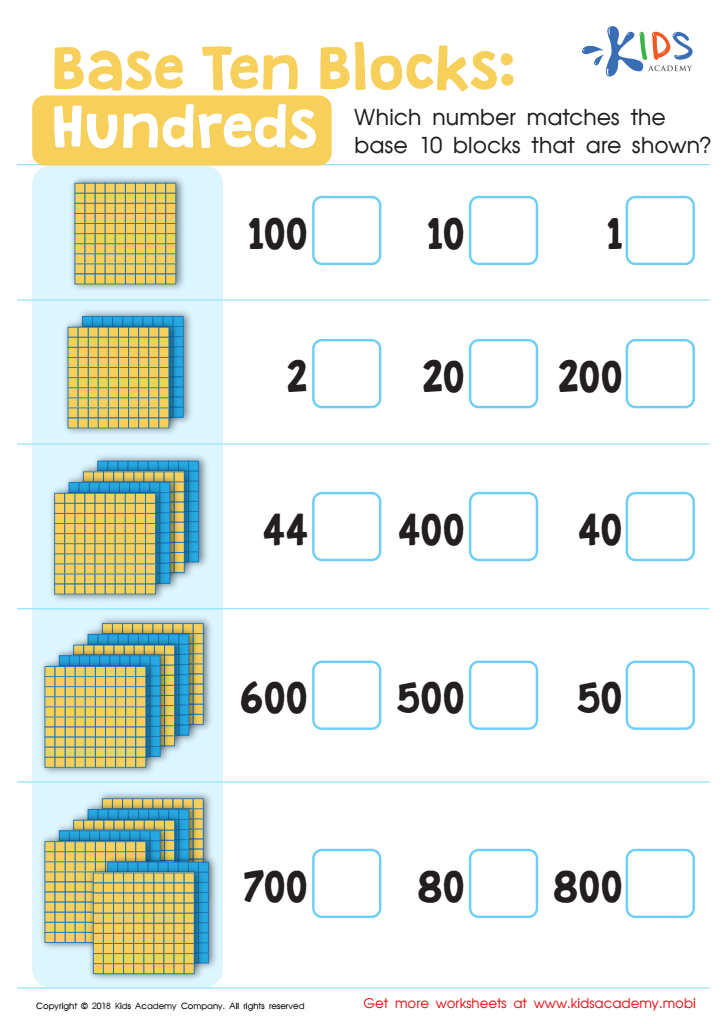
Base Ten Blocks: Hundreds Worksheet
Help your child overcome their dislike of math by guiding them with this base ten blocks worksheet. Count the blocks and answer the questions together. Ask them which number matches the base ten blocks shown. This will help them solve math problems more easily.
Base Ten Blocks: Hundreds Worksheet
Worksheet
Join Kids Academy for Free
Who is primarily going to use this learning content?




%20(1).jpg)

Understanding base ten math is crucial for children aged 7-8 because it forms the foundation for their future mathematical learning. At this stage, children transition from learning basic arithmetic to more complex concepts, and a strong grasp of base ten helps them understand addition, subtraction, multiplication, and division.
Base ten is the numeric system that uses powers of ten to represent numbers, emphasizing the significance of each digit's position. For instance, understanding that the "3" in "23" represents 20 and that the "3" represents 3 units is essential. This comprehension aids in mental math and problem-solving skills, making students more confident in their abilities.
Additionally, mastery of base ten enables learners to perform multi-digit calculations, such as regrouping in addition and borrowing in subtraction. It is also vital for later concepts like fractions and decimals, as these rely on an understanding of whole numbers.
Educators and parents play a pivotal role in reinforcing these concepts through engaging activities and practical applications. Investing time in understanding base ten math not only builds mathematical skills but also nurtures critical thinking and logical reasoning, fostering a solid foundation for lifelong learning in math and beyond.








