Fine Motor Skills Letter E Worksheets for Ages 7-9
3 filtered results
Difficulty Level
Grade
Age
-
From - To
Subject
Activity
Standards
Enhance your child's fine motor skills with our engaging Letter E worksheets designed for ages 7-9. These printable activities provide a fun and interactive way for kids to develop hand-eye coordination and handwriting precision while reinforcing their understanding of the letter E. From tracing and coloring to cutting and gluing, each worksheet is tailored to boost dexterity and creativity. As children work through these exercises, they will not only improve their motor skills but also build confidence in their ability to write and recognize the letter E. Perfect for home or classroom learning, these worksheets promote both education and enjoyment!
Favorites
With answer key
Interactive
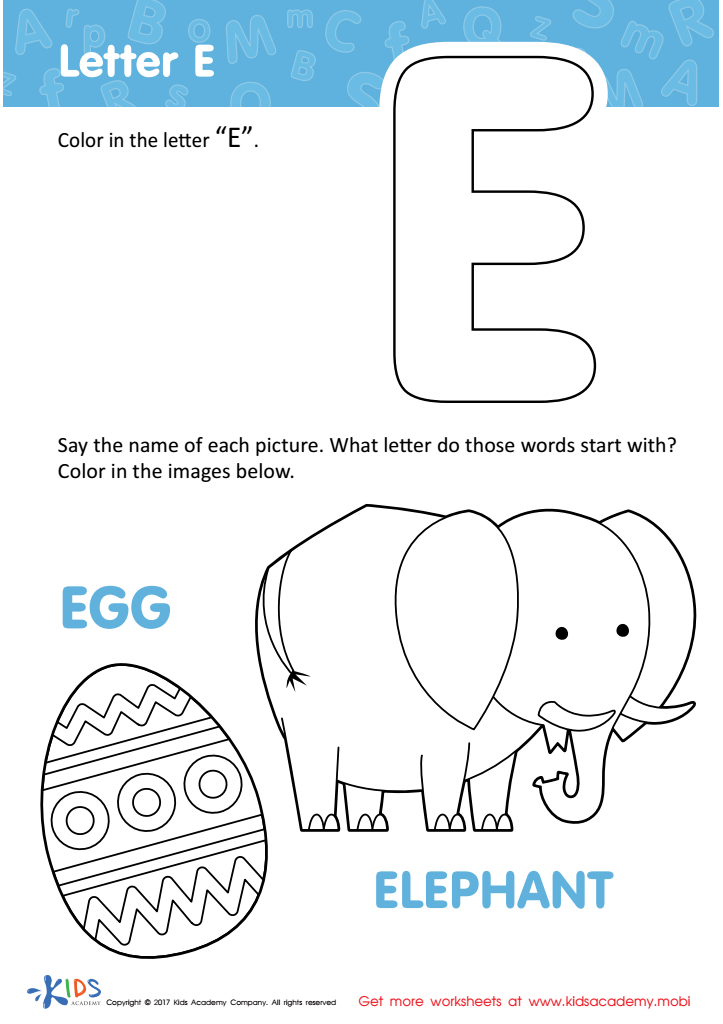
Letter E Coloring Sheet
Coloring pages are great for teaching kids the alphabet and words! This "E" page features a cute elephant and Easter egg. Kids will love it and learn the letter "E" at the same time. 80 words
Download (PDF)
 Assign to My Students
Assign to My Students
Letter E Coloring Sheet
Worksheet
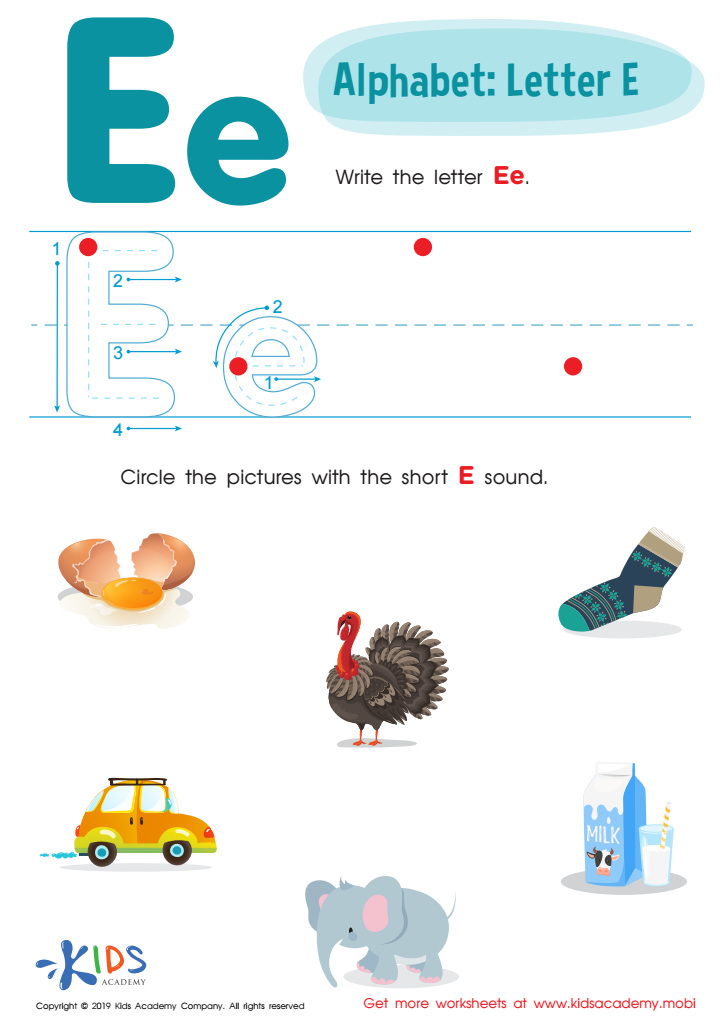
Letter E Tracing Worksheet
Students trace and write uppercase and lowercase letter E. They sound out "E" words, choosing those with short "E" sounds. Preschoolers identify the difference between the 'E' sounds in words like "egg" and "turkey." A tracing sheet helps them to understand.
Letter E Tracing Worksheet
Worksheet
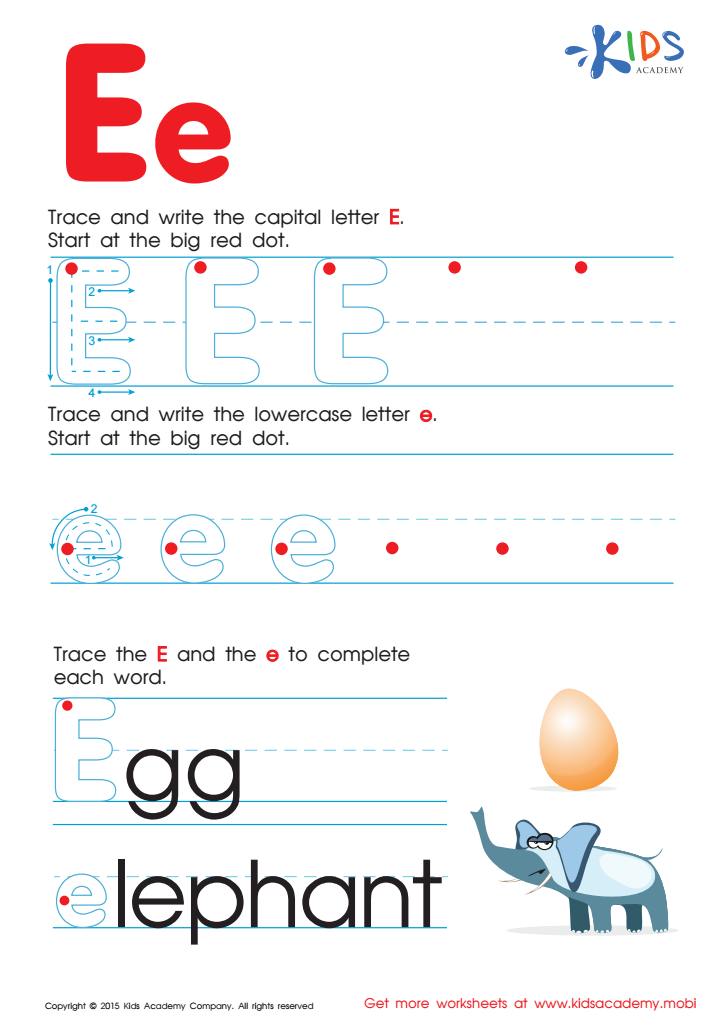
Letter E Tracing Page
Trace and write the uppercase and lowercase "E" starting at the big red dot. Complete words to perfect letter writing. Egg and Elephant must be written carefully. More alphabet worksheets for kindergarten are available for download to spend more time with your children learning.
Letter E Tracing Page
Worksheet
Join Kids Academy for Free
Who is primarily going to use this learning content?







Fine motor skills are crucial for children aged 7-9, as they are foundational for various daily activities and academic tasks. Mastering fine motor skills, including those involved in writing the letter "E," enhances children's ability to manipulate tools, from pencils to scissors, thereby improving their overall dexterity. An emphasis on this specific letter can help hone their pre-writing techniques, aiding in legible handwriting that is essential for clear communication.
Furthermore, as children in this age group shift from learning to write to writing to learn, proficient fine motor skills support their ability to take notes, complete assignments, and express ideas in written form. Development in this area can also influence academic confidence; children with well-developed fine motor skills may exhibit greater motivation to participate in classroom activities.
Additionally, fine motor skills link to critical cognitive development areas, such as problem-solving and concentration. Through engaging in activities focused on the letter "E," parents and teachers ensure that children not only master essential letters but also foster overall neurological growth. By prioritizing fine motor development, caregivers can better support a child's journey toward independent learning and self-expression.