
Mathematical thinking Worksheets for Ages 7-9
4 filtered results
Difficulty Level
Grade
Age
-
From - To
Subject
Activity
Standards
Unlock your child's mathematical potential with our engaging Mathematical Thinking Worksheets designed for ages 7 to 9. These worksheets promote critical thinking, problem-solving, and mathematical reasoning through fun activities tailored to this essential developmental stage. Children will explore addition, subtraction, patterns, and basic geometry, fostering a deep understanding of key concepts. Each worksheet is crafted to enhance learning while keeping students motivated and excited about math. Parents and teachers can easily access these resources online, making it convenient to provide extra support at home or in the classroom. Transform math into an enjoyable adventure and help foster a lifelong love for learning!
Favorites
With answer key
Interactive
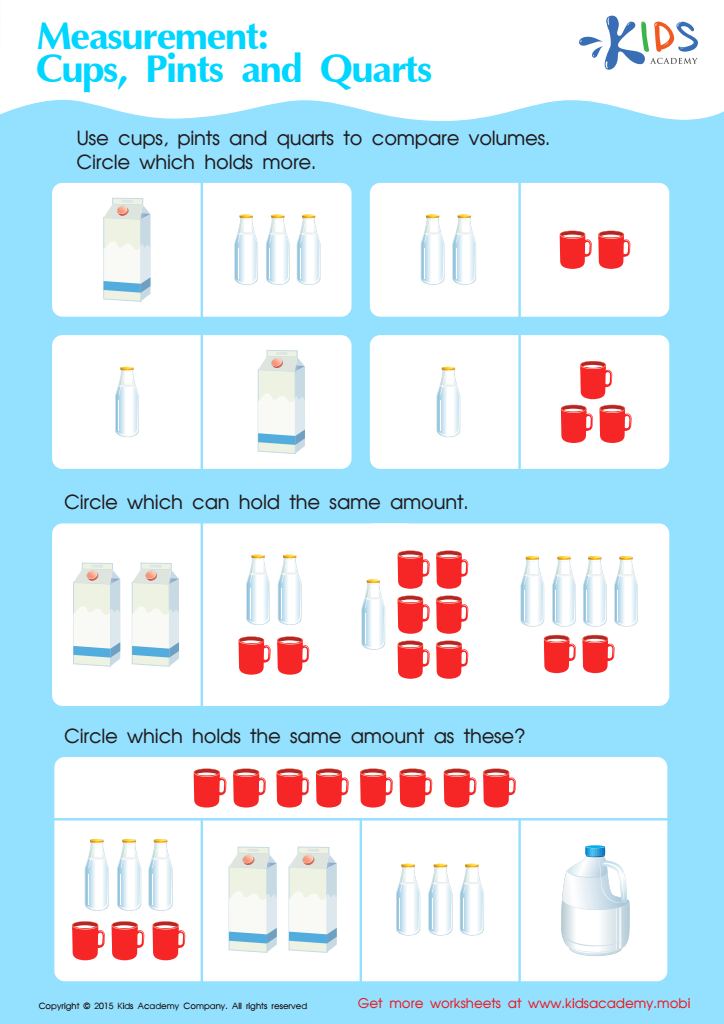
Measurement: Compare Volumes Worksheet
Compare volumes with Kids Academy and have fun! (80 words)
Practice measuring with Kids Academy and have fun! Compare volumes in pictures and circle which holds more. Keep learning with free math worksheets available on our website. Enjoy the process and have fun!
 Assign to My Students
Measurement: Compare Volumes Worksheet
Worksheet
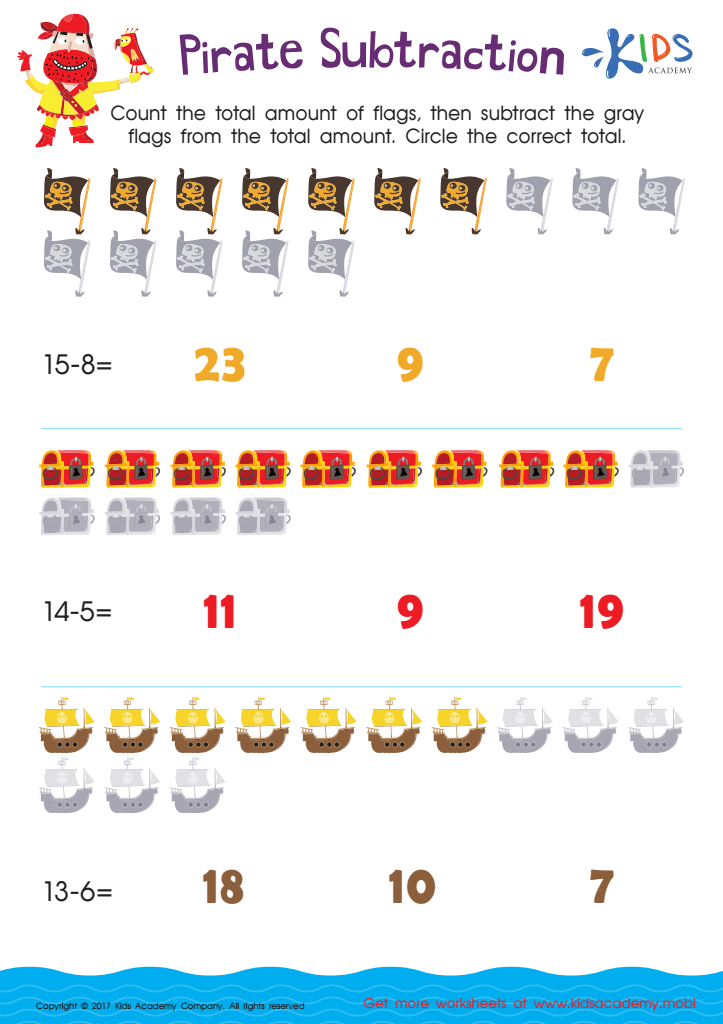
Pirate Subtraction Substraction Worksheet
Ahoy! Learn to subtract with pirate-themed math fun! This worksheet has ships and treasure chests to help your little one understand subtraction using a helpful strategy. Colorful illustrations make it a great learning experience.
Pirate Subtraction Substraction Worksheet
Worksheet
Join Kids Academy for Free
Who is primarily going to use this learning content?








Mathematical thinking during ages 7-9 is crucial as it lays the foundation for higher-order cognitive skills essential for lifelong learning. At this stage, children are transitioning from concrete to abstract reasoning, making it an ideal time to cultivate their problem-solving abilities and critical thinking skills. Mastering mathematical concepts helps children to understand patterns, relationships, and structures, which reinforces their ability to analyze and interpret information across subject areas.
Moreover, developing mathematical thinking nurtures confidence and perseverance. As children face mathematical challenges, they learn to approach problems systematically and develop strategies to resolve them. This process fosters resilience, an important quality that they will carry into future academic endeavors.
Mathematical thinking is also linked to everyday life skills, as children learn to apply math in real-world situations—such as budgeting, measuring, and time management. Encouraging parents and teachers to prioritize math can create a supportive environment that not only improves mathematical skills but also enhances cognitive development overall. Ultimately, a strong foundation in mathematical thinking prepares children for success in school and beyond, enabling them to tackle increasingly complex ideas as they progress through their education.








