Mathematical reasoning Adding up to 1000 with Regrouping Worksheets for Ages 7-9
3 filtered results
-
From - To
Enhance your child's mathematical reasoning with our "Adding up to 1000 with Regrouping Worksheets for Ages 7-9." Designed to build confidence and understanding, these worksheets make complex addition clear and approachable. Regrouping becomes second nature as children practice adding numbers up to 1000, honing their skills through structured, engaging exercises. Perfect for reinforcing classroom learning or extra practice at home, our worksheets foster critical thinking and fluency in arithmetic. Unlock the full potential of young learners and transform math into a fun, rewarding activity today with Kids Academy's expertly crafted resources!
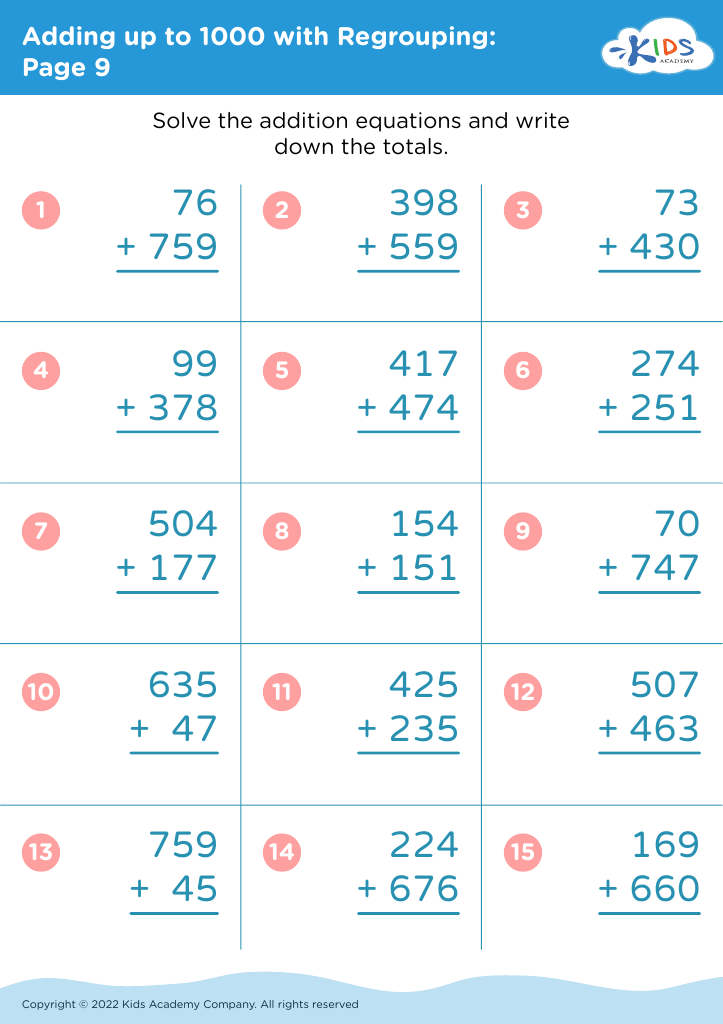
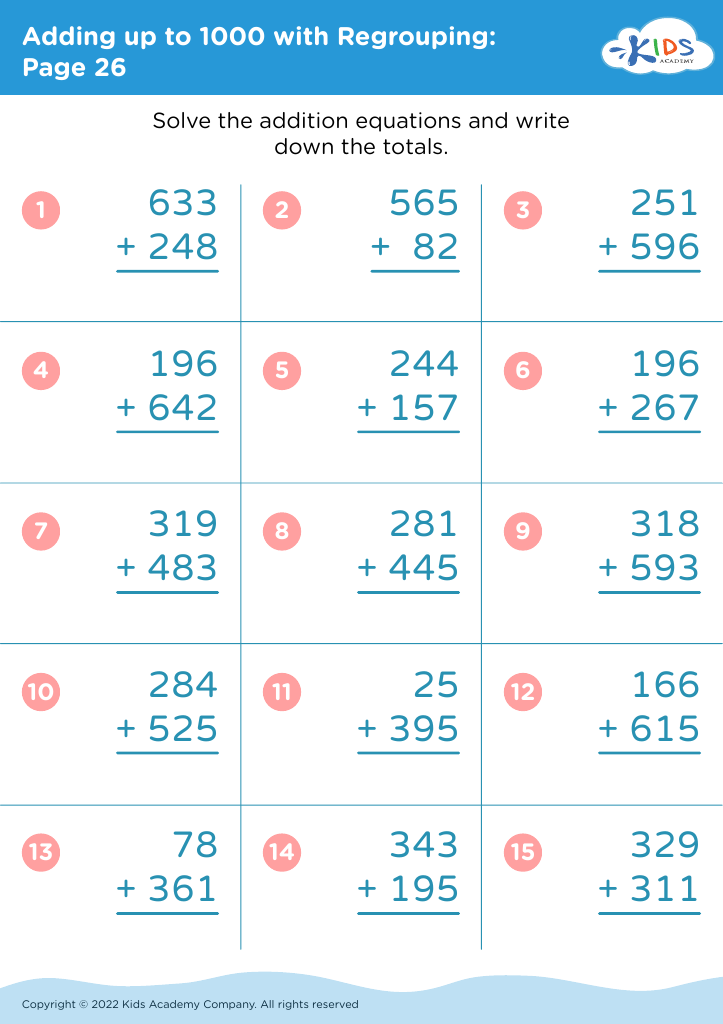
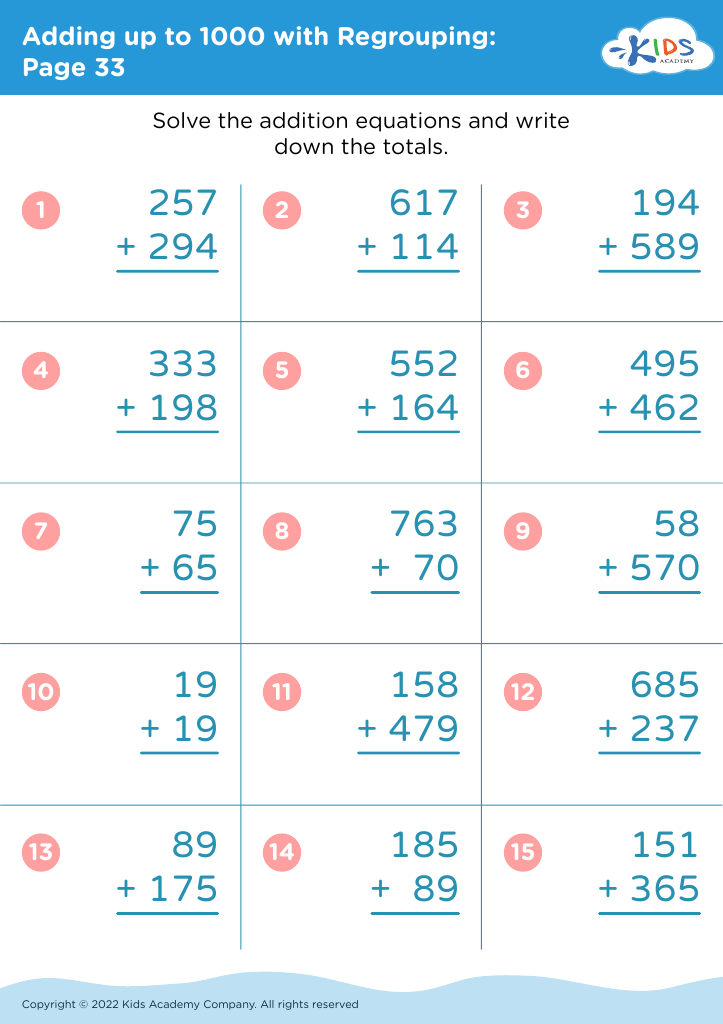


Parents and teachers should care about mathematical reasoning, especially when it includes adding up to 1000 with regrouping, for children aged 7-9 because it establishes a crucial foundation for their future academic success and everyday problem-solving skills. At this age, children are transitioning from basic arithmetic to more complex concepts, and understanding how to regroup — or carry and borrow — is essential for accurate addition and subtraction. This skill enhances number sense and helps children grasp the base-ten system, which is fundamental in mathematics.
Moreover, mastering these concepts early on fosters confidence in students’ abilities to tackle more challenging math problems later. Regrouping practices model logical thinking and efficient strategies, which are key components of mathematical reasoning. These skills transfer beyond the classroom — for example, when budgeting their allowance or dividing up items, children need to understand how numbers can be broken down and reorganized.
Furthermore, developing strong mathematical reasoning sparks curiosity and analytical thinking, nurturing a positive attitude towards math. It's an investment in their overall cognitive development, encouraging perseverance and critical thinking skills that benefit all areas of learning. Thus, parents and teachers play a vital role in supporting and encouraging proficiency in these early, yet foundational, mathematical skills.