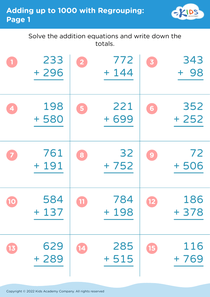
Recognize patterns Adding up to 1000 Without Regrouping Worksheets for Ages 7-9
3 filtered results
-
From - To
Enhance your child's math skills with our "Recognize Patterns Adding up to 1000 Without Regrouping Worksheets" tailored for ages 7-9! These engaging worksheets help young learners detect numerical patterns while adding numbers up to 1000, all without the complexity of regrouping. Kids will enjoy structured, easy-to-follow exercises that boost their problem-solving strategies and sharpen mental math abilities. Perfect for classroom use or at-home practice, these worksheets ensure your child advances confidently in math. Support their journey toward math proficiency with Kids Academy’s expertly designed resources. Discover the fun in learning while achieving mastery of essential math patterns today!
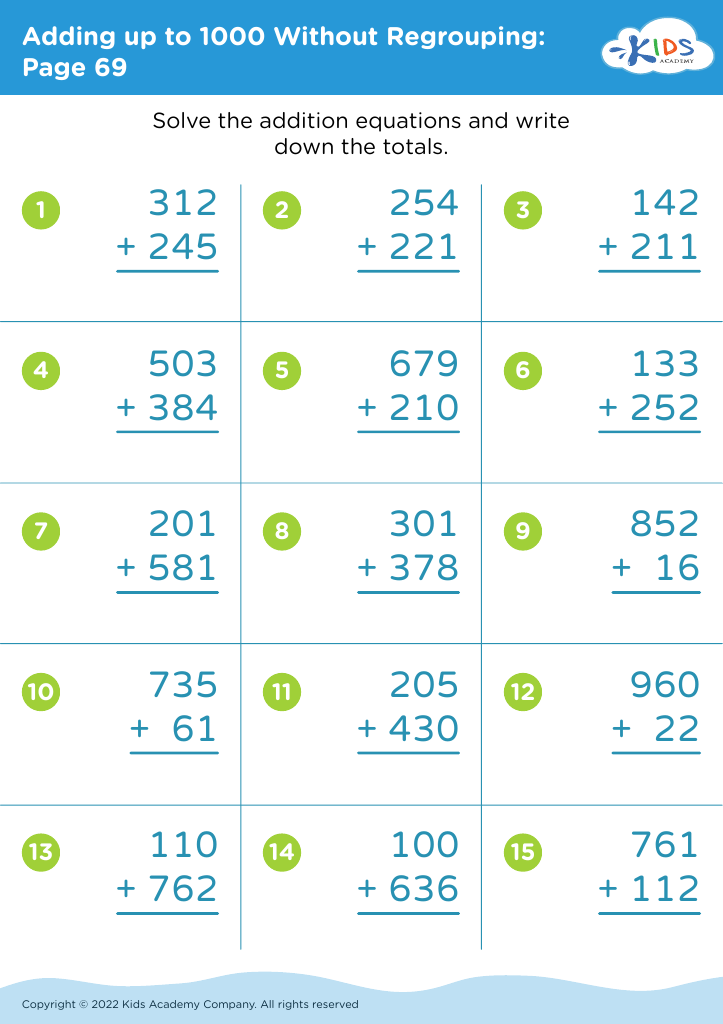
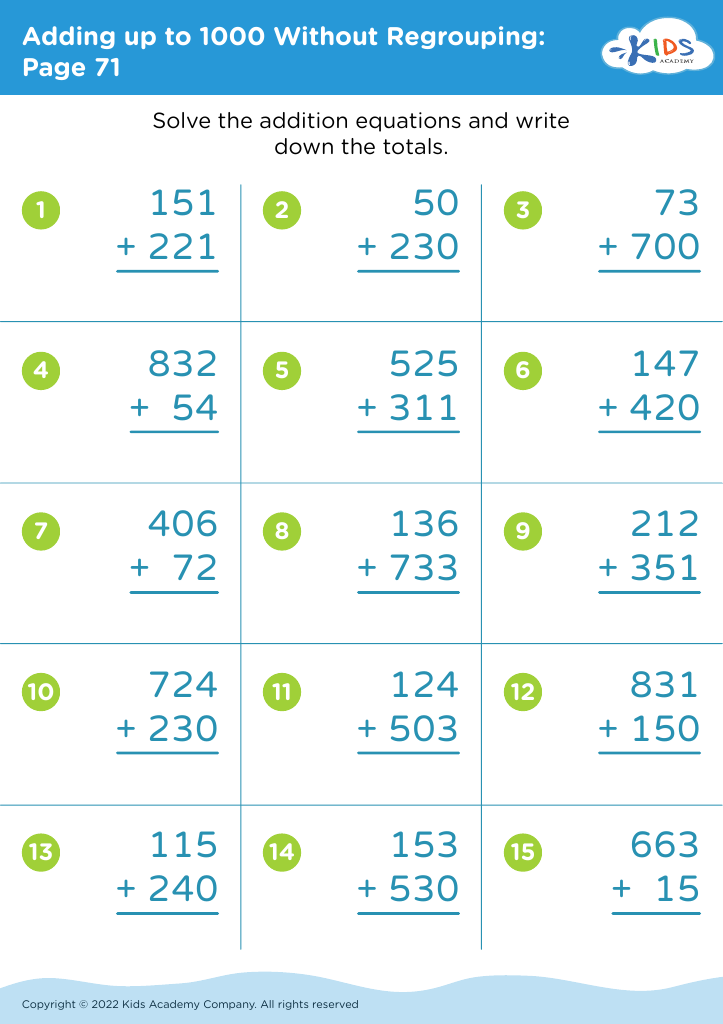
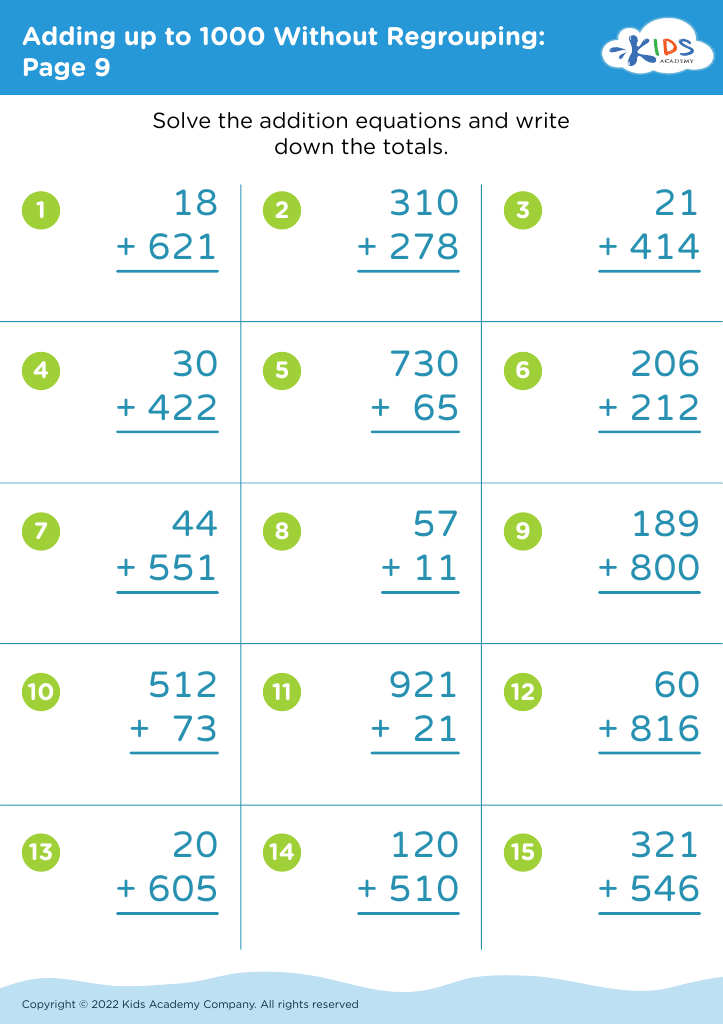


Understanding patterns in addition problems and being able to add up to 1000 without regrouping are crucial skills for children aged 7-9. At this developmental stage, children are solidifying their understanding of basic arithmetic, and recognizing patterns helps them make sense of more complex mathematical concepts.
When children learn to identify patterns, they improve their problem-solving skills, which can be applied across various subjects and in real-life situations. For example, recognizing that shifting digits eastward in a number adds a constant, practicing this makes it more intuitive to manage larger numbers.
Adding numbers without regrouping reinforces place value understanding and mental math skills. These foundational abilities significantly contribute to their confidence and proficiency in math. Learning this smoothly thanks to constant rules sharpens their mind to transitioning them later to more advanced arithmetic involving regrouping and carrying over, bridging between foundational and complex mathematical operation steps.
Moreover, fostering these early arithmetic skills can stimulate a positive attitude towards learning math, reducing anxiety and building resilience in the face of more challenging problems later. Therefore, both parents and teachers play a crucial role in encouraging and supporting children as they develop these key skills, whether through games, engaging exercises, or practical daily examples— setting students up for ongoing academic success.