Understanding division Adding up to 1000 Without Regrouping Worksheets for Ages 7-9
3 filtered results
-
From - To
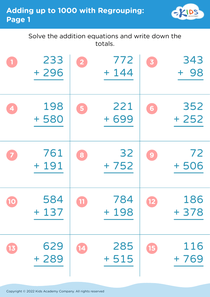
Explore our "Understanding Division Adding up to 1000 Without Regrouping Worksheets for Ages 7-9"! Designed to build strong foundational skills in mathematics, these worksheets focus on adding large numbers up to 1000 without the need for regrouping, making it easier for young learners to grasp addition and division concepts. Perfect for children aged 7-9, these printable resources offer engaging activities that boost confidence and proficiency in math. Ideal for both classroom use and home practice, these worksheets ensure consistent progress with carefully structured tasks that simplify complex problems, fostering a love for math in every child.
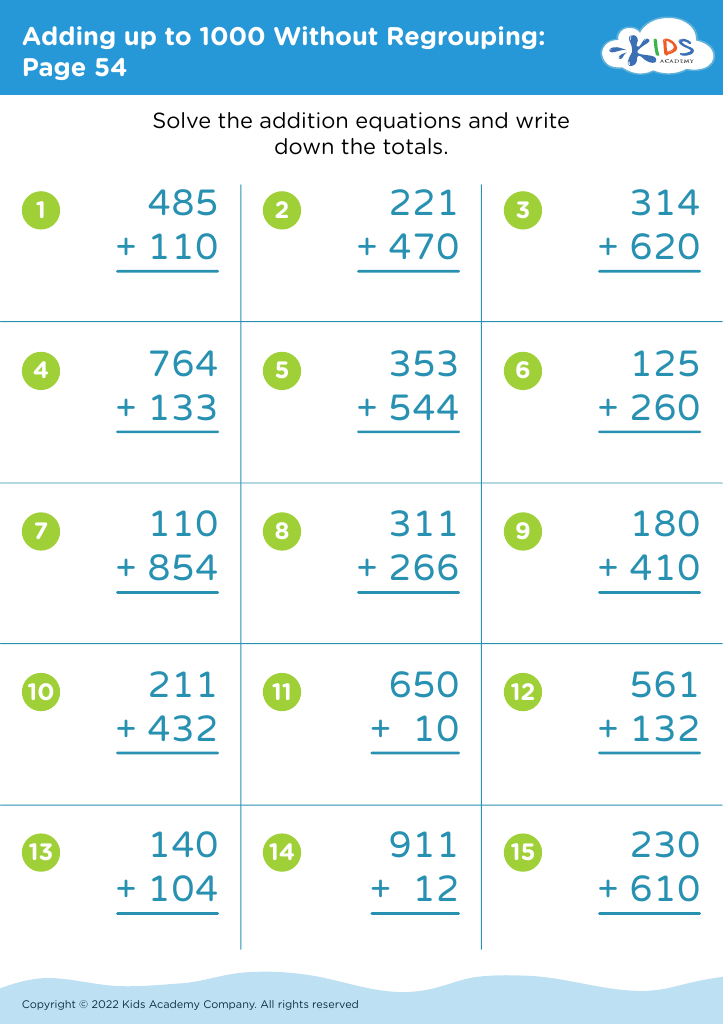
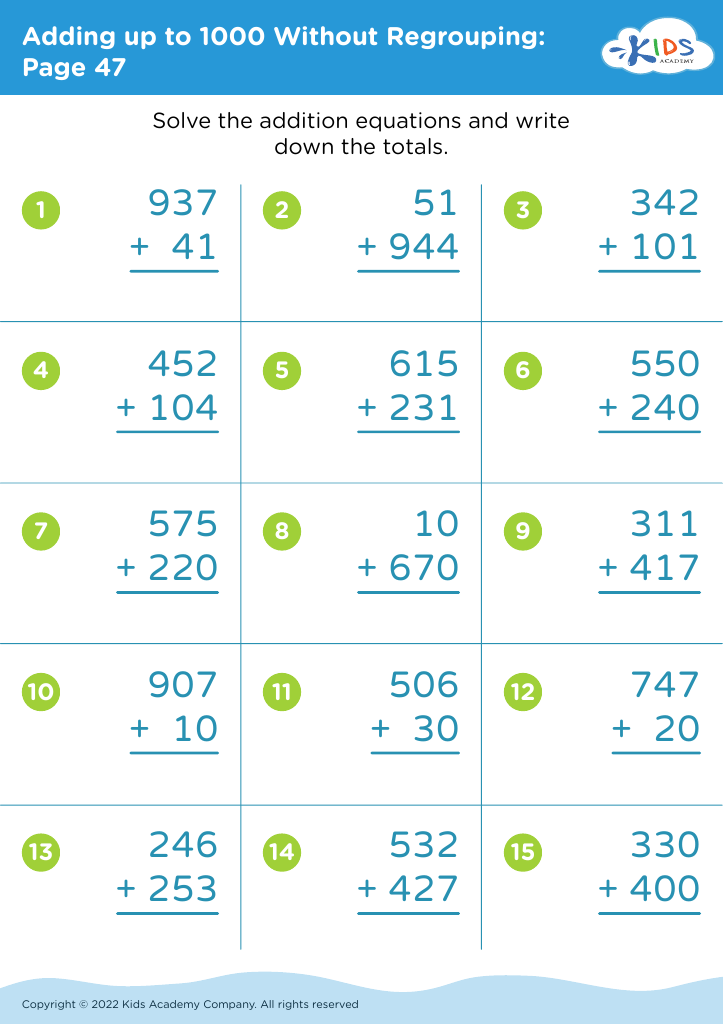
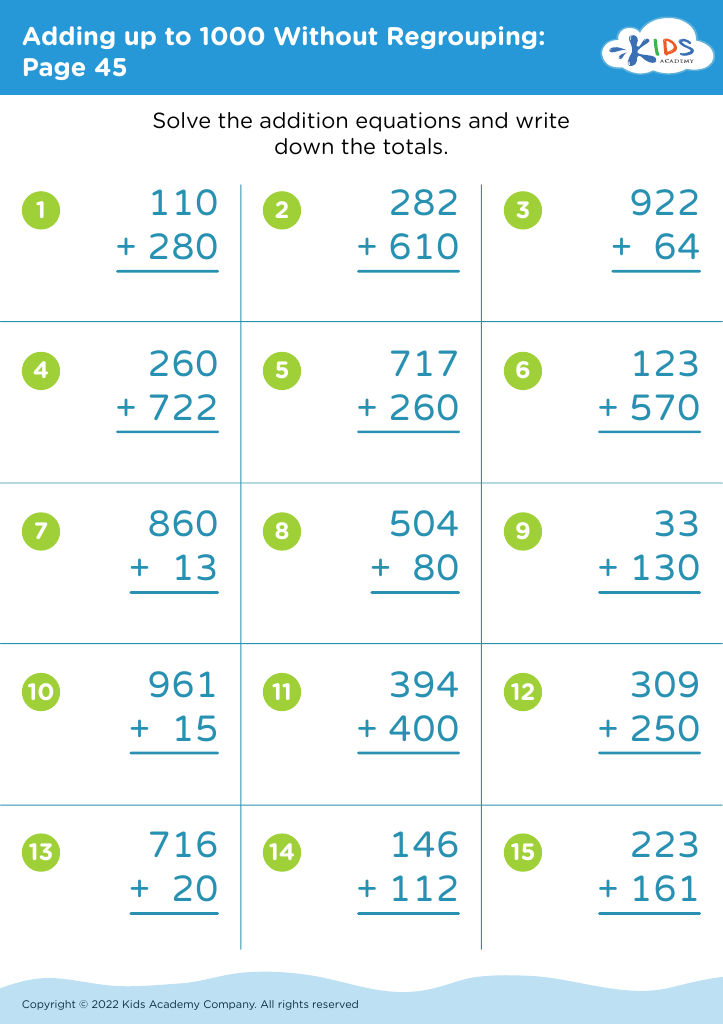


Understanding division and mastering addition up to 1,000 without regrouping are crucial foundational skills for children aged 7-9. These skills are not just about mathematics but developing logical thinking, problem-solving abilities, and confidence in handling numbers.
At this age, children's cognitive abilities are developing rapidly, and introducing them to division helps them comprehend how numbers are broken down and shared equally. It enhances their understanding of how numbers relate to each other, laying a strong foundation for more complex math concepts they'll encounter later. Division also teaches students about fairness and equal distribution, which are important life skills beyond the classroom.
Addition up to 1,000 without regrouping is equally important. It encourages children to practice carrying out calculations smoothly and accurately without needing to exchange values. It boosts their mental math capabilities, making daily activities, such as counting money or measuring ingredients, more manageable. Mastering this skill builds children’s confidence in performing calculations independently, preparing them for any learning that requires attention to detail and accuracy.
Both skills combined cultivate a child’s analytical thinking and attention to detail. By giving children the right foundation in these fundamental areas, teachers and parents are setting them up for lifelong success in not just mathematics, but in any field that involves logic and problem-solving.