Number Sequencing Adding up to 1000 Worksheets for Ages 7-9
5 filtered results
-
From - To
Explore our "Number Sequencing Adding up to 1000 Worksheets" tailored for ages 7-9! These engaging printables offer a fun and effective way for children to enhance their math skills. Students will enjoy sequencing numbers, identifying patterns, and solving problems that involve adding up to 1000. Perfect for classroom use or homeschooling, these worksheets support critical thinking and numeracy skills. With colorful designs and interactive tasks, learners are motivated to practice and improve their proficiency in number sequencing. Visit Kids Academy for top-quality resources that make learning math enjoyable and stress-free. Empower your child's mathematical journey today!
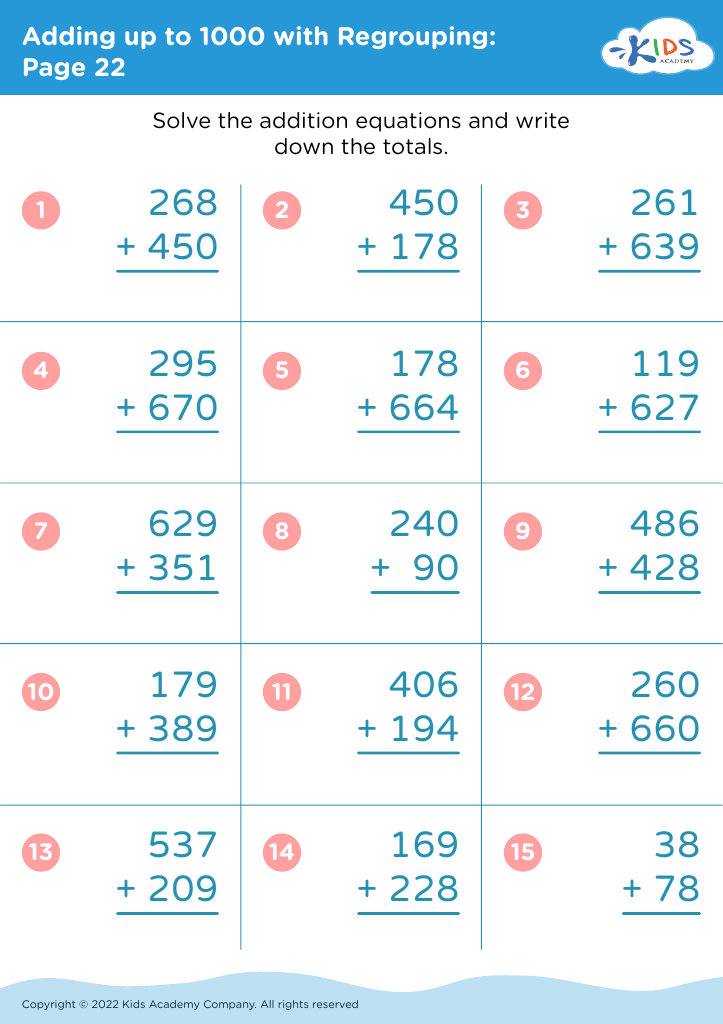
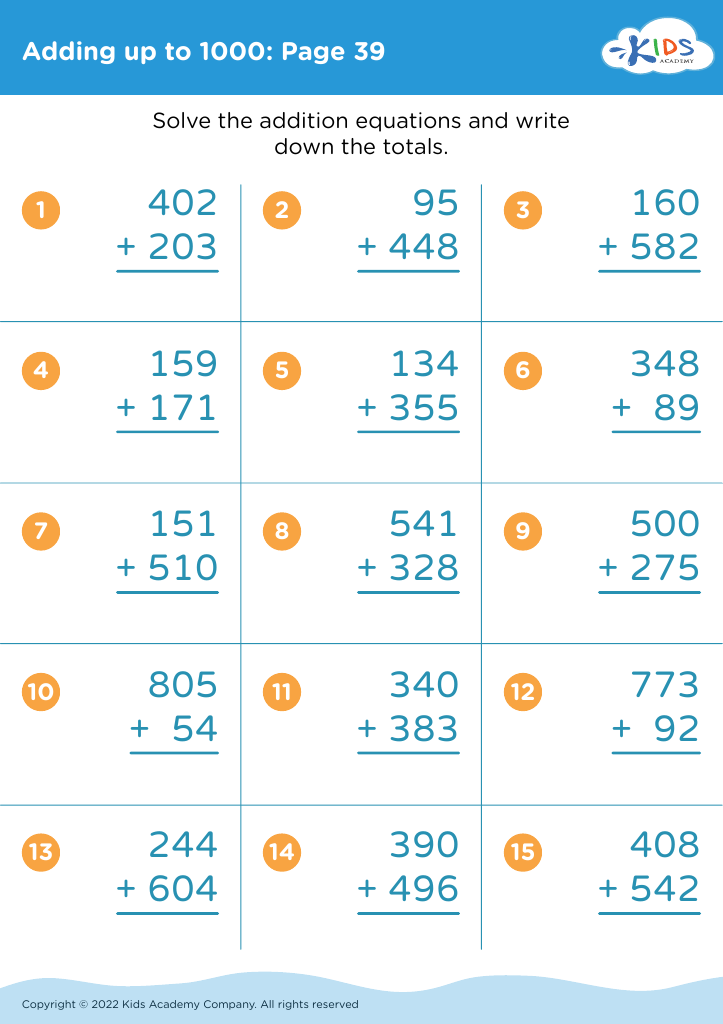
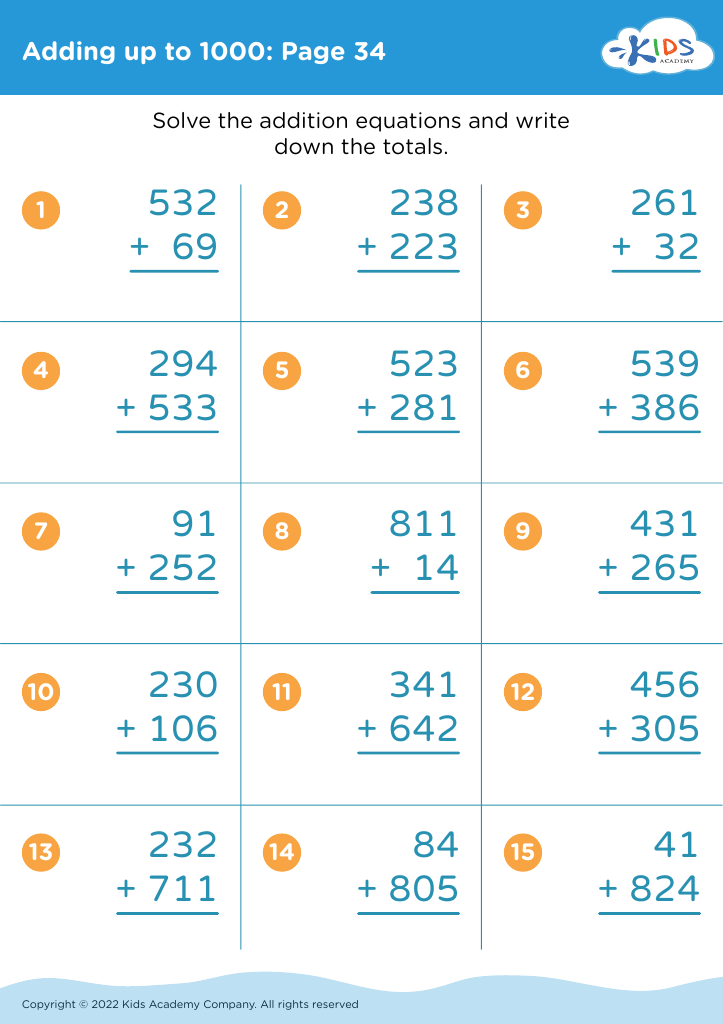
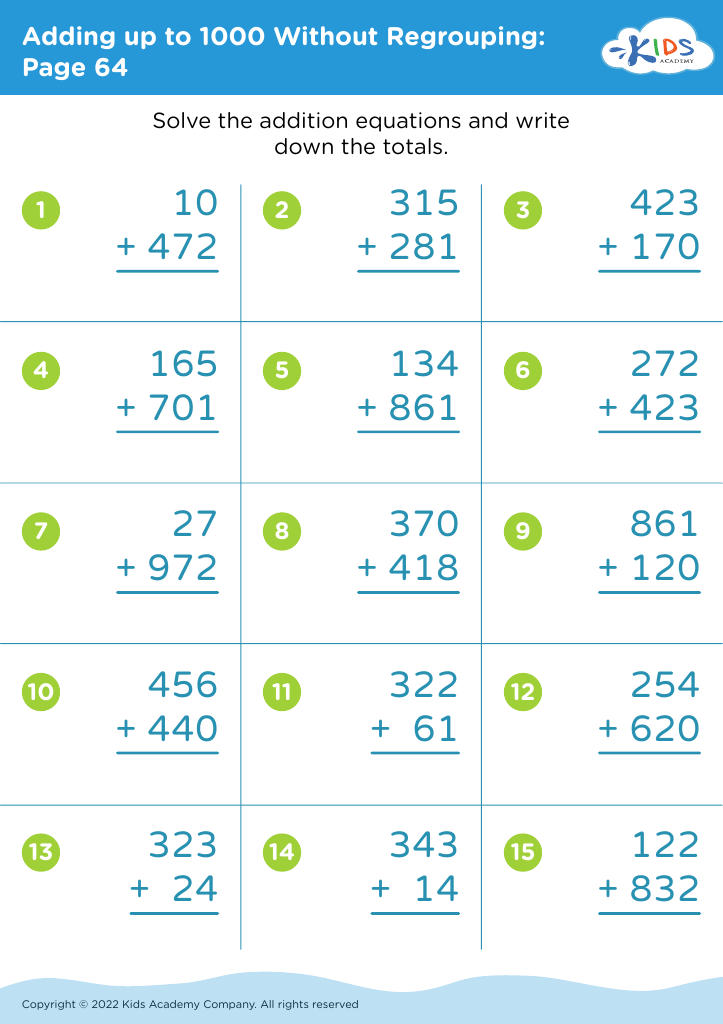
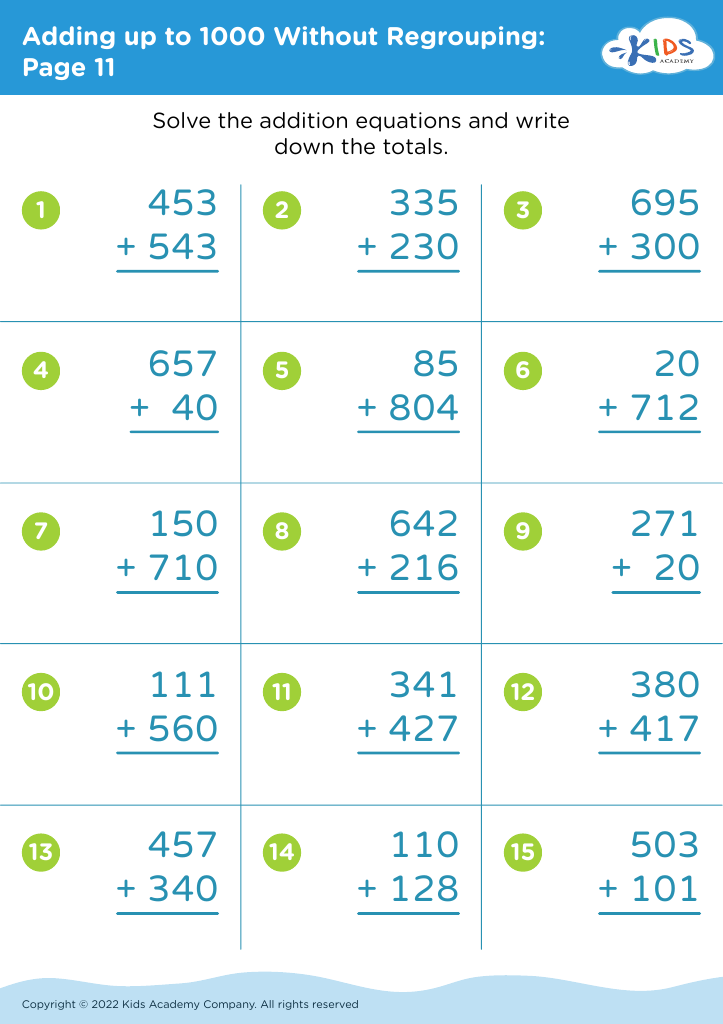



Number sequencing up to 1000 is an essential skill for children ages 7-9, as it forms a fundamental part of their mathematical foundation. At this developmental stage, understanding and working with larger numbers helps kids get comfortable with more advanced arithmetic concepts. First, it promotes number sense, enabling children to comprehend the size and position of numbers in a sequence. This understanding is crucial when they begin tackling addition, subtraction, multiplication, and division of larger numbers.
Moreover, engaging with number sequencing enhances logical thinking and problem-solving skills. As children recognize patterns and sequences, like counting by 2s, 5s, or 10s, they develop strategies to approach various math problems more effectively. This logical groundwork also dovetails with learning place value—a critical concept for understanding the decimal system and performing multi-digit arithmetic.
Another vital benefit is the improvement of cognitive skills such as concentration, memory, and mental math. Sequencing exercises encourage students to think ahead and recall number facts quickly, contributing to better performance in timed tasks and standardized tests.
Additionally, experience with number sequences fosters confidence and self-efficacy in math. When students see themselves progress in handling larger numbers, their confidence builds, creating a positive feedback loop that reinforces their enthusiasm for learning. Thus, parents and teachers should be keen on nurturing this skill to support holistic cognitive development and a strong mathematical foundation.








