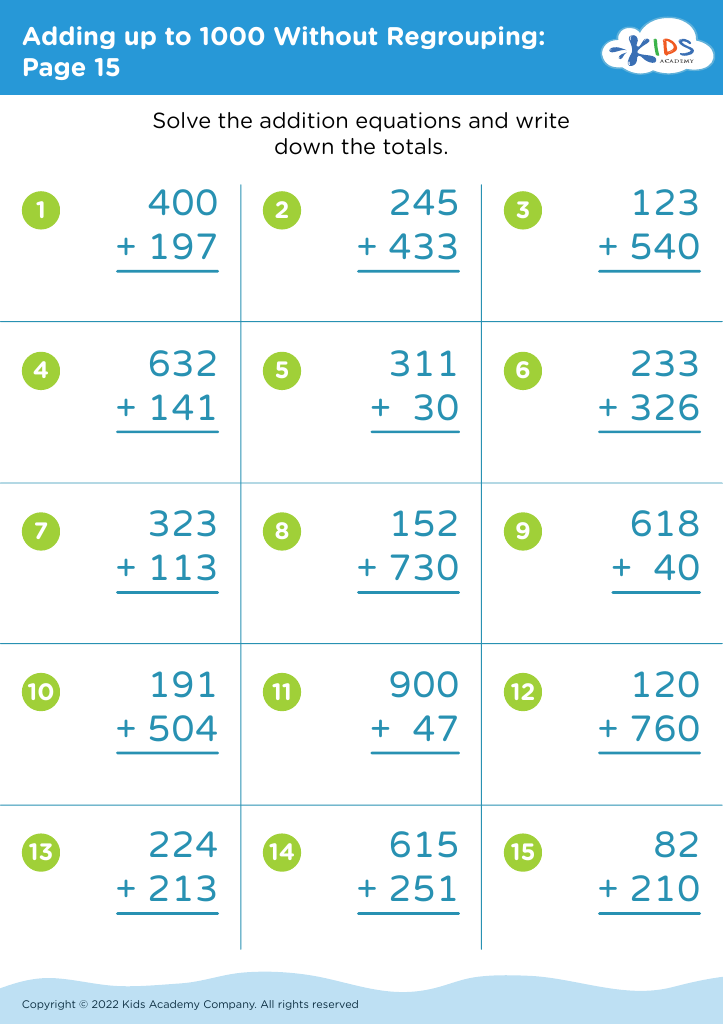




Problem-solving skills are essential for children ages 7-9, particularly when dealing with mathematical concepts like adding up to 1000. Cultivating these skills at a young age not only enhances their numerical abilities but also strengthens their overall cognitive development. Children who can confidently solve problems are more likely to develop resilience, critical thinking, and adaptability—qualities that will serve them throughout their education and beyond.
For parents and teachers, emphasizing problem-solving reinforces a child’s understanding of mathematical principles and patterns. Adding up to 1000 involves a deeper comprehension of place value, number sense, and operational fluency. It encourages a child to break down complex problems into manageable steps, fostering a methodological approach to tasks.
Furthermore, these skills are highly transferrable and instrumental in everyday life. Whether it's budgeting pocket money or planning a schedule, a solid foundation in problem-solving prepares children for real-world scenarios. Parents and teachers who prioritize these skills create a supportive environment that champions curiosity and experimentation, promoting an enduring love for learning. In essence, nurturing problem-solving abilities lays down a vital cornerstone for a child’s holistic development and future academic success.








