Understand patterns Adding up to 1000 Worksheets for Ages 7-9
3 filtered results
-
From - To
Unlock the power of math with our "Understand Patterns Adding up to 1000 Worksheets" designed specifically for children ages 7-9. These engaging worksheets help young learners recognize mathematical patterns, promoting critical thinking and problem-solving skills as they tackle addition up to 1000. With a variety of exercises, students will explore number sequences, visual representations, and relatable examples that make learning fun and effective. Perfect for classroom activities or at-home practice, these worksheets boost confidence in arithmetic while adhering to educational standards. Empower your child’s math journey and make mastering addition an enjoyable experience with our thoughtfully crafted resources!
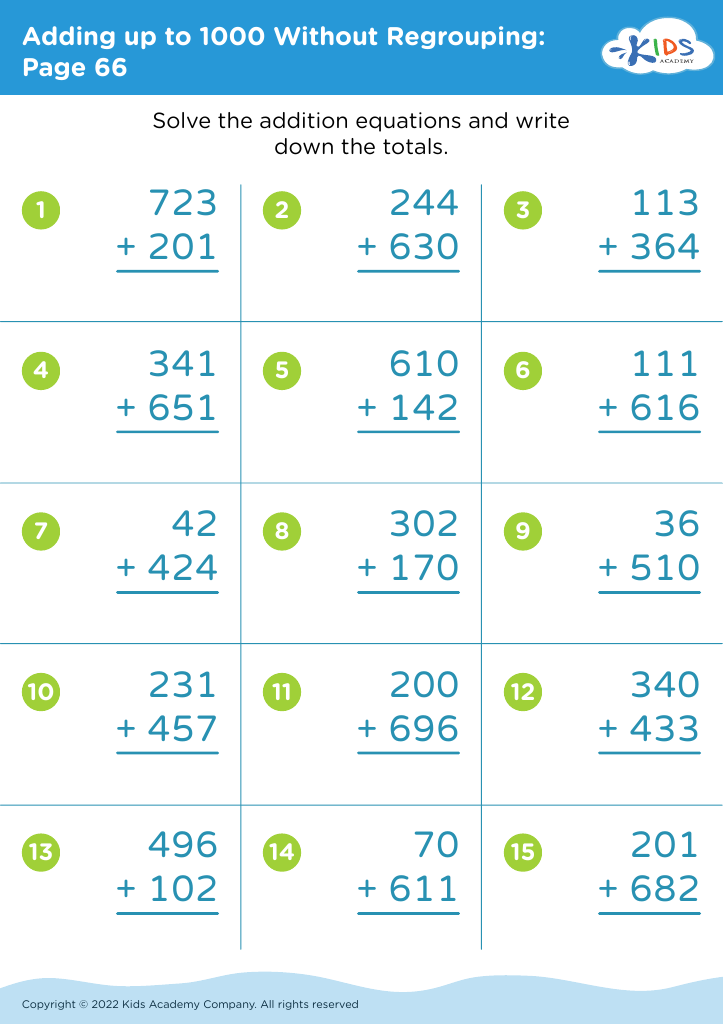
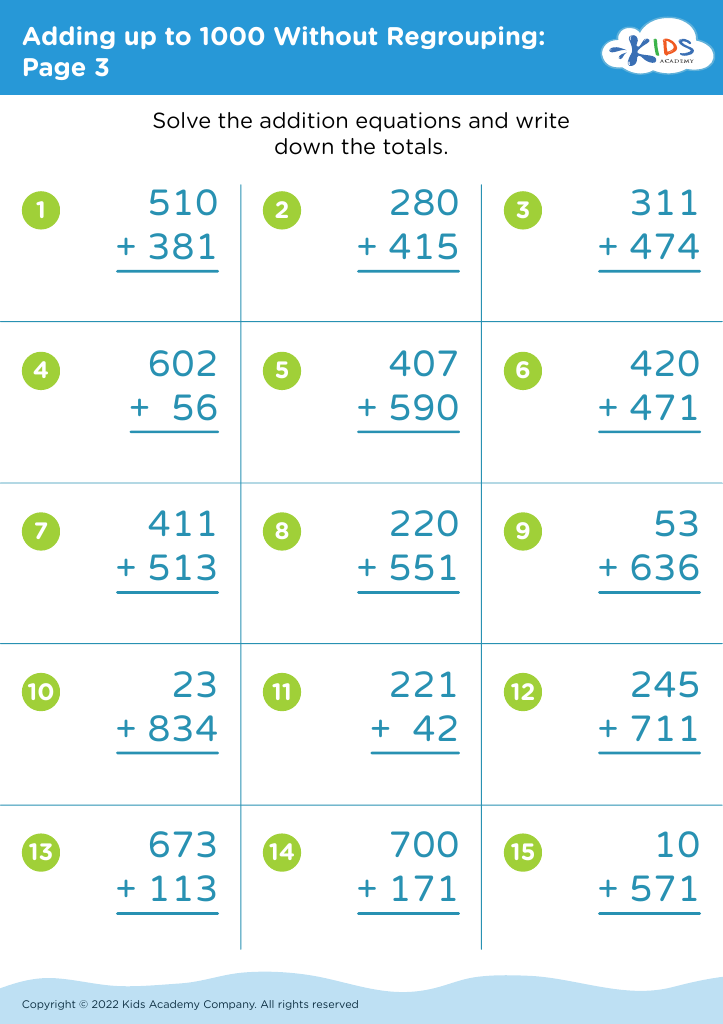
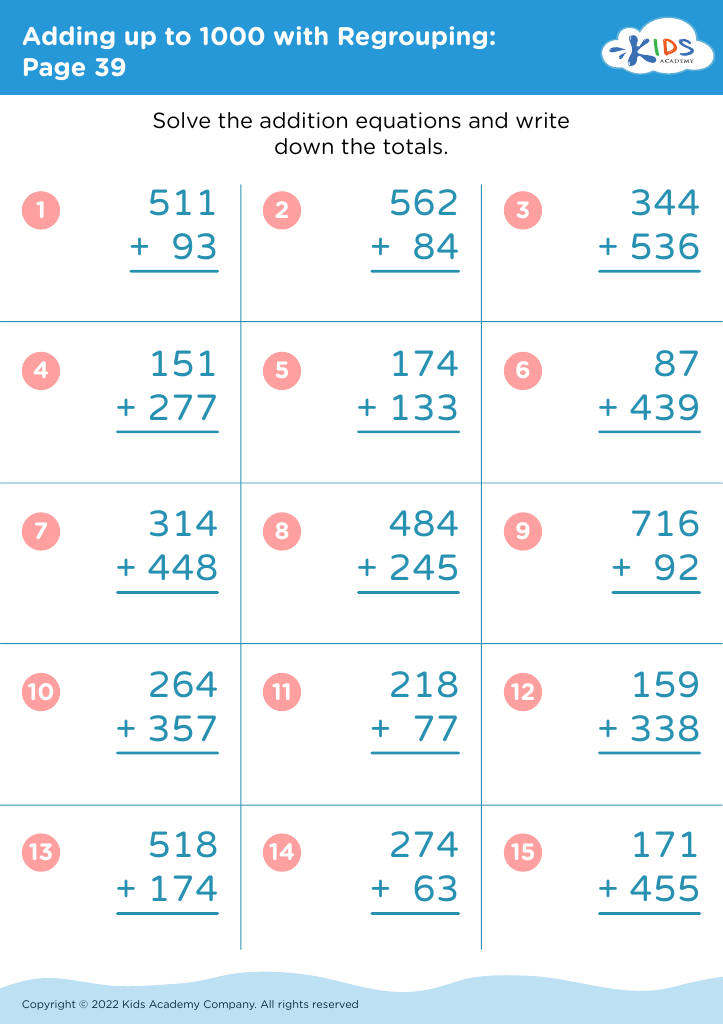



Understanding patterns and adding up to 1000 is crucial for children aged 7-9 as it forms the foundation for their mathematical literacy and problem-solving skills. During this developmental stage, children become more adept at recognizing numerical relationships and patterns, which are essential for higher-level math concepts such as algebra and geometry.
By focusing on patterns, children learn to identify repetitions and trends, aiding them in predicting outcomes and solving real-life problems. For example, recognizing patterns empowers them to efficiently increase or decrease numbers when making calculations. Furthermore, the ability to add up to 1000 enhances their numerical fluency and increases confidence when dealing with larger numbers often encountered in their future educational journey.
Parents and teachers play a vital role by engaging children in exercises that focus on patterns and addition, encouraging collaboration and creativity in problem-solving. These activities can take various forms, from manipulatives in a classroom setting to fun games at home, making learning enjoyable. Ultimately, mastering these skills at an early age not only helps with academic performance but also prepares children for everyday situations requiring basic math competencies, establishing a robust framework for their continuous learning journey.








