Understanding division Adding up to 1000 Worksheets for Ages 7-9
3 filtered results
-
From - To
Boost your child's math skills with our "Understanding Division Adding up to 1000 Worksheets for Ages 7-9"! Designed to make learning fun and interactive, these worksheets help young learners grasp essential division concepts while practicing addition up to 1000. Our engaging activities provide a solid foundation for mathematical proficiency, linking division with real-world scenarios to enhance understanding. Tailored for ages 7-9, these printable resources support classroom learning and home practice, fostering confidence and competence in math. Empower your child to succeed with our expertly crafted worksheets, ensuring a bright future in mathematics. Explore today and make division enjoyable!
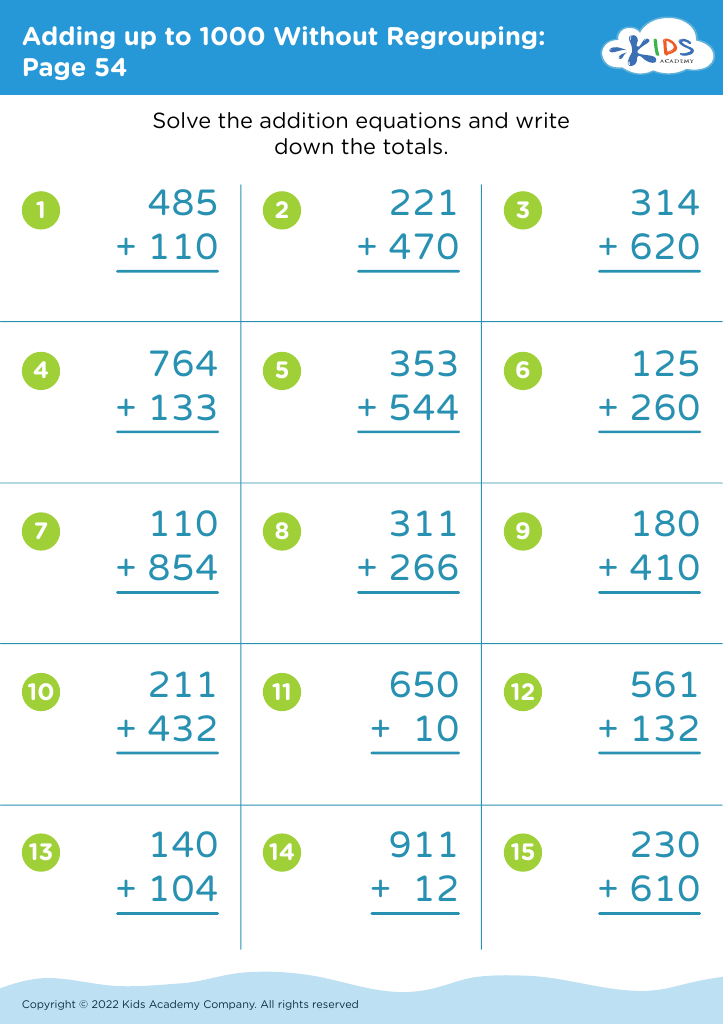
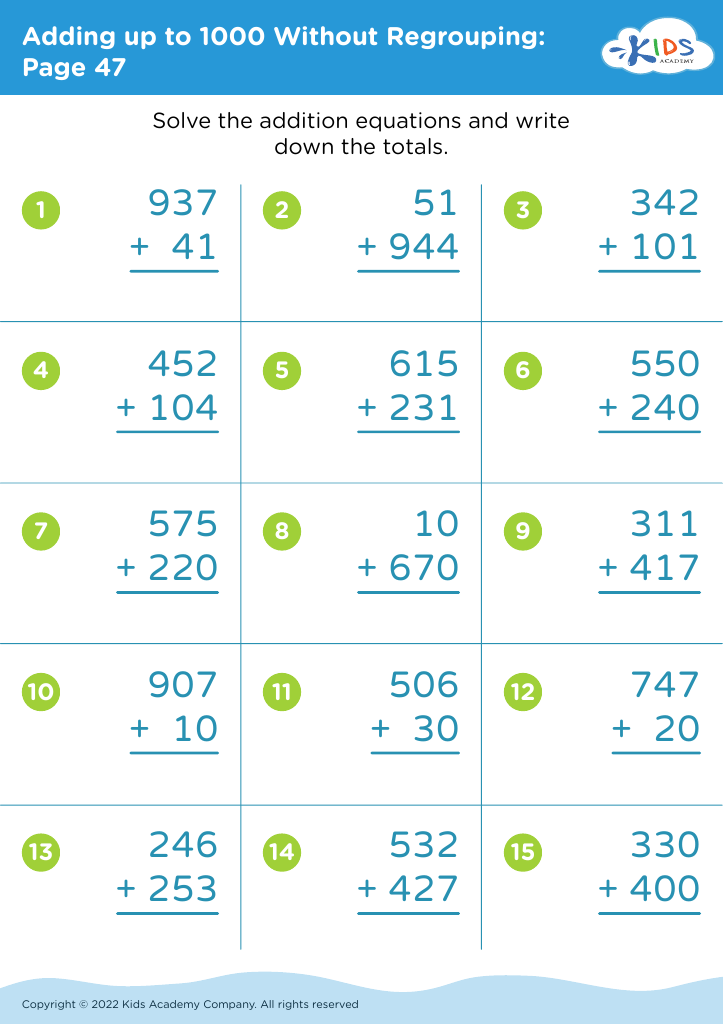
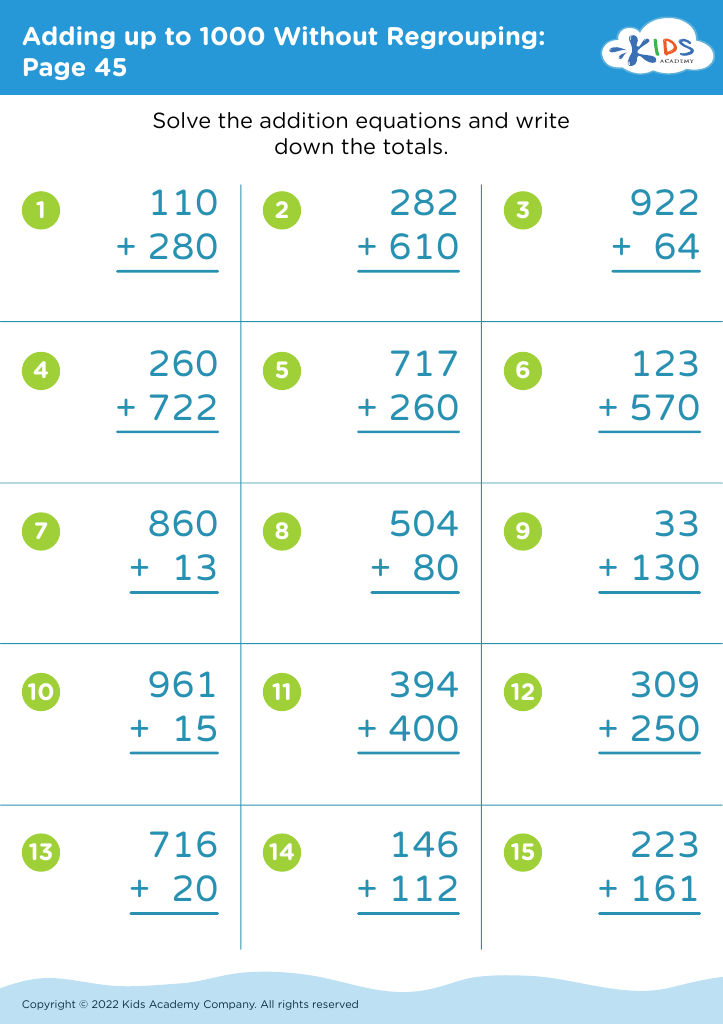



Understanding division and adding up to 1000 for children ages 7-9 is crucial for laying a strong mathematical foundation. Division is a fundamental operation in math that introduces children to the concept of sharing and distributing equally. Comprehending division ignites their analytical thinking and problem-solving skills, which are essential in everyday life and across various academic disciplines. Similarly, mastering addition up to 1000 deepens their arithmetic skills, allowing them to handle larger numbers with confidence, enhance mental calculation abilities, and improve numerical fluency.
Developing a sound understanding of these concepts at an early age is advantageous for several reasons. First, it helps children build self-confidence as it enables them to tackle more complex problems without apprehension. Second, these skills are directly applicable in real-world scenarios, such as estimating costs while shopping or dividing tasks evenly among friends. Moreover, having a solid grasp of basic arithmetic prepares children for advanced mathematical topics that they will encounter in later grades, such as fractions, percentages, and algebra.
Educators and parents who focus on helping children practice and understand these mathematical principles help cultivate a positive attitude towards math and ensure that students are well-prepared for future academic success.








