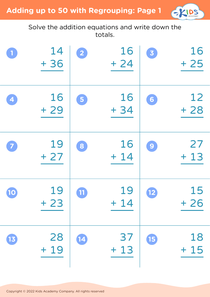
Enhance number recognition Adding up to 50 Without Regrouping Worksheets for Ages 7-9
3 filtered results
-
From - To
Enhance your child's number recognition skills with our "Adding Up to 50 Without Regrouping" worksheets, specifically designed for ages 7-9. These engaging resources help young learners practicing essential addition skills, enabling them to confidently solve problems that sum up to 50 without the need for regrouping. Each worksheet features a variety of exercises, reinforcing number recognition as kids complete fun, educational activities. Ideal for reinforcing classroom learning or supplementing homeschooling, our worksheets combine skill development with interactive elements to maintain student interest. Empower your child’s math journey and set the foundation for lifelong number fluency today!
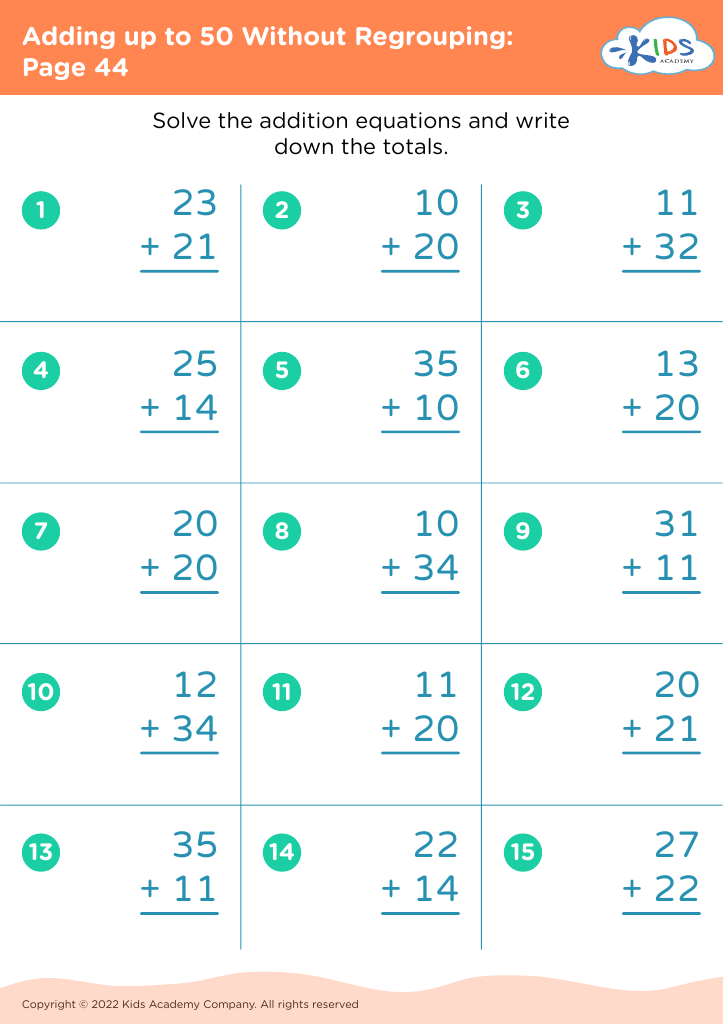
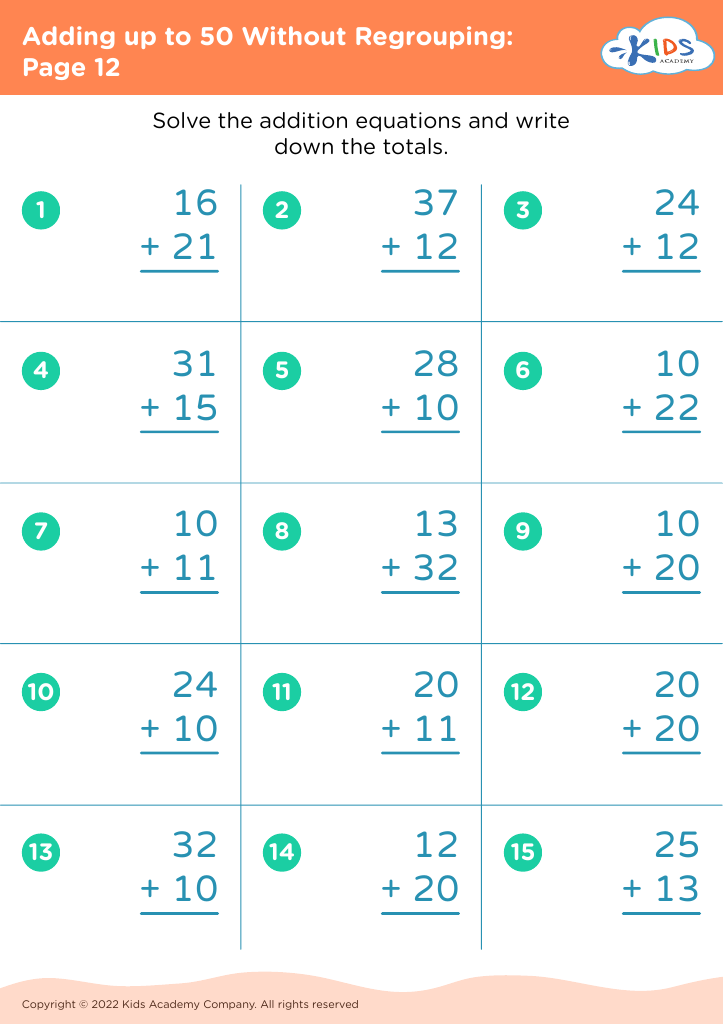
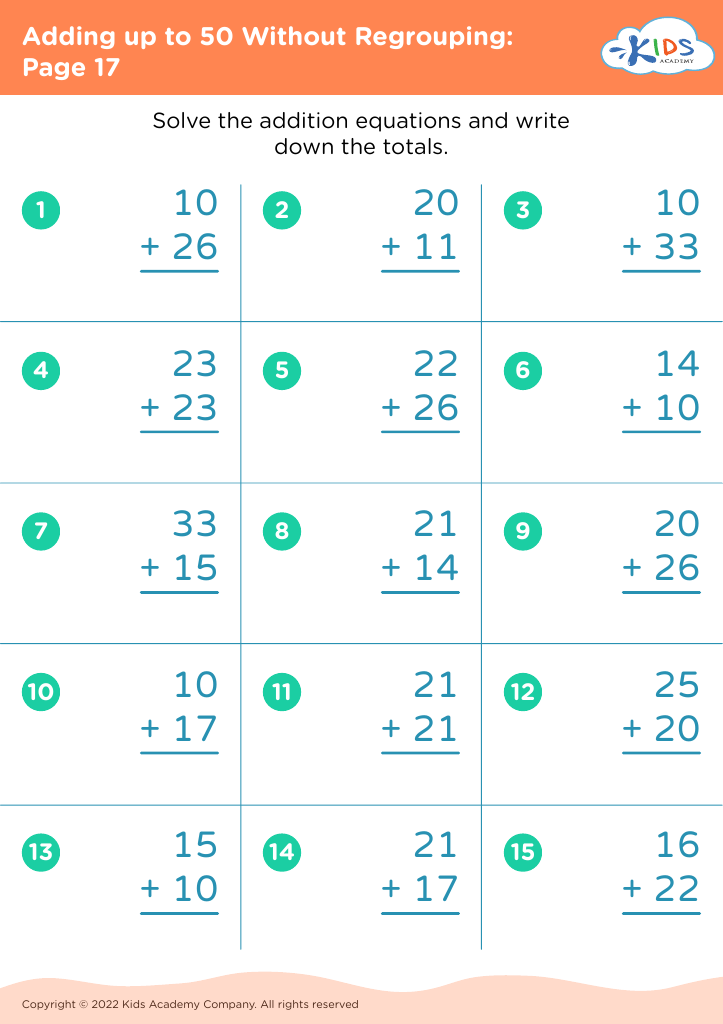


Enhancing number recognition and the ability to add numbers up to 50 without regrouping is crucial for children aged 7-9, as it forms the foundation for their future mathematical understanding and overall academic success. During these formative years, children develop essential numeracy skills that are pivotal for higher-level math concepts. Recognizing numbers and performing addition without regrouping not only helps in basic problem-solving but also promotes critical thinking and cognitive development.
For parents and teachers, fostering these skills can lead to increased confidence among students. When children can accurately recognize numbers and perform straightforward addition, they experience a sense of accomplishment, making them more inclined to engage with math in the future. Additionally, these skills are often applied in real-life situations, enabling children to handle everyday tasks such as budgeting, shopping, and time management.
Moreover, improving number recognition and addition skills lays the groundwork for concepts like subtraction, multiplication, and division. Focusing on these basics ensures that children develop strong mathematical foundations, which will support their learning as they advance in school and beyond. Therefore, a concerted effort by parents and educators to enhance these skills can significantly impact a child's academic trajectory and positive attitude towards math.