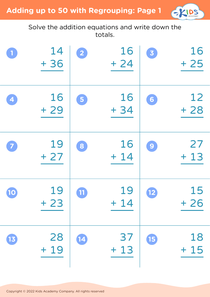
Recognizing Patterns Adding up to 50 Without Regrouping Worksheets for Ages 7-9
4 filtered results
-
From - To
Unlock your child's mathematical potential with our "Recognizing Patterns Adding Up to 50 Without Regrouping Worksheets" designed specifically for ages 7-9. These engaging worksheets will help young learners identify numerical patterns and enhance their addition skills while building a strong foundation in math. By recognizing patterns, children can simplify addition problems and solve them efficiently, boosting their confidence in mathematics. Our resources are crafted to make learning fun, with vibrant illustrations and easy-to-follow formats. Perfect for use at home or in the classroom, these worksheets will encourage your child to explore the world of numbers and develop essential problem-solving strategies.
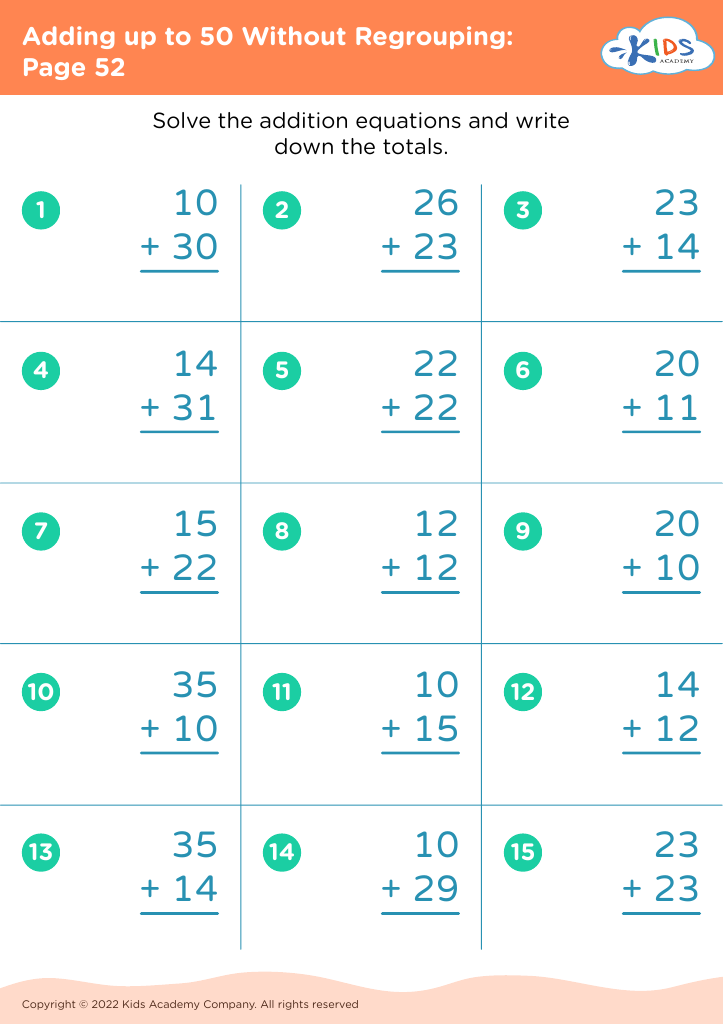
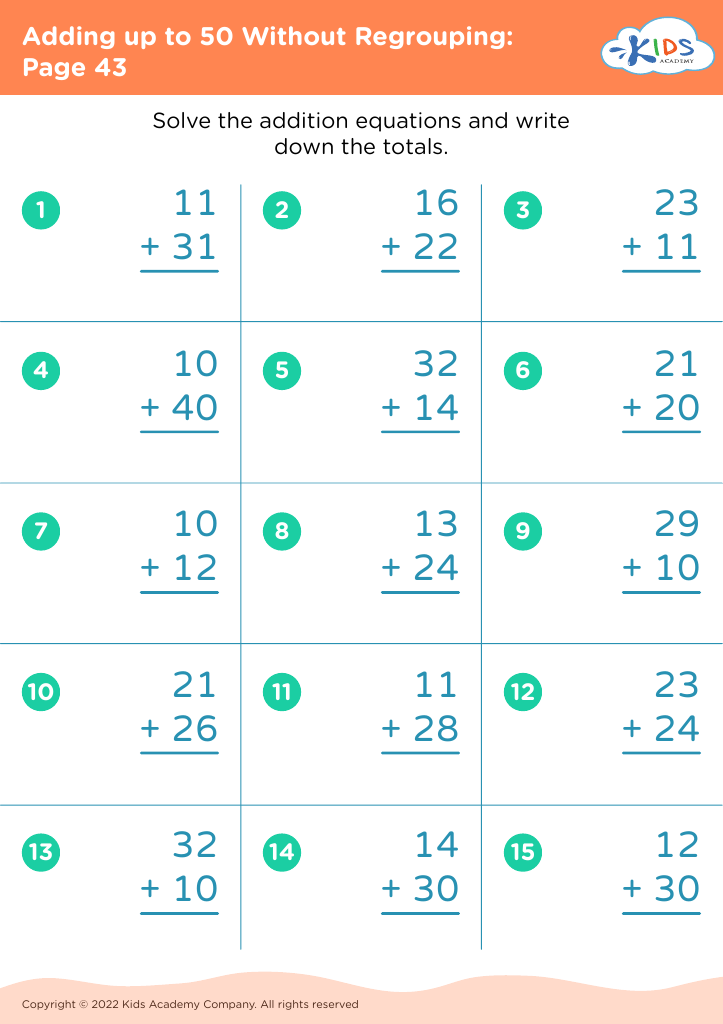
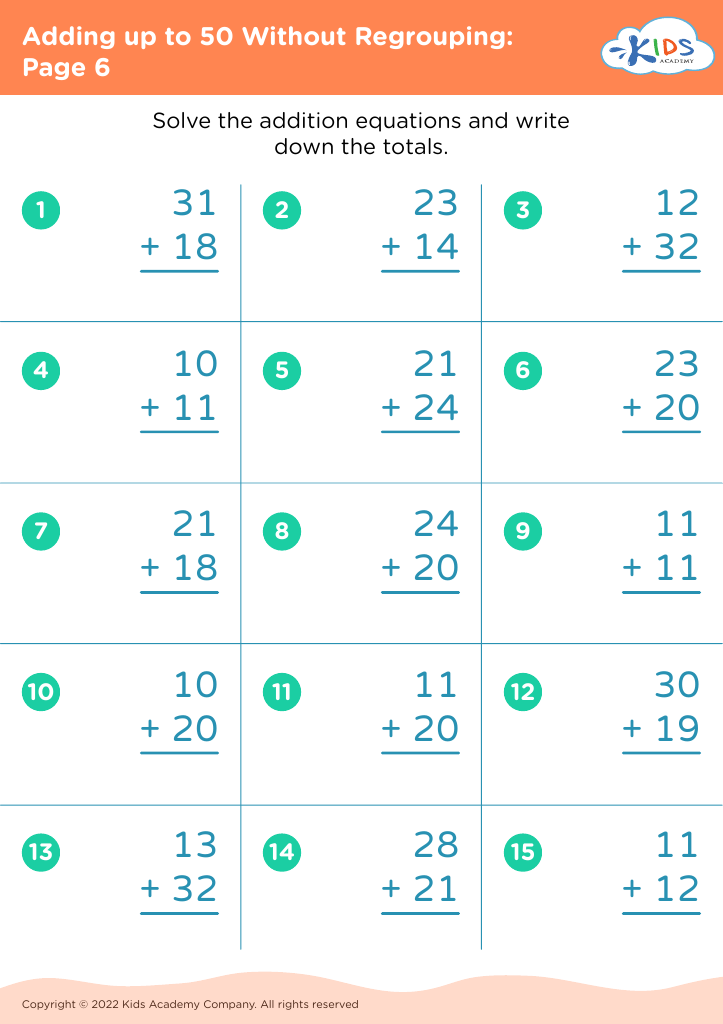
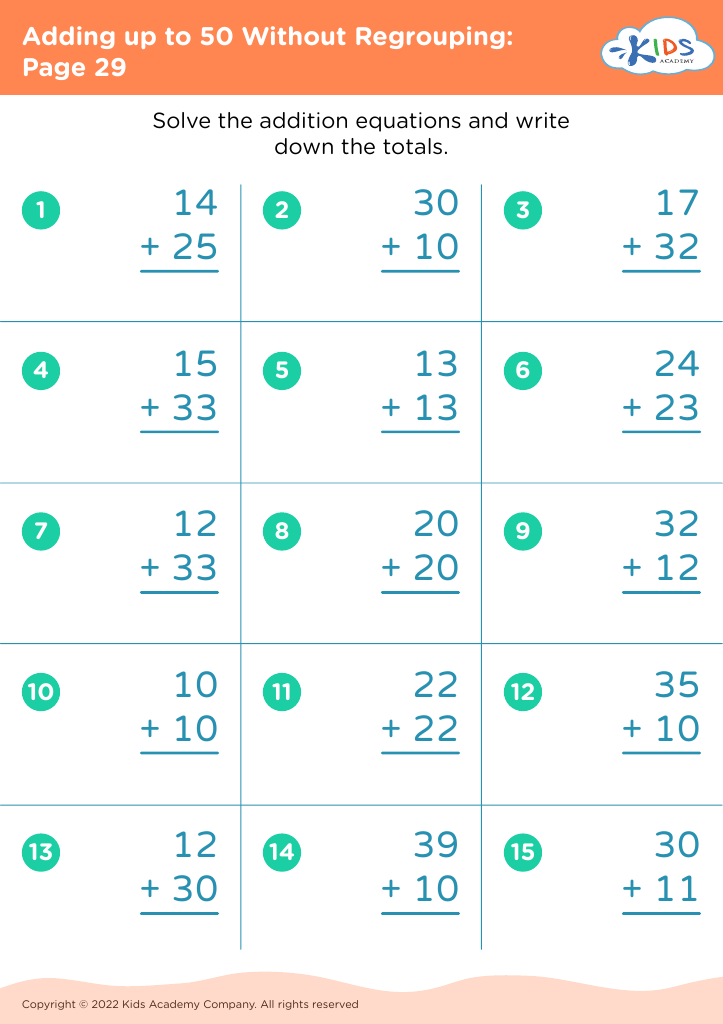


Recognizing patterns while adding up to 50 without regrouping is an essential skill for children ages 7-9. This skill is foundational in helping young learners develop a strong mathematical understanding that extends beyond mere memorization of facts. By identifying patterns, children can enhance their number sense, allowing them to see the relationships between numbers and improve their problem-solving abilities.
When parents and teachers emphasize this skill, they facilitate a more engaging learning process. Recognizing patterns, such as pairs that make ten or multiples of five, enables students to perform calculations more efficiently and accurately. This leads to increased confidence in their mathematical capabilities.
Additionally, mastery of this skill promotes mental math strategies, which are crucial in later grades. It lays the groundwork for more complex concepts, such as addition with regrouping and algebraic thinking. Encouraging students to recognize patterns fosters critical thinking skills, enabling them to apply mathematical concepts in real-world situations.
Furthermore, it nurtures a positive attitude towards math. When children experience success in recognizing patterns, they build resilience and a willingness to tackle more challenging problems. Therefore, parents and teachers must prioritize and support skill development in recognizing patterns, ultimately fostering a lifelong love for learning in mathematics.