Math problem-solving skills Addition & Subtraction Worksheets for Ages 7-9
4 filtered results
-
From - To
Enhance your child's math problem-solving skills with our engaging addition and subtraction worksheets, specially designed for ages 7-9. These worksheets promote critical thinking and help young learners master fundamental math concepts through a variety of fun and interactive problems. With plenty of practical exercises, children will develop their ability to analyze and tackle mathematical challenges effectively. Our resources align with educational standards, ensuring that students build confidence in their math abilities while enjoying the learning process. Perfect for home or classroom use, these worksheets are a vital tool for fostering a love for math and improving academic performance. Start exploring today!
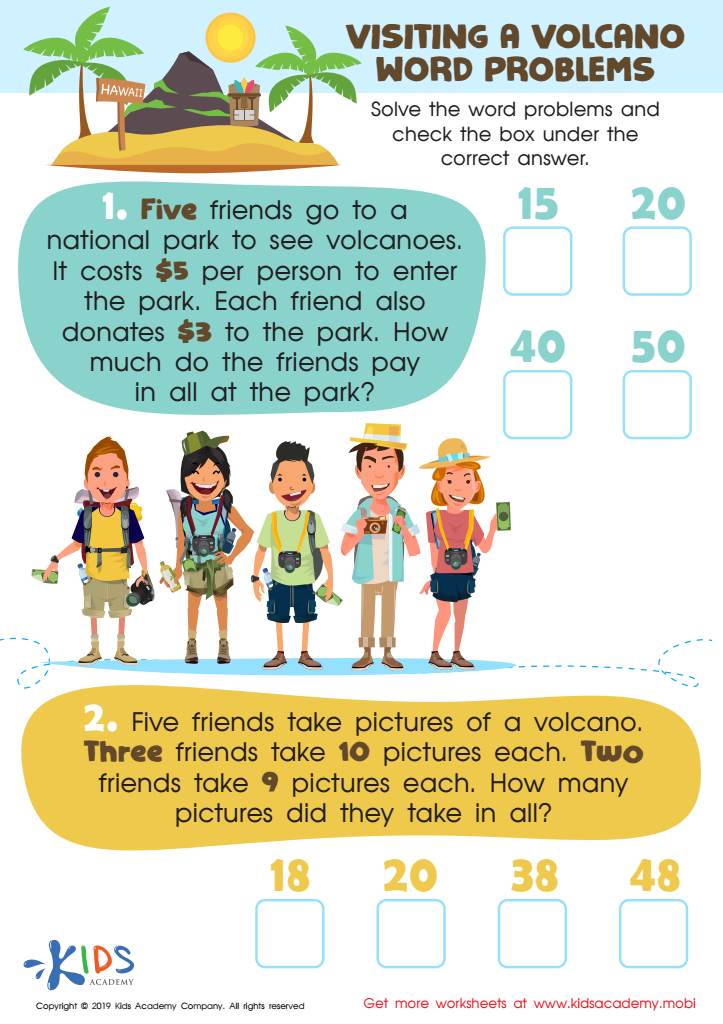
Visiting a Volcano Word Problems Worksheet
 Assign to My Students








Math problem-solving skills in addition and subtraction are crucial for children ages 7-9 because they form the foundation for all future mathematical understanding. This period typically encompasses second and third grades, where students transition from basic arithmetic to more complex concepts. By fostering strong problem-solving skills in these operations, parents and teachers equip children with the tools they need to tackle a variety of mathematical challenges.
Firstly, mastery of addition and subtraction enhances logical thinking and promotes cognitive development. Problem-solving requires children to analyze, strategize, and think critically, skills that are valuable not only in math but across all subjects and real-life situations.
Furthermore, these skills directly contribute to their confidence and self-esteem in learning. When students can successfully solve problems, they are motivated to engage with math more deeply, often leading to increased interest in the subject.
Additionally, strong addition and subtraction skills are necessary for understanding higher-level math concepts, such as multiplication, division, and fractions. Poor grounding in these basic skills can hinder a child's progress in school, leading to lasting anxieties and gaps in knowledge. Thus, valuing and prioritizing math problem-solving at this age is essential for nurturing lifelong learners who are proficient in mathematics.








