
Enhancing math skills Addition Worksheets for Ages 7-9
6 filtered results
Difficulty Level
Grade
Age
-
From - To
Subject
Activity
Standards
Discover a fun and engaging way to boost your child's math skills with our "Enhancing Math Skills Addition Worksheets" for ages 7-9. Designed to make learning exciting, these worksheets provide a variety of exercises that focus on developing addition proficiency. Each worksheet is tailored to target key concepts, helping children to practice basic math facts, solve word problems, and explore number patterns. With clear instructions and vibrant illustrations, kids will enjoy hours of meaningful practice, building confidence in their mathematical abilities. Perfect for home or classroom use, these worksheets are an excellent resource for reinforcing essential addition skills in young learners.
Favorites
With answer key
Interactive
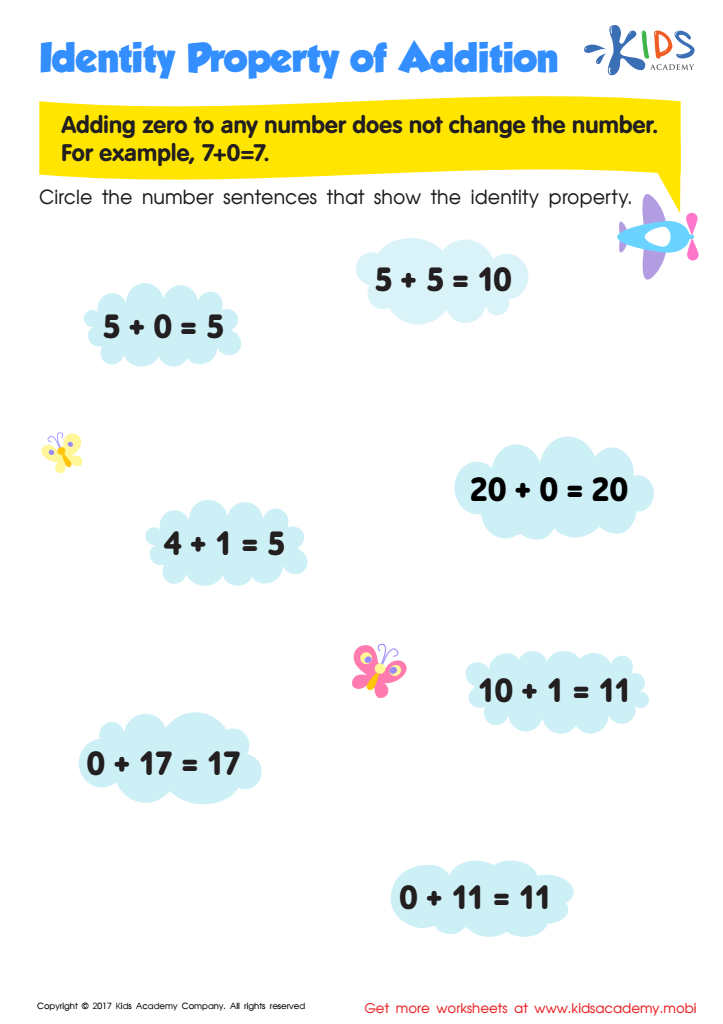
Identity Property of Addition Worksheet
Kids must learn the identity property of addition in math. It states that adding zero to an equation does not change the number. A great way to help kids understand this concept is with a Kids Academy worksheet. It encourages kids to identify which number sentences demonstrate the identity property of addition. Doing so builds vital mental math skills for fast addition.
 Assign to My Students
Identity Property of Addition Worksheet
Worksheet
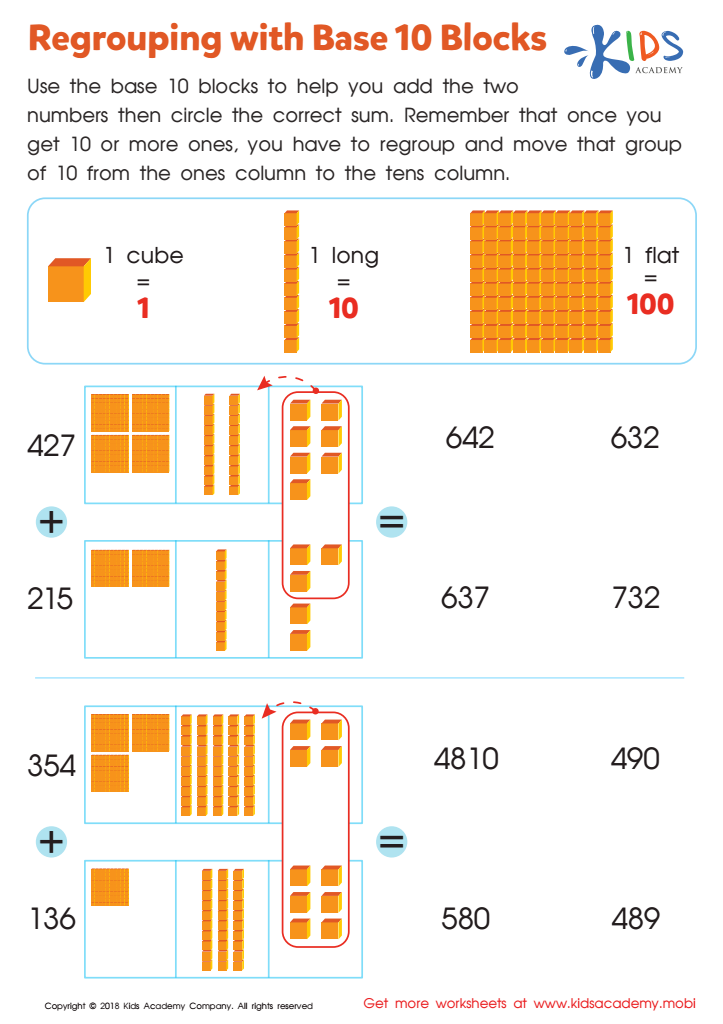
Regrouping with Base 10 Blocks Worksheet
Practice and master 3-digit subtraction with this handy worksheet! It uses base ten blocks to illustrate what's being taken away, helping children understand this tricky skill. Viewing the visual aid will help them get the hang of larger numbers quickly.
Regrouping with Base 10 Blocks Worksheet
Worksheet
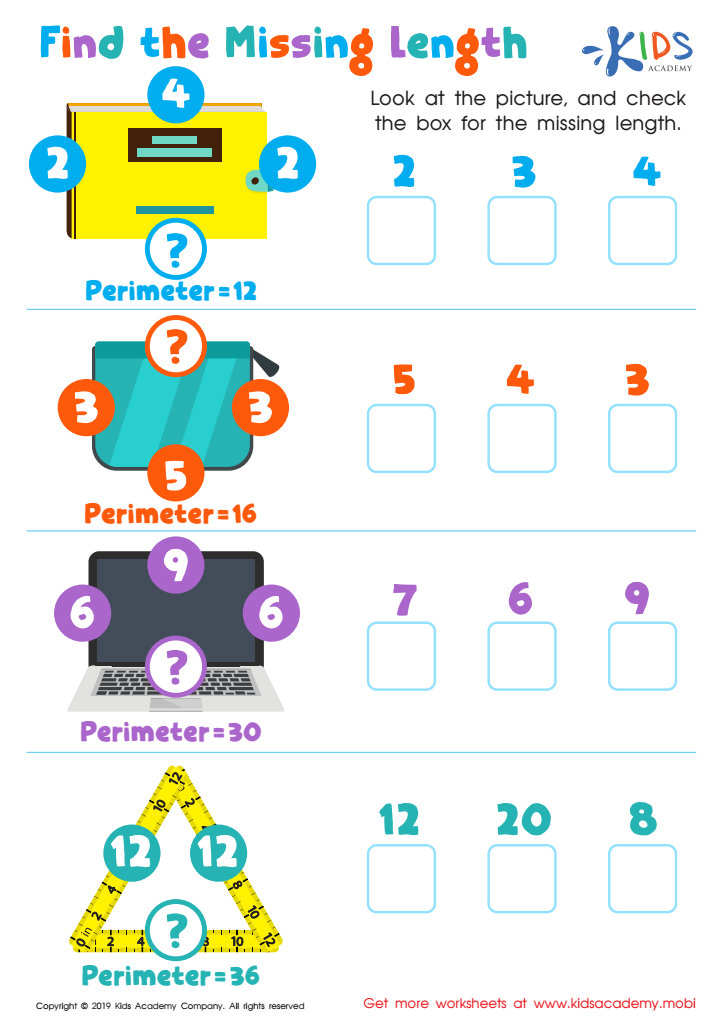
Find the Missing Length Worksheet
Help your kids learn more about geometry, addition and subtraction with this simple worksheet. Look at the four equations and solve the problems with your little ones. Have them check the box for the missing length. This will help your kids become more comfortable with math calculations.
Find the Missing Length Worksheet
Worksheet
Join Kids Academy for Free
Who is primarily going to use this learning content?








Enhancing math skills, particularly addition, for children aged 7-9 is crucial for several reasons. At this developmental stage, kids are making significant cognitive advances, and building a robust foundation in math can set the tone for their future learning. Mastery of addition is not simply about numbers; it fosters critical thinking, problem-solving abilities, and logical reasoning, which are essential skills in life.
Understanding addition enables children to tackle more complex mathematical concepts, such as subtraction, multiplication, and eventually division. These skills are not only vital for academic success but also for day-to-day tasks, such as managing time and finances. Furthermore, a strong grasp of addition allows kids to grow in confidence, reducing anxiety around math and encouraging a positive attitude toward learning.
Additionally, engaged parents and teachers can play pivotal roles in utilizing various interactive and fun methods to enhance these skills, such as games and real-world applications. Such involvement not only reinforces learning but also strengthens the parent-child or teacher-student relationship, creating a supportive environment that fosters curiosity and a love for math. Ultimately, nurturing these foundational skills at this age equips children for future academic success and promotes lifelong learning.








