Understanding directions Math Worksheets for Ages 7-9
4 filtered results
-
From - To
Enhance your child's mathematical skills with our "Understanding Directions" math worksheets, tailored specifically for ages 7-9. These engaging worksheets are designed to help young learners master important skills like following instructions, enhancing comprehension, and boosting their problem-solving abilities. Each worksheet features engaging activities that challenge students to interpret and apply various directional prompts, making learning both fun and effective. Parents and educators can easily access these printable resources, providing children with ample opportunities to practice and reinforce their understanding of mathematical concepts through structured and interactive exercises. Perfect for home or classroom use, watch your child's confidence soar in mathematics!
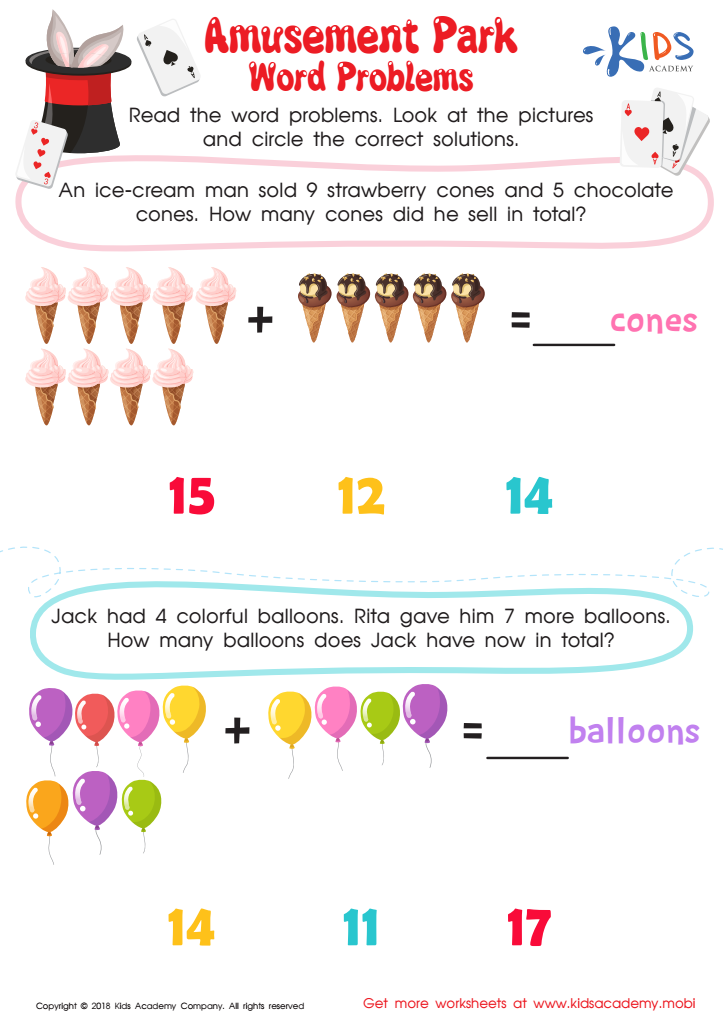
Amusement Park Word Problems Worksheet
 Assign to My Students








Understanding directions in math is crucial for children aged 7-9 as it lays the foundation for their mathematical development and problem-solving skills. At this age, children are transitioning from concrete operational thinking to more abstract reasoning. They begin to tackle increasingly complex problems, such as multi-step word problems, fractions, and measurements. Mastering the ability to follow and comprehend directions not only enhances their computational skills but also fosters critical thinking and logical reasoning.
Parents and teachers play a vital role in this process. They need to ensure that children can interpret math terms and instructions correctly, as misunderstanding can lead to errors and avoidable frustration. Moreover, attention to direction-following supports emotional resilience; children learn that persistence is essential, even when faced with challenges.
Additionally, understanding directions enhances communication skills by teaching children to articulate their thought processes or seek clarification when they encounter difficulties. Encouraging autonomy as they navigate math concepts fosters confidence and a proactive approach to learning. By prioritizing direction comprehension in math, parents and teachers equip young learners with essential skills that benefit not only their academic journeys but also their everyday decision-making.








