
Analyzing patterns Worksheets for 7-Year-Olds
3 filtered results
Difficulty Level
Grade
Age
-
From - To
Subject
Activity
Standards
Discover engaging "Analyzing Patterns Worksheets for 7-Year-Olds" that enhance critical thinking and problem-solving skills! These dynamic worksheets from Kids Academy are crafted to make learning fun and effective. Through a variety of interactive activities, children will identify, follow, and create patterns, boosting their ability to recognize sequences and predict future outcomes. Each worksheet is designed to cater to the unique learning needs of young minds, using colorful and kid-friendly illustrations to keep them engaged. Perfect for both classroom and home use, these worksheets foster a love for learning and build essential math and reasoning skills. Unlock your child's potential today!
Favorites
With answer key
Interactive
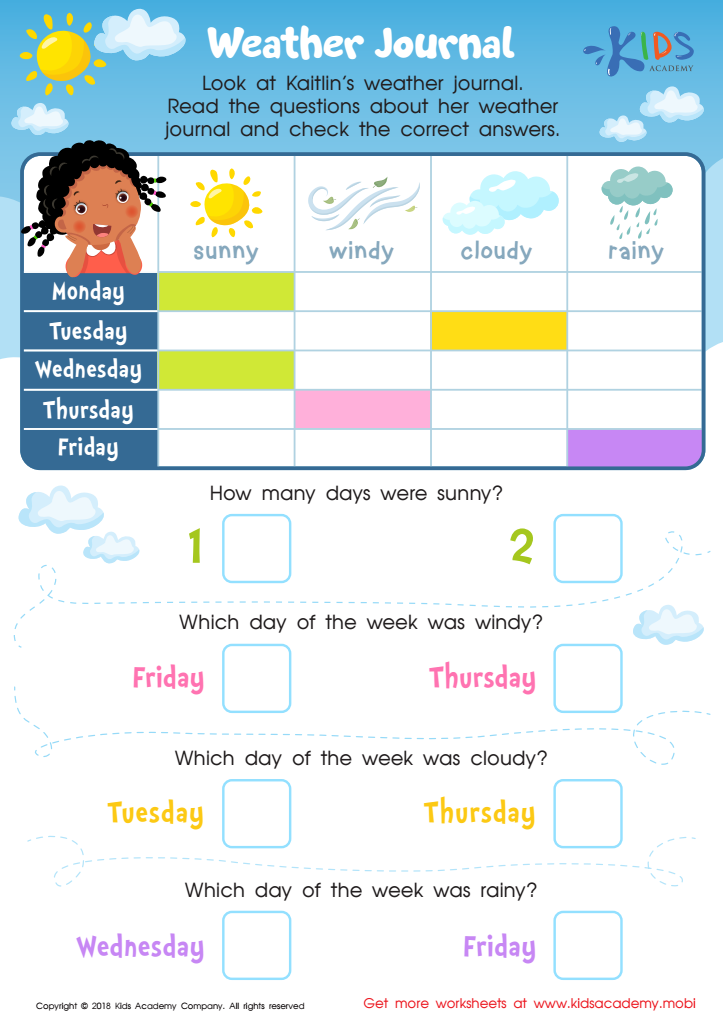
Weather Journal Worksheet
Kaitlin keeps a weather journal. Encourage your child to do the same! Look at Kaitlin's journal with them, and have them note the weather for each day. Read aloud the questions and check the correct answers.
 Assign to My Students
Weather Journal Worksheet
Worksheet
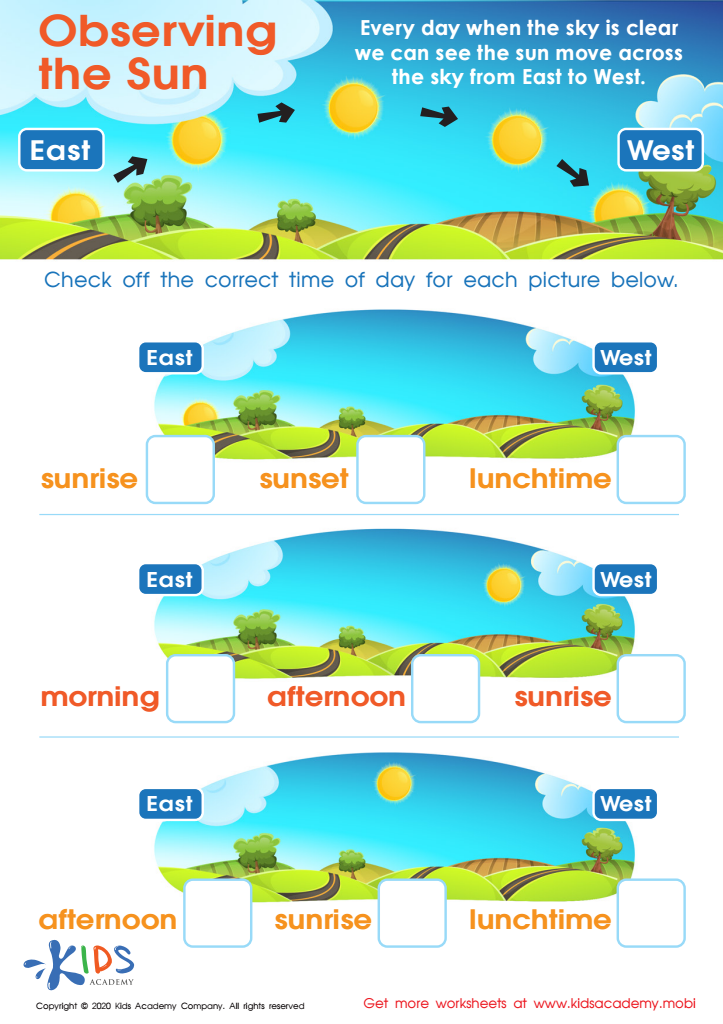
Observing the Sun Worksheet
Observe the image of the sun's progression with your child and use it to complete this free printable worksheet from Kids Academy. Have your kid look at the pictures on the left and check off the numbers in the correct order from sunrise to sunset! This will expand their science knowledge and help them understand when it's time to rise, reach its highest point during midday and set again in the West.
Observing the Sun Worksheet
Worksheet
Join Kids Academy for Free
Who is primarily going to use this learning content?







Analyzing patterns is crucial for 7-year-olds as it forms a foundation for several key areas of learning and cognitive development. Understanding patterns aids in the development of mathematical skills, which are vital for concepts such as number sequences, multiplication tables, and problem-solving strategies. For example, recognizing a repeating pattern in numbers can help children predict the next numbers in a sequence, fostering their number sense and arithmetic fluency.
Moreover, pattern recognition enhances critical thinking and analytical skills. It encourages children to observe, compare, and categorize objects and events, which are essential skills in scientific inquiry. For instance, when children identify patterns in nature or in daily routines, they learn to make observations, develop hypotheses, and test their ideas—core scientific processes.
Patterns also play a key role in literacy development. Recognizing phonetic patterns aids in decoding words, which is fundamental for reading fluency and comprehension. Additionally, exposure to patterns in language—such as rhymes and rhythms in poetry—can enhance memory, vocabulary, and linguistic skills.
Furthermore, examining patterns fosters creativity and artistic expression, as seen in music, art, and dance. It strengthens cognitive connections and aids in the development of spatial awareness.
By caring about pattern analysis, parents and teachers are nurturing a child's capacity to understand complex systems and equipping them with problem-solving tools that are necessary for lifelong learning.








