
Improving mental math Worksheets for 7-Year-Olds
3 filtered results
Difficulty Level
Grade
Age
-
From - To
Subject
Activity
Standards
Enhance your 7-year-old's math skills with our engaging Improving Mental Math Worksheets! Designed to foster independent thinking and boost confidence in basic math concepts, these worksheets offer fun activities that reinforce addition, subtraction, and number fluency. Delightful illustrations and age-appropriate challenges make learning enjoyable, supporting your child’s development in mental calculation. Each worksheet encourages problem-solving and critical thinking, helping young learners grasp mathematical principles effectively. Perfect for at-home practice or classroom use, our comprehensive collection is tailored to meet the educational standards for 7-year-olds. Unlock your child’s full potential in math with creative exercises that kindle a love for learning!
Favorites
With answer key
Interactive
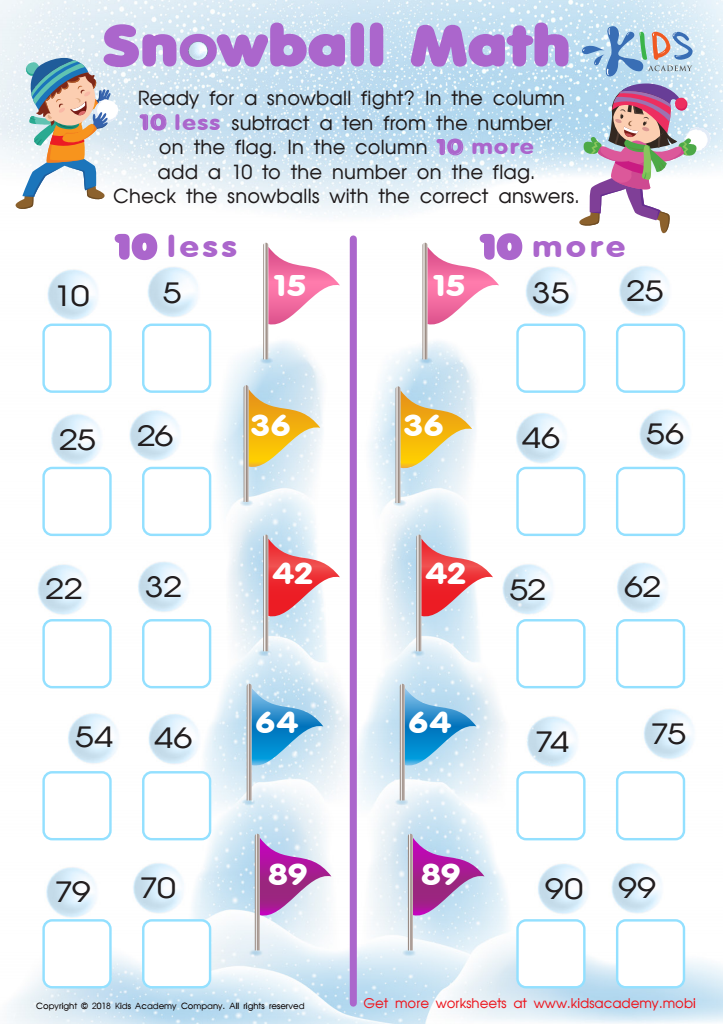
Snowball Math Worksheet
Kids can have a snowball fight and build math skills at the same time with this free worksheet. Kids can use tens to add and subtract for quick math equations and select the correct answers. No need to worry about getting cold either - these snowballs won't chill you!
 Assign to My Students
Snowball Math Worksheet
Worksheet
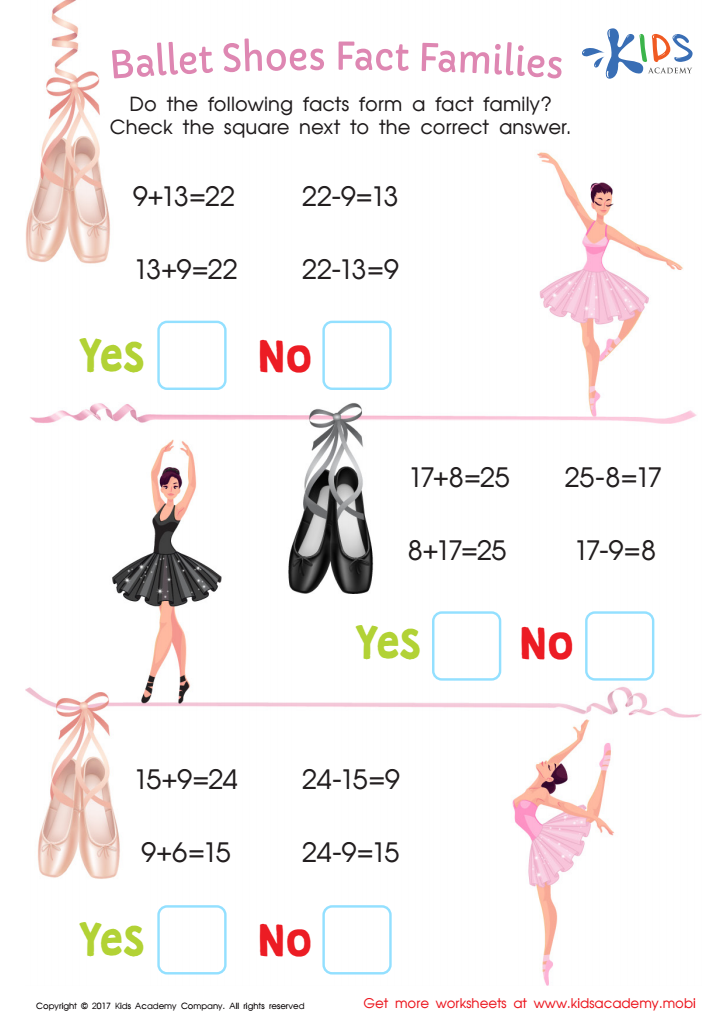
Ballet Shoes Fact Family Printable
Have them observe the equations and determine which groupings are fact families for a delightful learning experience. It encourages critical thinking, showing how addition and subtraction are related.
Ballet Shoes Fact Family Printable
Worksheet
Join Kids Academy for Free
Who is primarily going to use this learning content?








Improving mental math skills in 7-year-olds is crucial for several reasons, making it a priority for parents and teachers alike. First, mental math fosters confidence in young learners, empowering them to solve problems without reliance on calculators or paper. This independence boosts their overall mathematical self-efficacy, enabling them to tackle more complex concepts as they advance in their education.
Moreover, mental math enhances cognitive development, as it engages critical thinking and problem-solving skills. Children develop better numerical understanding and logical reasoning ability through consistent practice. Mental math also strengthens memory and concentration, as children learn to hold numbers in their minds and manipulate them.
Additionally, a strong foundation in mental math simplifies everyday activities, such as budgeting, shopping, and time management, making these tasks less daunting for children as they grow. It equips them with practical skills vital for everyday life.
Finally, fostering mental math skills early sets a positive attitude towards mathematics, reducing anxiety and aversion to this subject. When children enjoy math, they are more likely to continue to engage with it in the future, leading to more significant academic success. Overall, supporting mental math development is an investment in a child’s future learning and life skills.








