Learning number patterns Worksheets for 7-Year-Olds
4 filtered results
-
From - To
Explore our engaging Learning Number Patterns Worksheets designed specifically for 7-year-olds! These worksheets aim to enhance your child's mathematical skills by introducing them to the fascinating world of number patterns. Through fun activities, children will develop their understanding of sequencing, skip counting, and identifying patterns in numbers. Our resources are tailored to make learning enjoyable, fostering both creativity and critical thinking. Perfect for home or classroom use, these worksheets provide essential practice to boost confidence in math. Encourage your young learners to explore, solve, and engage with numbers like never before! Download your worksheets today and spark your child's mathematical journey!
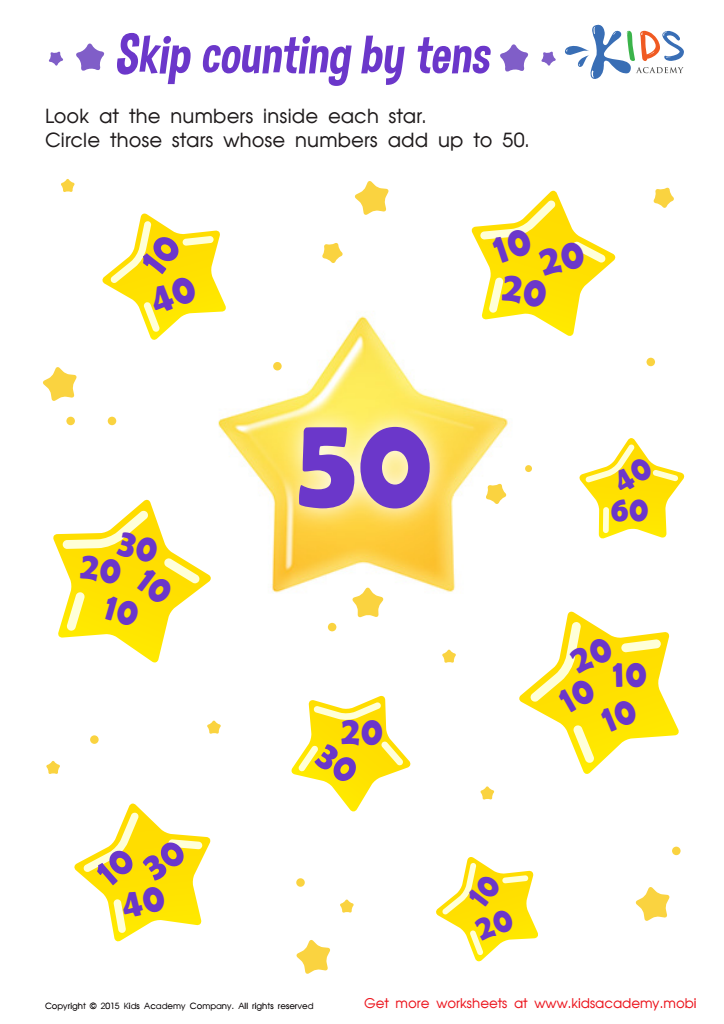
Learn Dozens: Skip Counting by Tens Printable
 Assign to My Students







Understanding number patterns is crucial for 7-year-olds as it lays the foundation for essential mathematical skills that are vital for their academic success. At this age, children begin to transition from simple arithmetic to more complex problem-solving strategies, and recognizing patterns can greatly enhance their number sense. These patterns help students understand relationships between numbers, paving the way for concepts like multiplication, division, and ultimately, algebra.
Learning number patterns also fosters critical thinking and analytical skills. It encourages children to identify, predict, and extend sequences, helping them develop logic and reasoning abilities that are applicable beyond mathematics. Additionally, recognizing patterns nurtures mental flexibility, enabling children to approach problems from different angles.
Teachers and parents should care about this because it directly impacts children's confidence in math. When kids can identify and work with patterns, they are more likely to engage positively with mathematical concepts. Furthermore, early mastery of these skills can set a strong precedent, reducing math anxiety later in life. Thus, promoting an understanding of number patterns will not only benefit children in their current learning but equip them with skills needed for future educational endeavors.








