Understand sequencing Worksheets for 7-Year-Olds
3 filtered results
-
From - To
Introducing our "Understand Sequencing Worksheets for 7-Year-Olds" – a fun and educational tool to enhance your child's cognitive skills! These expertly designed worksheets cater to second graders, focusing on the ability to sequence events and ideas logically. Through engaging and colorful activities, children will learn to order stories, understand timelines, and improve their reading comprehension. Ideal for at-home practice or classroom use, these worksheets ensure a solid foundation in cognitive development, essential for academic success. Spark your child's curiosity and develop critical thinking skills with our comprehensive sequencing exercises! Get started today with Kids Academy!
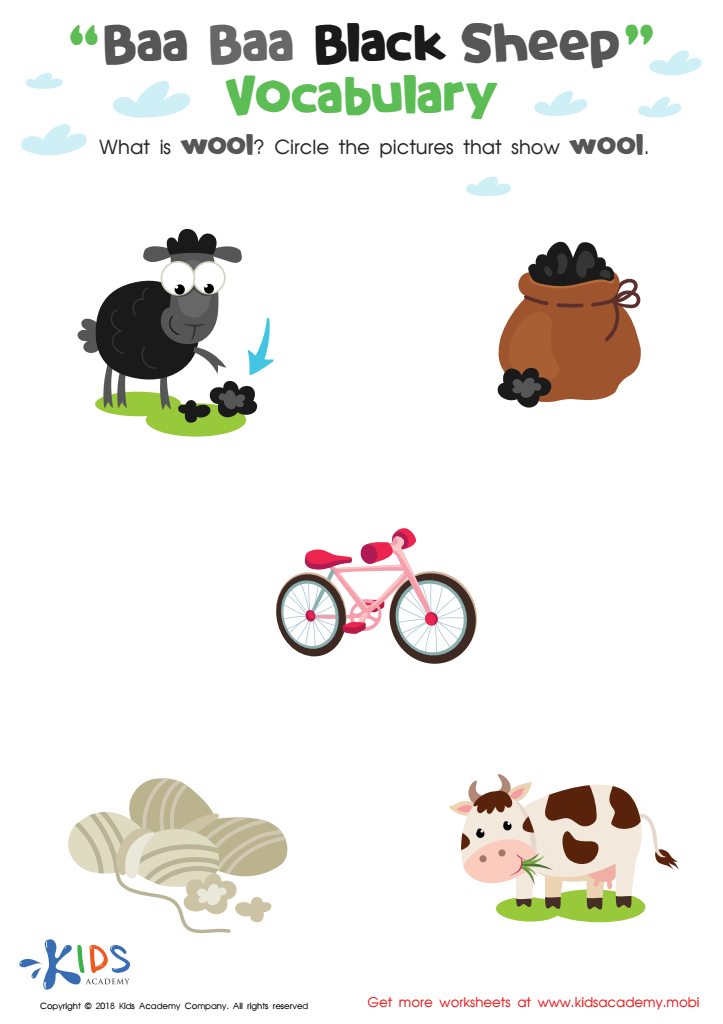
Baa Baa Black Sheep: Vocabulary Worksheet
 Assign to My Students







Understanding sequencing is essential for 7-year-olds because it forms the foundation for critical cognitive skills, literacy, and general problem-solving abilities. Sequencing—the ability to identify the order of events, numbers, or steps—is fundamental for reading comprehension, math proficiency, and daily routines. For instance, when reading a story, recognizing the beginning, middle, and end helps children understand the narrative’s flow and improves retention and comprehension. This is crucial not just academically but also in developing empathy and effective communication skills.
In math, understanding sequences supports grasping concepts like counting, patterns, and eventually more complicated arithmetic operations. When sequencing is mastered, children can easily follow multi-step instructions, a vital skill both inside the classroom and in real-world situations, such as following recipes or understanding timetables.
Moreover, sequencing enhances executive functions like planning and organizing, which are vital for academic success and time management. For parents and teachers, focusing on sequencing helps children develop structured thinking, improving their ability to tackle progressively complex tasks.
By emphasizing sequencing, adults can support a child’s overall intellectual development, preparing them for future learning challenges and everyday activities. This creates a robust groundwork for lifelong learning and problem-solving capabilities.








